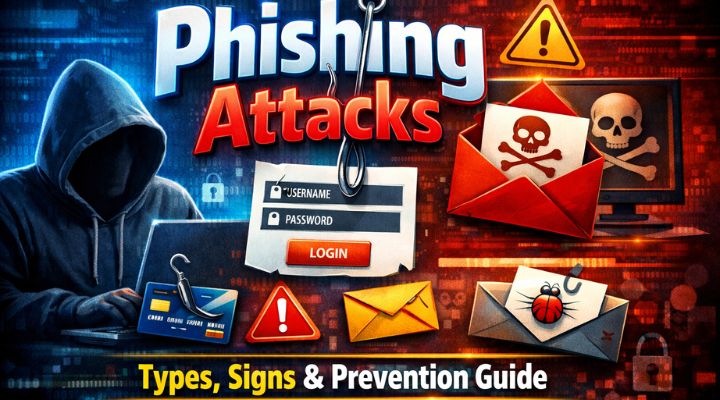
What is Phishing Attack?
- Posted by 3.0 University
- Categories Cyber Security
- Date April 5, 2026
- Comments 0 comment
Cyber threats are evolving rapidly, and one of the most common and dangerous attacks today is a phishing attack. From fake emails to fraudulent websites, phishing scams trick users into revealing sensitive information like passwords, banking details, and personal data.
In this guide, you’ll learn what a phishing attack is, how it works, its types, real-life examples, and how to prevent it.
It is observed that phishing attacks have been emerging increasingly sophisticated. It is essential to comprehend the ins and outs of what Phishing is!
Besides, it is as much crucial to learn how a phishing attack works, and the different types of phishing attacks that threaten individuals and organizations alike. Of course, by being vigilant or identifying the telltale signs of a phishing email and staying informed about phishing in cybersecurity, you can better protect yourself from falling victim to these deceptive schemes.
Causes of Phishing & Prevention
All those who spend time on the internet should know the methods and techniques often used by cybercriminals.
So, in this article, we shall explain the phishing process from the beginning, then focus on how the phishing attack operates, the suspicious use of social engineering by the attackers, and finally, what actions you can take to avoid becoming a victim to them.
What is Phishing?
Cyberattack looms in different forms and “Phishing” is one of them. And it aims to treacherously acquire or poach sensitive information such as a person’s password, credit card number, or personal identification number.
Attackers create deceptive emails, messages, or websites to deceive their victims; this practice, known as “fishing,” is where the term “phishing” originates.
This kind of scam of phishing characteristically gives precedence to the user’s trust; and thus, creates a sense of persistence and immediacy, often deceiving them into acting by clicking on a malicious link or downloading a harmful file.
What is a Phishing Attack in?
A phishing attack is a type of cyberattack where attackers impersonate trusted entities to steal sensitive information such as login credentials, credit card details, or personal data.
These attacks usually occur through:
- Emails
- SMS messages
- Fake websites
- Social media
The goal is simple: manipulate users into taking harmful actions
How Does a Phishing Attack Work?
Phishing attacks mostly follow a routine pattern; however, let us note that cyber crooks keep
improving their techniques.
Generally, we can sum up the process of phishing an individual as follows:
Step-by-step process:
- Attacker creates a fake identity (bank, company, or service)
- Sends a phishing email or message
- User clicks a malicious link
- A fake website collects sensitive data
- Data is used for fraud or identity theft
Types of Phishing Attacks
There are several ways to carry out phishing, each with slightly different variations. We will take a closer look at the most common types of phishing attacks:
Email Phishing
Yes, this is the commonest of all kinds of phishing; in this type, scammers transmit a fake email that appears like a genuine message from a bank or other online service.
And this thrusts or encourages the recipient to act quickly, and initiate some steps, often directing them to a fake site where they provide sensitive information unknowingly.
Spear Phishing
Spear phishing is the targeted stealing of sensitive information, such as account credentials or financial details, from an individual, cumulatively meant to inflict harm, by masquerading as a trustworthy entity in electronic communications.
Spear phishing involves manipulating a fake company name along with a specific target. We used the phrase “spear phishing” to describe a more specialized method of phishing.
In spear phishing, it is more common for the attacks to be focused or personalized. The attackers conduct in-depth research on their target and/or send them a specific message, not a general one or even a changed one.
Additionally, the email could come from your company or another firm that you can trust. Spear phishing is a more cautious approach to phishing, and its most dangerous aspect is that it can sometimes be difficult to detect.
Whaling
Whaling is part of spear phishing; it targets high-profile people, such as executive managers, CEOs, boards chairs, or other powerful figures in the industry.
Attackers frequently use well-researched and targeted attacks to infiltrate companies, obtain sensitive information, or transfer money.
Clone Phishing
The victim’s first email is, in fact, a clone of the original one for clone phishing.
Attackers with specialized skills create a cloned email that contains harmful links or files, often designing it to resemble a previously innocent one.
The victim deceives himself into believing it is secure, as he recalls an email he received earlier.
Vishing and Smishing
Phishing through email is a commonly used method, although other forms of vishing and smishing are also becoming quite common.
Vishing is when criminals act as legitimate organizations over the phone. In most cases, they deceive or misuse the phone to obtain sensitive information.
Smishing is a type of phishing attack that uses text messages.
This method is used by scammers to pick on targets or victimise people by contacting them via SMS with malicious links or phone numbers.
Strategies to Prevent & Mitigate Phishing Attacks
The insights were from people who are knowledgeable about protecting against phishing attacks.
Moreover, it is to accentuate that phishing is a foremost security issue for both people and organizations.
Various such tactics are used by cybercriminals, including email, social media, and phone calls, to steal passwords, credit card information, and other sensitive data. No doubt, companies are attractive targets. Prevalent phishing attacks targeting businesses
Impersonation of a Company
One of the most common forms of phishing is company impersonation.
A rather common way of doing this would be to use an email address that appears similar to that of the target company, like “first.name@amazon-support.”
This sort of attack presents a real challenge for the organizations, as it usually goes undetected until a victim arises, or an event is reported.
A representative customizes a pitch email with the recipient’s name, position, and other tailored items in the same way as is common in sales.
Attackers also use the same tokens to lure other victims.
This technique is extremely risky.
Email Account Takeover
The whole range of executive and managerial personnel will be targeted.
Crooks expect to target as many different people as possible by using the email credentials of high-profile leaders. Targets could include colleagues, team members, and even clients, especially if their information is compromised.
Phishing emails are a growing concern in digital marketing. The essence of this act is to trick the receiver into providing sensitive information. Typically, phishing emails disguise themselves as legitimate sources, thus rendering them particularly harmful.
Keeping oneself informed and vigilant is critical in recognizing and avoiding such threats. This phishing attack, also like email account takeover fraud, makes use of an email; the internet is its main medium.
Cybercriminals are crafty with emails; they take real people’s ones and/or organizations’ sites very close to the real ones, such as Bush, who probably uses HTML cut by orange in the Bush case. Action prompts appear as “click a link”, “reset a password”, “make a payment’, “provide personal information”, or “open a file attachment.”
Phone-based phishing, also known as voice phishing, is a growing concern. In this case, fraudsters also use VoIP technology to impersonate corporations.
This method of committing the crime consists of various techniques, such as using individuals’ personal data to get them on the line and impersonating corporate executives to gain a better understanding of the crime and deception. Tiffany Tucker, a systems engineer at Chelsea Technologies, the tech giant making the news, has a decade of experience in IT professionals and can identify a critical mistake that companies often make, rendering them vulnerable to phishing attempts.
A lack of information security technologies and a shortage of trained personnel become a serious problem.
The security breach of an organization mainly depends on the valuable properties and the knowledge and capability of the employees. Attackers use the phishing technique to extract sensitive information from the victims’ sources.
A phisher sends an email with the intention of gathering sensitive information, either by directing the recipient to a phishing website or an unsecured network.
The level of confidence with which a phisher can convince their victims determines their success. We have grown past the times of sorting through the trash for information; today, acquiring information via the Internet is a lot simpler.
Real-Life Examples of Phishing Attacks
Example 1: Fake Bank Email
You receive an email saying your bank account is locked. It asks you to click a link and verify your details.
Example 2: Job Offer Scam
A fake recruiter sends a job offer asking for personal information.
Example 3: OTP Scam
Attackers pretend to be customer support and ask for OTPs.
👉 These are common phishing attack examples used globally.
Common Signs of a Phishing Attack
Knowing the warning signs can save you from serious damage:
- Suspicious email addresses
- Urgent or threatening language
- Generic greetings like “Dear User”
- Spelling and grammar mistakes
- Fake URLs or domains
- Unexpected attachments
Always verify before clicking anything.
How to Prevent Phishing Attacks
Here are the best phishing prevention techniques:
Security Practices
- Enable Multi-Factor Authentication (MFA)
- Use strong, unique passwords
- Avoid clicking unknown links
Awareness Tips
- Verify sender email addresses
- Double-check URLs before entering data
- Never share OTPs or passwords
Tools & Solutions
- Use antivirus software
- Install email spam filters
- Use browser security extensions
Prevention is the strongest defense against phishing attacks
Advanced Phishing Techniques (Modern Threats)
Phishing is becoming more sophisticated:
- AI-generated phishing emails
- Deepfake voice scams
- MFA bypass attacks (AiTM)
- Social engineering attacks
These advanced methods make phishing harder to detect.
Tools to Detect Phishing Attacks
Here are some commonly used tools:
- Email security gateways
- Anti-phishing browser extensions
- Threat detection systems
- Security awareness platforms
Attackers employ a variety of phishing techniques:
- Hyperlinks are planted to web emails that entice employees to transfer their information to the spoof’s website.
- Trojans are used in email attachments or ads to exploit existing vulnerabilities and obtain sensitive data.
- By changing email sender addresses, though only a small number of appendices, it would be possible to get a name on the legitimate list.
The second identified phishing method involved altering the sender’s email address to appear credible in order to obtain sensitive information.
- Playing the role of a vendor or IT department to obtain corporate information via phone communication.
The company can prevent phishing attacks by implementing several of the following measures:
- Train staff on how to report phishing incidents simulations.
- Implement a SPAM filter that is capable of identifying both invalid sender addresses and spam.
- Ensure your systems are up to date with the latest security patches and updates.
- Make sure to apply and upgrade the virus signatures on a regular basis, and carefully monitor the status across other systems.
- Create a document maintaining a list of standards for password expiration/completeness.
- Use web filtering software to prevent access to dangerous sites.
- The security policy must cover encryption for significant enterprise data.
- When communicating via HTML, use a text-only format, or remove the HTML email completely.
- Insert encryption protocols for remote employees.
To effectively prevent phishing attacks, a company should employ a variety of strategies, including closely monitoring the evolution of phishing techniques, informing personnel of the groups and resources available, and monitoring what those groups are doing to combat these problems.
The organization’s protection against phishing attacks necessitates employee knowledge and the use of technology solutions.
Stay connected for more insights on Phishing in our next article.
If you’re looking for an Ethical Hacking Course with AI or intend to learn about Threat Intelligence or a Cybersecurity online certification course, register now at 3.0 University.
FAQs on Phishing Attacks
What is phishing in simple words?
Phishing is a scam where attackers trick you into sharing sensitive information by pretending to be someone you trust.
What are examples of phishing attacks?
Fake bank emails, job scams, OTP fraud, and social media scams.
How can I identify a phishing email?
Look for suspicious links, urgent messages, and incorrect email domains.
How to prevent phishing attacks?
Use MFA, verify sources, avoid unknown links, and stay aware of scams.

You may also like
Cyber Security Course Eligibility