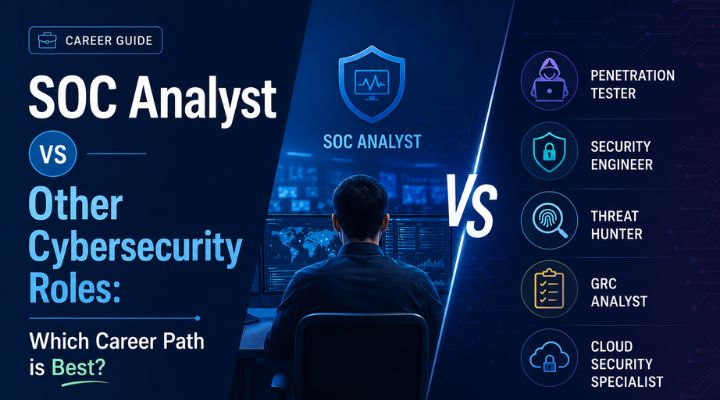
SOC Analyst vs Other Cybersecurity Roles: Which Is Right?
- Posted by 3.0 University
- Categories Cyber Security
- Date May 25, 2026
- Comments 0 comment
Cybersecurity is one of the fastest-growing industries globally, creating thousands of job opportunities for both beginners and experienced IT professionals. However, many aspiring cybersecurity professionals face a common challenge understanding which cybersecurity role aligns best with their skills, interests, and long-term career goals.
Should you become a SOC Analyst?
Is a Cybersecurity Analyst a better fit? What about a Security Engineer, Threat Hunter, Incident Responder, or Penetration Tester?
The confusion is understandable because many cybersecurity roles overlap in responsibilities, tools, and career progression paths.
The good news is that each role serves a distinct purpose within an organization’s security ecosystem. Understanding these differences can help you make an informed career decision and accelerate your growth in cybersecurity.
In this guide, we’ll compare SOC Analyst vs Cybersecurity Analyst and other popular cybersecurity careers to help you to choose the right path for your future.
What Does a SOC Analyst Do?
A Security Operations Center (SOC) Analyst is responsible for monitoring, detecting, investigating, and responding to cybersecurity threats in real time.
SOC Analysts act as the first line of defense against cyberattacks and play a critical role in protecting organizational assets.
Key Responsibilities of a SOC Analyst
- Monitor security alerts and events
- Investigate suspicious activities
- Analyze logs and network traffic
- Respond to security incidents
- Escalate critical threats
- Work with SIEM and EDR tools
- Document incidents and remediation steps
Common Tools Used
- Splunk
- Microsoft Sentinel
- IBM QRadar
- CrowdStrike Falcon
- Microsoft Defender
- Wireshark
- Elastic SIEM
SOC Analyst roles are often considered the ideal entry point into cybersecurity because they provide hands-on exposure to real-world security operations.
SOC Analyst vs Cybersecurity Analyst: What’s the Difference?
Here’s the honest breakdown:
SOC Analyst | Cybersecurity Analyst | |
Focus | Real-time threat monitoring & incident triage | Broader security posture & risk management |
Environment | SOC team, shift-based operations | Security teams, project-based work |
Core Tools | SIEM, EDR, SOAR | Vulnerability scanners, compliance tools, GRC platforms |
Scope | Reactive (respond to what’s happening now) | Proactive + reactive (assess, plan, and respond) |
Entry Difficulty | Lower clear Tier 1 pathway | Moderate often requires some experience |
Avg. US Salary | 137,000 | 114,000 (entry to mid) |
Which Role Is Better?
Choose SOC Analyst if you enjoy:
- Investigating security incidents
- Monitoring threats
- Working in fast-paced environments
- Hands-on technical operations
Choose Cybersecurity Analyst if you prefer:
- Security strategy
- Risk management
- Compliance and governance
- Broader security responsibilities
For beginners, a SOC Analyst role often provides a stronger foundation for long-term cybersecurity growth.
SOC Analyst vs Security Engineer: Two Different Worlds
A lot of people confuse these two because both operate inside the security team. But the nature of the work is fundamentally different.
SOC analysts detect and respond. Security engineers design and build.
A security engineer creates the defensive infrastructure firewalls, intrusion detection systems, security automation pipelines, and cloud security architecture.
They write code, deploy security controls, and architect the systems that SOC analysts then monitor.
SOC Analyst | Security Engineer | |
Work Type | Operational, real-time | Architectural, project-based |
Skills Required | SIEM, threat analysis, incident response | Programming, scripting, cloud platforms, system design |
Entry Point | More accessible (certifications-first) | Requires 4–6 years of IT/dev experience |
Salary Range | 130,000 | 200,000+ |
Career Trajectory | SOC Analyst → IR Lead → Detection Engineer | Software Engineer → Security Engineer → Security Architect |
Security engineers earn more on average, security architects earn around $25,000 more in base salary than cybersecurity analysts. But they also require significantly deeper technical backgrounds including proficiency in languages like Python, Terraform, or Go, plus cloud platforms.
Is a SOC analyst the same as a security engineer?
Not at all. They’re complementary roles. Many SOC analysts eventually transition into security engineering after developing automation skills, but they’re two distinct career tracks.
SOC Analyst vs Incident Responder: Close Cousins, Different Missions
If you’ve ever heard these two roles are basically the same, you’ve heard wrong. They’re closely related but the mission shifts significantly.
A SOC analyst monitors and triages. An incident responder takes over when things have already gone wrong.
Think of it this way the SOC analyst is the early warning system. The incident responder is the containment team that shows up when the alarm turns into a fire.
SOC Analyst | Incident Responder | |
Primary Goal | Detect threats early | Contain and remediate active breaches |
When They Act | Continuously, proactively | During and after a confirmed incident |
Key Skills | SIEM, log analysis, threat triage | Forensics, malware analysis, containment playbooks |
Pressure Level | Moderate (routine monitoring) | High (breach response under time pressure) |
Avg. US Salary | 137,000 | 150,000 |
In many organizations especially smaller ones the Tier 2 or Tier 3 SOC analyst doubles as the incident responder. In larger enterprises with mature security programs, these are separate teams.
The difference between SOC analyst and incident responder is really about depth and timing. SOC is about catching threats. IR is about putting out fires and doing the forensic cleanup.
Starting as a SOC analyst gives you natural exposure to incident response most Tier 2 work involves containment activities. So it’s a logical career progression, not a career pivot.
SOC Analyst vs Threat Hunter: Reactive vs. Proactive
Here’s where it gets interesting for people who love the idea of going on offense without actually being in the offensive security lane.
A threat hunter doesn’t wait for alerts. They assume the attacker is already inside the network and go looking for them.
SOC Analyst | Threat Hunter | |
Mode | Reactive (respond to alerts) | Proactive (assume breach, hunt for indicators) |
Data Sources | SIEM alerts, EDR alerts | Raw logs, network traffic, behavioral analytics |
Experience Level | Entry to mid-level | Senior — typically 3–5+ years of SOC experience |
Key Skills | Alert triage, log correlation | Threat intelligence, hypothesis-driven investigation, MITRE ATT&CK |
Avg. US Salary | 100,000 (Tier 1–2) | 160,000+ |
Threat hunters are essentially elite-tier SOC analysts. Most threat hunters spend years in a SOC first developing the pattern recognition, tool fluency, and threat intelligence knowledge that makes proactive hunting effective.
SOC analyst vs threat hunter — which is better?
Neither is better. Threat hunting is simply a more senior, more specialized evolution of SOC work. If hunting intrigues you, the path runs directly through the SOC.
The Tier 3 SOC analyst role in 3.0 University program is your bridge it explicitly covers threat hunting skills alongside advanced incident detection, giving you a foundation to grow into that role faster.
SOC Analyst vs Penetration Tester: Blue Team vs. Red Team
This is the most popular comparison in cybersecurity career discussions and for good reason. They represent two fundamentally different philosophies.
SOC analysts are blue team: they defend.
Penetration testers are red team: they attack (ethically, with permission) to find vulnerabilities before real attackers do.
SOC Analyst | Penetration Tester | |
Mindset | Defender detect and stop threats | Attackers find the holes before bad guys do |
Work Type | Continuous monitoring, incident triage | Project-based engagements, reporting |
Core Skills | SIEM, threat analysis, log forensics | Exploitation frameworks, scripting, web/network hacking |
Certifications | CEH, CSA, CompTIA Security+, CySA+ | OSCP, CEH, GPEN, eJPT |
Entry Point | Accessible with right certifications | Moderate requires deep technical knowledge |
Avg. US Salary | 137,000 | 150,000+ |
Work Hours | Shift-based, 24/7 SOC coverage | Flexible, project-driven |
Which Career Should You Choose?
Choose SOC Analyst if you enjoy:
- Security monitoring
- Threat detection
- Incident response
- Defensive security
Choose Penetration Testing if you enjoy:
- Ethical hacking
- Exploit development
- Vulnerability research
- Offensive security techniques
SOC Analyst vs Threat Intelligence Analyst:
A threat intelligence analyst (TIA) and a SOC analyst both work with threat data but they consume it very differently.
SOC analysts use threat intel in real time to contextualize alerts. Threat intelligence analysts produce and analyze intel tracking threat actors, mapping TTPs (Tactics, Techniques, and Procedures), and delivering reports that shape an organization’s security posture.
| SOC Analyst | Threat Intelligence Analyst |
Focus | Active defense | Research, analysis, strategic intel |
Output | Incident tickets, escalations | Intel reports, threat actor profiles |
Skills | SIEM, IR, log analysis | OSINT, dark web monitoring, adversary tracking |
Experience Level | Entry to mid | Mid to senior |
Avg. US Salary | 137,000 | 145,000+ |
For the SOC analyst or threat intelligence analyst career debate if you’re analytical, enjoy research, and love connecting dots across large datasets without being in a real-time response environment, threat intel might be your long-term home.
That said, the path again typically runs through the SOC. Understanding how defenders use intel makes you a far more effective intel analyst.
SOC Analyst vs Network Security Analyst: Overlap Is Real
Network security analysts focus specifically on network infrastructure monitoring traffic, managing firewalls and VPNs, and securing the pipes that data flows through.
SOC analysts, on the other hand, cover a broader scope endpoint, identities, cloud environments, email, and yes, network traffic too.
| SOC Analyst | Network Security Analyst |
Scope | Organization-wide security monitoring | Network-layer focus |
Primary Tools | SIEM, EDR, SOAR | Wireshark, Zeek, IDS/IPS, firewall platforms |
Key Skills | Threat detection, log correlation, IR | Packet analysis, network protocols, firewall config |
Best For | Broad security operations career | Deep infrastructure specialization |
The SOC analyst vs network security analyst comparison often comes up in organizations that still silo their security teams. In modern security operations, these functions increasingly converge SOC analysts are expected to understand TCP/IP, packet analysis, and network behavior anomalies as foundational skills.
SOC Analyst vs SIEM Engineer: Operator vs. Builder
A SIEM engineer is the person who builds and maintains the SIEM platform that SOC analysts use every day.
Think of it this way: the SOC analyst drives the car. The SIEM engineer builds and tunes the engine.
| SOC Analyst | SIEM Engineer |
Work | Operational monitoring and triage | SIEM deployment, tuning, and optimization |
Relationship to SIEM | End user runs queries and reviews alerts | Builder creates correlation rules, onboards log sources |
Skills | Threat analysis, alert triage, incident response | SIEM architecture, SPL/KQL, log parsing, automation |
Experience Required | Entry-level accessible | Mid to senior often requires development/infrastructure background |
Salary Range | 137,000 | 155,000+ |
The SOC analyst vs SIEM engineer comparison is essentially operator vs. architect. Many SIEM engineers started as SOC analysts who became exceptionally good at query writing and log management then pivoted into building the systems they used to operate.
Which Cybersecurity Role Should You Start With?
Here’s the honest framework:
Start as a SOC analyst if:
- You’re new to cybersecurity or transitioning from IT
- You want the fastest, most structured path into the industry
- You’re comfortable with shift-based work and alert-heavy environments
- You want exposure to many cybersecurity domains before specializing
Move toward Security Engineering if:
- You have a software development or infrastructure background
- You love building and automating systems
- You’re patient with a longer skill-building runway
Consider Incident Response if:
- You thrive under pressure and want to be the person who stops the breach.
- You have 2–3 years of SOC experience under your belt
Go into Threat Hunting or Threat Intelligence if:
- You’re a natural researcher and pattern recognizer
- You want a more senior, analytical role without the 24/7 alert queue
Try Penetration Testing if:
- You love thinking offensively and want project-based creative work
- You’re willing to invest in deep technical certifications like OSCP
What’s the Salary Picture in 2026?
Here’s a realistic salary comparison across all these roles in the US market:
Role | Entry-Level | Mid-Level | Senior |
SOC Analyst (Tier 1) | 85,000 | 105,000 | 130,000 |
Cybersecurity Analyst | 95,000 | 120,000 | 155,000 |
Security Engineer | 110,000 | 150,000 | 200,000+ |
Incident Responder | 95,000 | 130,000 | 165,000 |
Threat Hunter | N/A (senior role) | 140,000 | 170,000+ |
Penetration Tester | 90,000 | 130,000 | 165,000 |
Threat Intel Analyst | 95,000 | 125,000 | 155,000 |
SIEM Engineer | 100,000 | 130,000 | 165,000 |
Sources: BLS OEWS 2024, Glassdoor 2026, Axis Intelligence 2026, Coursera 2026
One important 2026 trend: many Tier 1 SOC tasks are being automated through AI and SOAR platforms. This is compressing entry-level analyst salaries slightly while increasing demand and compensation for Tier 2–3 specialists who can manage AI-driven detection tools. That makes upskilling from Tier 1 to Tier 2 faster than ever before a smart career move.
How to Get Started: The SOC Analyst Path in 2026
If you’ve read this far, you probably already sense that the SOC analyst role is the most logical entry point into cybersecurity for most people.
Here’s why:
- Lower barrier to entry than engineering or architecture roles
- Broad exposure to every security domain endpoints, network, cloud, identity
- Clear tier progression from Tier 1 → Tier 2 → Tier 3
- Natural pivot points into incident response, threat hunting, SIEM engineering, and security engineering
- High demand the ISC2 2025 Workforce Study confirms a global cybersecurity talent shortage of nearly 4.8 million, with the gap concentrated in experienced talent
The right certification makes a significant difference. The EC-Council Certified SOC Analyst (CSA) certification is widely respected and covers the full SOC workflow from SIEM deployment and log management to incident detection, threat intelligence, and response playbooks.
3.0 University SOC Analyst Certification Course online in Mumbai prepares you for exactly this with hands-on labs, real-world project scenarios, and industry-aligned curriculum designed to get you job-ready, not just exam-ready.
Whether you’re starting fresh or leveling up from a general IT role, the SOC is where cybersecurity careers are built.
FAQs
1. What is the difference between a SOC analyst and a cybersecurity analyst?
A SOC analyst focuses on real-time threat monitoring, alert investigation, and incident response within a Security Operations Center (SOC). A cybersecurity analyst has a broader role that may include risk assessments, compliance, vulnerability management, and security policy implementation.
2. Is a SOC analyst the same as a security engineer?
No. SOC analysts monitor security events, detect threats, and respond to incidents. Security engineers design, implement, and maintain the security infrastructure and tools that help protect an organization’s systems and data.
3. SOC analyst vs threat hunter – which is better?
Both roles serve different purposes. SOC analysts focus on monitoring and responding to security alerts, while threat hunters proactively search for hidden threats. Threat hunting is generally considered a more advanced role that often builds on SOC experience.
4. Should I be a SOC analyst or a penetration tester?
It depends on your interests. SOC analysts focus on defending systems by monitoring and responding to threats, while penetration testers identify vulnerabilities through ethical hacking. SOC roles are often a common starting point for cybersecurity careers.
5. What is the difference between SOC analyst and incident responder?
SOC analysts continuously monitor and detect potential security threats, helping identify incidents early. Incident responders handle confirmed security incidents by containing threats, investigating root causes, and supporting recovery efforts.
Final Thoughts
When comparing SOC Analyst vs Cybersecurity Analyst, Security Engineer, Incident Responder, Threat Hunter, or Penetration Tester, there is no universal best role.
The right choice depends on your interests, technical strengths, and career goals.
For beginners and IT professionals transitioning into cybersecurity, the SOC Analyst role remains one of the most practical and accessible entry points. It provides hands-on exposure to security operations, threat detection, incident response, SIEM platforms, and enterprise security tools skills that can lead to multiple specialized cybersecurity careers.
If you’re looking to build a future-proof cybersecurity career, starting as a SOC Analyst can provide the experience and foundation needed to grow into advanced security roles.
Start Your Cybersecurity Journey with 3.0 University
At 3.0 University, our industry-focused SOC Analyst and Cybersecurity training programs are designed to help beginners and working professionals gain practical, job-ready skills through real-world labs, security tools, and hands-on projects.
Whether you’re transitioning from IT, networking, cloud, or system administration, our programs can help you build the expertise needed to launch and grow a successful cybersecurity career.
Explore our cybersecurity programs and take the first step toward becoming a skilled SOC Analyst today.

You may also like

Cyber Security Course Eligibility