
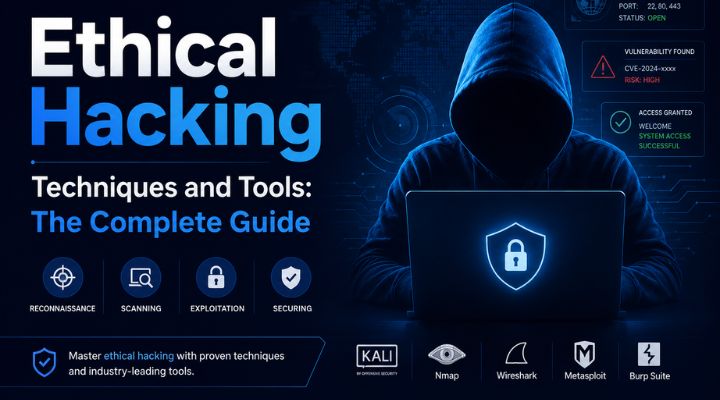
Top Ethical Hacking Techniques and Tools Every Beginner Should Know
- Posted by 3.0 University
- Categories Ethical Hacking
- Date May 26, 2026
- Comments 0 comment
Ethical hacking is the practice of legally identifying security vulnerabilities in computer systems, networks, applications, and digital infrastructure before cybercriminals can exploit them. Ethical hackers use specialized techniques and tools to test security defenses, improve cybersecurity, and protect organizations from cyber threats.
Today, ethical hacking has become one of the most in-demand cybersecurity skills, creating lucrative career opportunities across industries including banking, healthcare, IT services, e-commerce, and government sectors.
Every 39 seconds, a system somewhere on the internet is probed by an attacker. By the end of 2026, cybercrime is projected to cost the world roughly $10.8 trillion a year a figure Cybersecurity Ventures notes would rank as the third-largest economy on the planet if it were a country.
Whether you’re a student weighing a cybersecurity career an IT professional sharpening your skills, or simply curious about how white-hat hackers actually work this is the practical, no-fluff breakdown for 2026.
What Is Ethical Hacking?
Ethical hacking is the authorized process of testing and evaluating the security of systems, networks, applications, and digital assets to discover vulnerabilities before malicious attackers can exploit them.
Unlike cybercriminals, ethical hackers operate with permission and follow legal guidelines while performing security assessments.
Their primary objective is simple:
Find security weaknesses before hackers do.
Organizations hire ethical hackers to:
- Identify vulnerabilities
- Prevent data breaches
- Strengthen cybersecurity defenses
- Meet compliance requirements
- Protect customer and business data
Quick Summary
Ethical hacking involves legally testing systems for vulnerabilities to improve security and reduce cyber risks.
Why Ethical Hacking Matters More Than Ever
Cyberattacks are increasing at an unprecedented rate across the globe.
From ransomware attacks targeting businesses to phishing campaigns aimed at individuals, organizations are under constant pressure to strengthen their cybersecurity posture.
Companies today invest heavily in:
- Penetration testing
- Vulnerability assessment
- Security audits
- Threat intelligence
- Incident response
As a result, skilled ethical hackers are becoming critical assets for organizations.
Industries actively hiring ethical hackers include:
- Banking and Financial Services
- IT and Software Companies
- Healthcare
- Government Agencies
- E-commerce Platforms
- Telecommunications
- Cloud Service Providers
The financial stakes are brutal. According to IBM’s 2025 Cost of a Data Breach Report, the global average breach now costs $4.44 million, while U.S. organizations pay a record-high $10.22 million per incident. Healthcare remains the most expensive sector to breach.
Attackers now use AI too. The 2025–2026 threat landscape is defined by AI on both sides of the fight. Criminals deploy AI to write polymorphic malware, craft convincing phishing campaigns, and automate reconnaissance at scale. Defenders need ethical hackers who can think and test just as fast.
The talent gap is enormous. Industry estimates put unfilled cybersecurity roles at roughly 4.8 million globally, with 514,000+ open positions in the United States alone (CyberSeek / CompTIA). Demand consistently outpaces the supply of skilled professionals.
There’s a clear payoff for going on offense. Organizations that use AI and automation extensively in security save an average of $1.9 million per breach (IBM, 2025). Proactive testing isn’t a cost center it’s risk reduction with a measurable return.
Quick Summary
Growing cyber threats and digital transformation have made ethical hacking one of the most valuable cybersecurity skills in today’s job market.
The 5 Core Phases of Ethical Hacking
Before diving into tools, it helps to understand the methodology. Professional ethical hacking follows a structured five-phase process. Tools are simply what you reach for at each stage.
Reconnaissance (Information Gathering)
This is the homework phase. The hacker gathers as much intelligence about the target as possible domain names, IP ranges, employee names, technologies in use, and exposed services.
Reconnaissance can be passive (collecting public information without touching the target, e.g., via OSINT) or active (directly interacting with the target to gather data).
Scanning
Now the hacker actively maps the target’s attack surface. This means identifying live hosts, open ports, running services, and potential vulnerabilities. Network scanners and vulnerability scanners do the heavy lifting here.
Gaining Access
The exploitation phase. Using the weaknesses found during scanning, the hacker attempts to break in through a vulnerable service, a weak password, an unpatched application, or a social engineering trick.
Maintaining Access
A real attacker wants to stay inside. In this phase, the ethical hacker tests whether persistent access is possible simulating how a threat actor might install a backdoor or escalate privileges to move deeper into the network.
Clearing Tracks and Reporting
A malicious hacker covers their tracks to avoid detection. An ethical hacker documents everything instead. The deliverable is a detailed report: what was found, how it was exploited, the business risk, and clear remediation steps.
Quick takeaway: Tools without methodology produce noise. The five-phase framework turns scattered scans into a coherent, repeatable security assessment.
Popular Ethical Hacking Tools Used by Professionals
Ethical hackers use specialized tools throughout different phases of security testing.
Nmap
Nmap is one of the most widely used network scanning tools.
It helps professionals:
- Discover hosts
- Identify open ports
- Map network infrastructure
- Detect running services
Wireshark
Wireshark is a packet analysis tool used to monitor network traffic.
It helps security teams:
- Troubleshoot networks
- Analyze suspicious activity
- Detect security incidents
Burp Suite
Burp Suite is a leading web application security testing platform.
It is commonly used for:
- Web vulnerability scanning
- API security testing
- Manual penetration testing
Metasploit
Metasploit helps ethical hackers validate vulnerabilities through controlled exploitation.
Security professionals use it to:
- Test security controls
- Verify vulnerabilities
- Simulate attacks
Nessus
Nessus is a popular vulnerability assessment tool used by organizations worldwide.
It helps identify:
- Missing patches
- Configuration issues
- Security weaknesses
Quick Summary
Ethical hackers rely on tools like Nmap, Wireshark, Burp Suite, Metasploit, and Nessus to identify and assess security vulnerabilities.
Skills Required to Become an Ethical Hacker
A successful ethical hacker combines technical expertise with analytical thinking.
Key skills include:
Networking Fundamentals
Understanding:
- TCP/IP
- DNS
- Routing
- Firewalls
- Network protocols
Operating Systems
Knowledge of:
- Linux
- Windows
- Command Line Operations
Cybersecurity Fundamentals
Understanding:
- Threats
- Vulnerabilities
- Security controls
- Risk management
Programming and Scripting
Useful languages include:
- Python
- Bash
- JavaScript
- PowerShell
The Game-Changer: AI-Powered Ethical Hacking in 2026
Here’s what’s genuinely new. The biggest shift in ethical hacking right now isn’t a single tool it’s the AI layer being built on top of the entire toolkit.
Traditional tools like Nmap, Metasploit, and Burp Suite remain foundational. But AI is supercharging how they’re used, and a new class of AI-native security tools is emerging alongside them.
What’s changing on the ground:
- AI-assisted reconnaissance lets bug bounty hunters’ surface critical vulnerabilities in hours instead of weeks.
- AI-powered scanners detect both known and unknown weaknesses by analyzing patterns across massive datasets.
- AI payload generation helps red teams bypass endpoint defenses that previously stopped them cold.
- Automated triage filters false positives, letting humans focus on the findings that actually matter.
Tools and platforms increasingly cited in 2026 include AI-enhanced versions of Burp Suite, Darktrace for anomaly detection, Recon-ng for automated OSINT, and a growing field of LLM-assisted analysis tools.
A crucial caveat:
AI doesn’t replace the ethical hacker. It removes the repetitive grunt work so humans can do the strategic thinking interpreting context, validating results, and making judgment calls a model can’t.
As one industry analysis put it, building a career on purely manual tasks in 2026 means racing against machines you’ll lose to. The winners blend deep manual expertise with smart automation.
Other 2026 Trends Worth Watching
- Zero Trust Architecture (ZTA) 2.0 — Dynamic, AI-driven access verification is replacing perimeter-based defense. Pen testers now must probe identity-based weaknesses, not just network ports.
- Cloud, container, and API security: As workloads shift to the cloud, these have become top targets and top hiring priorities.
- Supply-chain risk– A single compromised vendor can cascade across thousands of organizations, making third-party testing essential.
Real-World Use Cases and Benefits of Ethical Hacking
Why do organizations invest in ethical hacking? Because the benefits are concrete and measurable.
Finding vulnerabilities before criminals do. This is the headline benefit. A flaw you discover in a controlled test is a problem you can fix calmly not a breach you explain to regulators and customers.
Meeting compliance requirements. Standards like PCI DSS, HIPAA, ISO 27001, and GDPR often require regular penetration testing. Ethical hacking keeps organizations audit ready.
Protecting brand and customer trust. A single public breach can erode years of reputation. Proactive testing signals that an organization takes security seriously.
Strengthening incident response. Red team exercises stress-test not just the technology but the people and processes behind it, revealing how a team actually performs under pressure.
Saving money. Given that the average U.S. breach now costs $10.22 million, the price of regular testing is a rounding error by comparison.
Real-world examples span every industry: banks running continuous red-team simulations, hospitals testing medical-device networks, fintech startups hardening their APIs, and bug bounty programs at companies like Google and Microsoft paying ethical hackers millions for responsibly disclosed flaws.
Ethical Hacking as a Career: Roles, Salaries, and Demand
If the demand statistics didn’t already make it clear, ethical hacking is one of the most future-proof careers in technology.
The roles you can target:
- Penetration Tester / Ethical Hacker
- Security Analyst / SOC Analyst
- Vulnerability Assessor
- Red Team Operator
- Bug Bounty Hunter
- Security Consultant
The numbers behind the opportunity:
- The U.S. Bureau of Labor Statistics projects roughly 29–33% job growth for information security analysts through 2034 far faster than the average occupation.
- The median annual pay for information security analysts was around $124,910 (BLS, May 2024).
- Earning an offensive-security credential like CEH or OSCP can boost salaries by about 21% (industry data, 2026).
- Cybersecurity has proven notably recession-resistant compared to other tech fields, with hiring staying robust even through broader tech slowdowns.
The credentials that open doors:
The Certified Ethical Hacker (CEH), OSCP, and CompTIA Security+ remain among the most requested certifications, with newer AI-security and cloud-native credentials gaining ground fast. Certified professionals are also promoted faster and earn more than their uncertified peers.
The takeaway is simple: there are millions of unfilled roles, the pay is strong, the work is intellectually demanding, and the demand isn’t slowing down.
How to Get Started in Ethical Hacking
If you’re ready to begin, here’s a practical roadmap:
- Build networking and OS fundamentals. Understand TCP/IP, DNS, HTTP, and how Linux and Windows actually work.
- Learn to script. Python and Bash will multiply everything you can do.
- Set up a home lab. Install Kali Linux and practice legally on platforms like TryHackMe, Hack The Box, and intentionally vulnerable apps such as DVWA.
- Master the core tools. Start with Nmap, Wireshark, Burp Suite, and Metasploit.
- Earn a recognized certification. A structured program like CEH gives you both the knowledge and the credential employers screen for.
- Practice ethically always. Only ever test systems you own or have explicit permission to assess.
Ready to Become a Certified Ethical Hacker?
The skills gap is real, the salaries are strong, and the world needs more white-hat defenders. 3.0 University Certified Ethical Hacker v13 Program is built for 2026 combining hands-on labs, the latest AI-driven techniques, and globally recognized certification to launch your cybersecurity career.
Want to go deeper into offensive security?
Explore our Certified Penetration Testing Professional (CPENT) program or browse our full School of Cyber Resilience.
Enroll today at 3.0 Universityand start building the skills that the digital world is desperate for.
Frequently Asked Questions (FAQs)
Is ethical hacking legal?
Yes. Ethical hacking is legal when performed with proper authorization from the organization being tested.
Can beginners learn ethical hacking?
Absolutely. Beginners can start by learning networking, Linux, cybersecurity fundamentals, and ethical hacking concepts before progressing to advanced topics.
Which certification is best for ethical hacking?
Certified Ethical Hacker (CEH) is among the most recognized certifications for aspiring ethical hackers and cybersecurity professionals.
Is ethical hacking a good career in India?
Yes. Ethical hacking remains one of the fastest-growing cybersecurity career paths due to increasing cyber threats and strong demand for skilled professionals.

You may also like

CEH v13 Course Syllabus 2026