
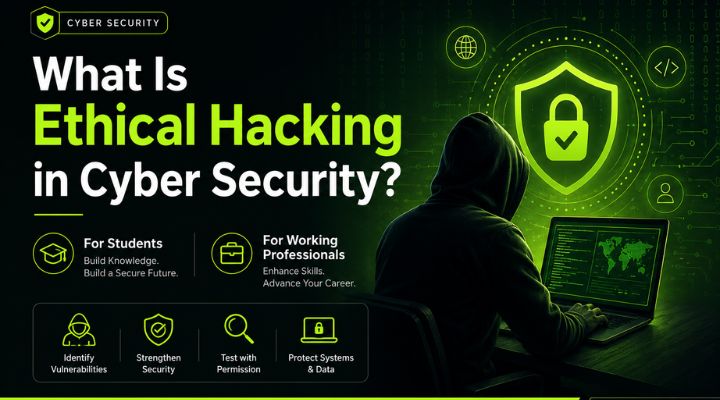
What Is Ethical Hacking? The Complete Guide for Beginners and Working Professionals
- Posted by 3.0 University
- Categories Ethical Hacking
- Date May 26, 2026
- Comments 0 comment
Ethical hacking is the authorized practice of identifying, testing, and fixing security vulnerabilities in computer systems, networks, applications, and digital infrastructure before cybercriminals can exploit them.
Ethical hackers use the same techniques as malicious hackers but operate legally and with permission to strengthen cybersecurity defenses.
As cyberattacks continue to rise globally, ethical hacking has become one of the most in-demand skills in cyber security, creating excellent career opportunities for both beginners and experienced IT professionals.
What Is Ethical Hacking in Cyber Security?
In cyber security, ethical hacking is a proactive security assessment process where authorized professionals simulate real-world attacks to uncover weaknesses in systems, applications, networks, cloud environments, and databases.
Organizations such as banks, government agencies, healthcare providers, e-commerce platforms, and multinational corporations regularly hire ethical hackers to strengthen their cybersecurity defenses.
Ethical Hacking Explained in Simple Terms
Imagine a bank hiring a security expert to attempt breaking into its vault. The goal is not theft but identifying weaknesses so they can be fixed.
Similarly, ethical hackers attempt to penetrate digital systems under authorization and provide recommendations to improve security.
Quick Summary
- Ethical hackers work legally and with permission.
- They identify security vulnerabilities.
- They help organizations prevent cyberattacks.
- They play a critical role in modern cybersecurity.
How Does Ethical Hacking Work?
Ethical hackers follow a structured methodology that mimics the tactics used by cybercriminals.
Step 1: Reconnaissance
The hacker gathers information about the target system.
Examples:
- Domain information
- Employee details
- Technology stack
- Publicly available data
Step 2: Scanning
The target is analyzed for vulnerabilities using specialized tools.
Common tools include:
- Nmap
- Nessus
- OpenVAS
- Burp Suite
Step 3: Gaining Access
The ethical hacker attempts to exploit identified vulnerabilities under controlled conditions.
Examples:
- Weak passwords
- Misconfigured servers
- Vulnerable web applications
Step 4: Maintaining Access
Security professionals assess how attackers could maintain persistence inside a compromised environment.
Step 5: Reporting
The final stage involves documenting vulnerabilities and providing remediation recommendations.
Quick Summary
Ethical hacking works through a systematic process of identifying, testing, exploiting, and reporting security vulnerabilities to improve organizational security.
Advantages of Ethical Hacking
Ethical hacking provides several benefits to organizations.
Identifies Security Weaknesses Early
Companies can fix vulnerabilities before attackers exploit them.
Prevents Data Breaches
Sensitive customer and business information remains protected.
Improves Regulatory Compliance
Helps organizations meet security standards such as:
- ISO 27001
- PCI DSS
- GDPR
- HIPAA
Protects Brand Reputation
A strong security posture builds customer trust.
Reduces Financial Losses
Preventing cyberattacks minimizes operational disruptions and recovery costs.
Quick Summary
The advantages of ethical hacking include stronger security, reduced risks, compliance support, and business continuity.
Learn Ethical Hacking with 3.0 University
If you’re looking for a structured ethical hacking online course, 3.0 University offers industry-focused cybersecurity training designed for both beginners and working professionals.
Benefits include:
- Live online learning
- Hands-on practical labs
- Real-world cybersecurity projects
- Industry-relevant curriculum
- Expert mentorship
- Career-focused guidance
Whether you’re starting from scratch or transitioning from an IT role, 3.0 University ethical hacking online course can help you build practical cybersecurity skills and prepare for in-demand ethical hacking careers.
Final Thoughts
Understanding what is ethical hacking is the first step toward entering one of the most exciting and rapidly growing fields in technology.
As cyber threats continue to evolve, organizations increasingly depend on skilled ethical hackers to identify vulnerabilities and protect critical systems.
By learning ethical hacking basics, developing hands-on experience, earning relevant certifications, and enrolling in a quality ethical hacking online course in Mumbai from 3.0 University, you can position yourself for a successful and rewarding cybersecurity career in 2026 and beyond.
The demand is growing, the opportunities are expanding and now is an excellent time to begin your ethical hacking journey.
Frequently Asked Questions (FAQs)
What is ethical hacking in cyber security?
Ethical hacking is the authorized process of testing computer systems, networks, and applications for security vulnerabilities. Ethical hackers identify weaknesses before cybercriminals can exploit them, helping organizations strengthen their cybersecurity defenses.
What is ethical hacking and how does it work?
Ethical hacking works by simulating real-world cyberattacks under legal authorization. Ethical hackers perform reconnaissance, scanning, vulnerability assessment, exploitation, and reporting to identify and fix security gaps in an organization’s infrastructure.
What is the ethical hacking meaning?
Ethical hacking refers to the practice of legally hacking systems with permission to find and fix security vulnerabilities. Ethical hackers use the same techniques as malicious hackers but for defensive and security purposes.
What are the advantages of ethical hacking?
The major advantages of ethical hacking include identifying security vulnerabilities, preventing data breaches, improving regulatory compliance, protecting business reputation, reducing financial losses, and strengthening overall cybersecurity posture.
Is ethical hacking legal?
Yes, ethical hacking is completely legal when conducted with proper authorization from the organization being tested. Unauthorized hacking, even with good intentions, can be illegal and lead to legal consequences.
Is ethical hacking a good career in India?
Yes, ethical hacking is one of the fastest-growing cybersecurity careers in India. With increasing cyber threats and digital transformation, organizations actively hire ethical hackers, penetration testers, and security analysts across industries.
What is the salary of an ethical hacker in India?
The salary of an ethical hacker in India typically ranges from ₹4 LPA to ₹8 LPA for freshers, ₹8 LPA to ₹18 LPA for mid-level professionals, and ₹18 LPA to ₹35 LPA or more for experienced cybersecurity experts.
How can beginners learn ethical hacking?
Beginners can learn ethical hacking by first understanding networking fundamentals, Linux, cybersecurity concepts, and programming basics. They can then practice on platforms like TryHackMe and Hack The Box before pursuing professional certifications.
Which certification is best for ethical hacking?
Popular ethical hacking certifications include Certified Ethical Hacker (CEH), CompTIA Security+, CompTIA PenTest+, eJPT, and OSCP. The best certification depends on your experience level and career goals.
What skills are required to become an ethical hacker?
Key skills include networking, Linux administration, web application security, penetration testing, vulnerability assessment, scripting with Python, and familiarity with cybersecurity tools such as Nmap, Wireshark, Burp Suite, and Metasploit.
Can a non-IT person learn ethical hacking?
Yes. Many cybersecurity professionals start without an IT background. With structured learning, hands-on practice, and industry-recognized training programs, non-IT professionals can successfully transition into ethical hacking careers.
How long does it take to learn ethical hacking?
The learning timeline depends on your background and commitment. Beginners typically require 6–12 months to build foundational ethical hacking skills, while working professionals with IT experience may progress faster.
Is coding necessary for ethical hacking?
Basic programming knowledge is helpful but not mandatory when starting. However, learning Python, Bash, JavaScript, and PowerShell can significantly improve an ethical hacker’s ability to automate tasks and understand vulnerabilities.
What tools do ethical hackers use?
Ethical hackers commonly use tools such as Nmap, Wireshark, Burp Suite, Metasploit, Nessus, OpenVAS, Kali Linux, John the Ripper, and Hydra for security testing and vulnerability assessment.
Is ethical hacking worth it in 2026?
Yes. Ethical hacking continues to be a highly sought-after cybersecurity skill due to increasing cyber threats, growing demand for security professionals, strong salary potential, and long-term career growth opportunities worldwide.
What is the difference between ethical hacking and penetration testing?
Ethical hacking is a broader cybersecurity practice that involves identifying and assessing security weaknesses. Penetration testing is a specific type of ethical hacking focused on simulating attacks to exploit vulnerabilities and evaluate security controls.
What jobs can I get after learning ethical hacking?
After learning ethical hacking, you can pursue roles such as Ethical Hacker, Penetration Tester, SOC Analyst, Cyber Security Analyst, Security Consultant, Vulnerability Assessment Analyst, Red Team Specialist, and Information Security Engineer.
Which is the best ethical hacking course for beginners?
The best ethical hacking course for beginners should include foundational cybersecurity concepts, hands-on labs, real-world projects, industry-recognized certification preparation, and mentorship support. Programs offered by 3.0 University are designed to help beginners build practical ethical hacking skills and prepare for cybersecurity careers.

You may also like

CEH v13 Course Syllabus 2026