Best Penetration Testing Tools for Beginners, CEH Students & Experts
- Posted by 3.0 University
- Categories Cyber Security
- Date June 6, 2026
- Comments 0 comment
Cyberattacks are becoming more sophisticated every year. According to IBM’s Cost of a Data Breach Report, the average global data breach cost reached $4.88 million in 2024. Organizations can no longer rely solely on firewalls and antivirus software to stay secure.
Firewalls, antivirus, and strong password policies can create a false sense of security. Yet a single misconfigured server or unpatched web app can give a hacker easy access.
By the time a breach becomes public, the harm is already done data is stolen, operations are disrupted, regulators may impose fines, and reputations can take years to recover. Most of this damage could have been prevented.
That’s exactly why penetration testing tools exist. They let security professionals think and act like attackers safely and legally to find vulnerabilities before the bad guys do.
In this guide, you’ll learn what these tools are, the best penetration testing tools used by ethical hackers in 2026, how they fit into a real assessment, and how you can master them through hands-on training at 3.0 University.
What Are Penetration Testing Tools?
Penetration testing tools are specialized cybersecurity software solutions used to identify, assess, and exploit vulnerabilities in systems, networks, applications, and infrastructure under controlled conditions.
These tools help ethical hackers and security analysts:
- Discover vulnerabilities
- Perform security assessments
- Simulate cyberattacks
- Test security controls
- Generate compliance reports
- Improve overall cybersecurity resilience
Modern cybersecurity testing tools are widely used by:
- Ethical Hackers
- Penetration Testers
- Security Consultants
- SOC Analysts
- Red Teams
- Cybersecurity Engineers
Why Penetration Testing Tools Matter in 2026
Demand has never been higher. The global penetration testing market was valued at roughly USD 2.74 billion in 2025 and is projected to grow to around USD 7.41 billion by 2034 (Fortune Business Insights).
Several forces are driving that surge:
- Cloud-first infrastructure expands the attack surface faster than teams can secure it.
- AI-powered attacks are accelerating industry reports now estimate that over 80% of cyberattacks involve some form of AI assistance.
- Compliance mandates such as PCI DSS 4.0, HIPAA, and the EU’s DORA require regular, documented penetration testing.
- A talent shortage of nearly 4.8 million unfilled cybersecurity roles globally (ISC2) means skilled testers are in serious demand.
The business case is blunt organisations with significant security staff shortages face data breach costs that run, on average, about USD 1.76 million higher than well-staffed peers.
Knowing how to use penetration testing tools isn’t just a technical skill it’s career insurance.
Types of Penetration Testing Tools
Not every tool does everything. Most professionals build a stack based on what they’re testing. Here are the main categories you’ll encounter.
Network Penetration Testing Tools
These tools and techniques focus on infrastructure servers, routers, firewalls, and open ports. They map what’s exposed, identify running services, and test for misconfigurations or weak protocols. Nmap and Wireshark are the classic entry points here.
Web Application Penetration Testing Tools
Modern breaches often start in the browser. Web application penetration testing tools target flaws like SQL injection, cross-site scripting (XSS), broken authentication, and insecure APIs. Burp Suite, OWASP ZAP, and sqlmap dominate this space.
Wireless, Password & Exploitation Tools
Beyond networks and web apps, ethical hacking tools also cover wireless security (Aircrack-ng), password cracking (John the Ripper, Hashcat), and full exploitation frameworks (Metasploit) that tie discovery and attack together.
Best Penetration Testing Tools Every Ethical Hacker Should Know
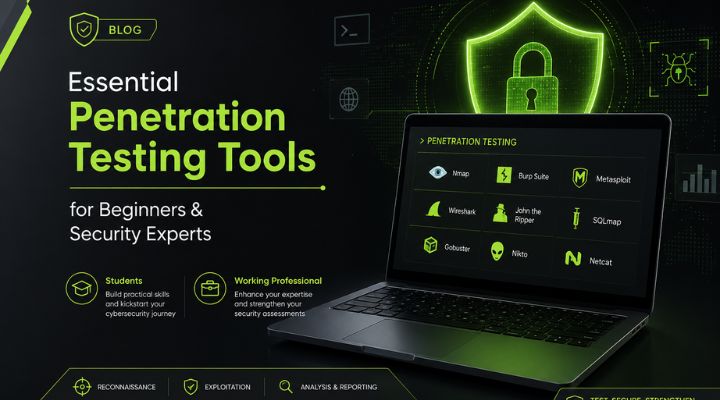
1. Nmap
Category:
Network Penetration Testing Tool
Nmap (Network Mapper) is one of the most widely used network penetration testing tools for scanning hosts, identifying open ports, and discovering network services.
Key Features
- Port scanning
- OS detection
- Network inventory
- Service version detection
- Vulnerability discovery
Best For
- Network reconnaissance
- Security audits
- Asset discovery
Real-World Example
Before conducting a penetration test, security professionals often use Nmap to map an organization’s attack surface and identify exposed services.
2. Metasploit Framework
Category:
Ethical Hacking Tool
Metasploit is considered the industry standard for exploitation and vulnerability validation.
Key Features
- Exploit database
- Payload generation
- Vulnerability validation
- Post-exploitation testing
- Security research
Best For
- Exploit development
- Vulnerability assessment
- Red team exercises
Why It Matters
Many CEH v13 students at 3.0 University learn Metasploit because it provides hands-on experience with real-world attack simulations.
3. Burp Suite
Category:
Web Application Penetration Testing Tool
Burp Suite is one of the most powerful tools for testing web application security.
Key Features
- Intercepting proxy
- Automated vulnerability scanning
- Session testing
- API security testing
- Intruder attack automation
Best For
- OWASP Top 10 testing
- Web application assessments
- API penetration testing
Common Vulnerabilities Detected
- SQL Injection
- Cross-Site Scripting (XSS)
- Authentication flaws
- Session management issues
4. Wireshark
Category:
Network Analysis Tool
Wireshark helps ethical hackers inspect network traffic and analyze communication between devices.
Key Features
- Packet capture
- Protocol analysis
- Traffic monitoring
- Network troubleshooting
Best For
- Incident investigation
- Threat hunting
- Malware traffic analysis
5. Nessus
Category:
Vulnerability Assessment Tool
Nessus is widely used for identifying security vulnerabilities across enterprise environments.
Key Features
- Automated scanning
- Compliance auditing
- Configuration assessment
- Vulnerability prioritization
Best For
- Enterprise security audits
- Continuous vulnerability management
6. Nikto
Category:
Web Server Security Scanner
Nikto is an open-source penetration testing tool designed to detect web server vulnerabilities.
Key Features
- Web server scanning
- Misconfiguration detection
- Vulnerability identification
- Security assessment reporting
Best For
- Quick web server audits
- Open-source security testing
7. John the Ripper
Category:
Password Security Testing Tool
John the Ripper is used for password auditing and credential security assessments.
Key Features
- Password cracking
- Hash analysis
- Credential strength testing
Best For
- Security awareness assessments
- Password policy validation
8. Aircrack-ng
Category:
Wireless Penetration Testing Tool
Aircrack-ng is a popular suite for wireless network security testing.
Key Features
- Wi-Fi auditing
- Packet capture
- WPA/WPA2 testing
- Wireless security analysis
Best For
- Wireless penetration testing
- Network security validation
Quick Comparison: Popular Penetration Testing Tools
Tool | Category | Best For | License |
Nmap | Network scanning | Host & port discovery | Open-source |
Metasploit | Exploitation framework | Validating vulnerabilities | Free / Pro |
Burp Suite | Web app testing | APIs, auth, sessions | Free / Paid |
Wireshark | Traffic analysis | Packet inspection | Open-source |
OWASP ZAP | Web vulnerability scan | Beginners & automation | Open-source |
sqlmap | SQL injection | Database exploitation | Open-source |
Aircrack-ng | Wireless testing | Wi-Fi security | Open-source |
Nessus | Vulnerability scanning | Enterprise assessments | Paid (free trial) |
Best Penetration Testing Tools for Beginners
If you’re just starting out, don’t try to learn everything at once. Focus on a small, high impact set first.
The best penetration testing tools for beginners are those with strong documentation and active communities:
- Nmap– learn how networks are mapped.
- Wireshark– see what traffic really looks like.
- Burp Suite Community + OWASP ZAP– understand web vulnerabilities hands-on.
- Metasploit– connect the dots between a flaw and a working exploit.
Most of these open-source penetration testing tools come pre-installed in Kali Linux, so you can practise in a safe lab environment without spending a rupee.
How to Use Penetration Testing Tools in Ethical Hacking
Tools alone don’t make a pen tester methodology does. A professional assessment generally follows five phases:
- Reconnaissance- gather information about the target (Nmap, OSINT).
- Scanning & Enumeration- identify live services and weaknesses (Nessus, OWASP ZAP).
- Exploitation- safely confirm vulnerabilities are real (Metasploit, sqlmap).
- Post-Exploitation- assess the impact and what an attacker could reach.
- Reporting- document findings with clear, prioritised remediation steps.
Notice that reporting is its own phase. A finding nobody can understand or fix is worthless which is why strong communication skills matter as much as technical ones.
Open-Source Penetration Testing Tools for Cybersecurity Professionals
Many organizations prefer open-source penetration testing tools because they are flexible, community-supported, and cost-effective.
Popular options include:
- Nmap
- Metasploit Framework
- Wireshark
- Nikto
- John the Ripper
- Aircrack-ng
- OWASP ZAP
- SQLmap
These tools are extensively used by ethical hackers and security researchers worldwide.
Are Penetration Testing Tools Legal to Use?
Yes – with one critical condition: explicit authorisation. Penetration testing tools are legal when used on systems you own or have written permission to test.
Running them against systems without consent is a crime in most countries, including under India’s IT Act. Ethical hackers always operate within a defined scope and a signed agreement.
That single line Do you have permission? is what separates a security professional from a criminal.
Frequently Asked Questions (FAQs)
What are penetration testing tools?
Penetration testing tools are cybersecurity applications used to identify, validate, and exploit security vulnerabilities in systems, networks, and applications during authorized security assessments.
Which penetration testing tools are most commonly used by ethical hackers?
The most widely used tools include Nmap, Metasploit, Burp Suite, Wireshark, Nessus, Aircrack-ng, and John the Ripper.
What is the best penetration testing tool for beginners?
Nmap is often considered the best penetration testing tool for beginners because it is easy to learn and provides foundational networking knowledge.
Are penetration testing tools legal to use?
Yes, penetration testing tools are legal when used with proper authorization. Unauthorized use against systems you do not own or have permission to test may be illegal.
What are the free and open-source penetration testing tools?
Popular open-source tools include Nmap, Metasploit Framework, Wireshark, Nikto, SQLmap, Aircrack-ng, and OWASP ZAP.
How do penetration testing tools help in cybersecurity?
They help identify vulnerabilities, validate security controls, reduce risk, support compliance, and strengthen an organization’s overall security posture.
Which penetration testing tools should CEH students learn?
CEH students should focus on Nmap, Metasploit, Wireshark, Burp Suite, Nessus, Aircrack-ng, and John the Ripper as part of their ethical hacking toolkit.
Conclusion
Penetration testing tools are the backbone of modern cybersecurity assessments. Whether you’re an aspiring ethical hacker, a CEH student, or an experienced cybersecurity professional, mastering these tools is essential for identifying vulnerabilities and defending organizations against evolving threats.
The most effective security professionals combine technical expertise with hands-on experience using industry-standard tools such as Nmap, Metasploit, Burp Suite, and Wireshark.
If you’re looking to build a career in cybersecurity and ethical hacking, explore the Cybersecurity Certification Programs and CEH v13 Training offered by 3.0 University.
These programs provide practical, job-ready skills and hands-on exposure to the penetration testing tools used by today’s leading cybersecurity teams.

You may also like

Cyber Security Course Eligibility