Penetration Testing: Complete Guide for Beginners & Cybersecurity Professionals
- Posted by 3.0 University
- Categories Cyber Security
- Date June 4, 2026
- Comments 0 comment
Cyberattacks are becoming more sophisticated every year. Organizations invest heavily in firewalls, antivirus solutions, endpoint protection, and security monitoring systems. Yet, data breaches continue to make headlines.
And the damage is not theoretical. According to IBM’s 2025 Cost of a Data Breach Report, the global average breach now costs around $4.44 million, climbing to roughly $10.22 million in the United States. On average, organizations still take about 241 days just to identify and contain an incident. That is eight months of an attacker quietly living inside systems most teams assumed were secure.
This is exactly where penetration testing earns its place. Instead of waiting for a criminal to find the cracks, you hire an ethical hacker to find them first, prove they can be exploited, and tell you precisely how to close them.
The reason is simple: most organizations don’t know where their real vulnerabilities exist until an attacker finds them first.
This is where penetration testing becomes critical.
Whether you’re a beginner exploring cybersecurity careers or an IT professional looking to advance into ethical hacking, understanding penetration testing is one of the most valuable cybersecurity skills you can develop today.
In this guide, we’ll break down penetration testing from the ground up: what it means, how it works step by step, the tools professionals rely on, and how you can actually learn penetration testing in 2026, whether you’re a complete beginner or a working IT professional looking to specialize.
What is Penetration Testing?
Penetration Testing Meaning
Penetration testing (often called pentesting) is a simulated cyberattack performed by security professionals to identify vulnerabilities in systems, applications, networks, and devices before malicious hackers can exploit them.
Simply put, penetration testing is the process of legally hacking a system to discover security weaknesses.
The goal is not to cause damage but to:
- Identify vulnerabilities
- Assess security risks
- Validate existing security controls
- Recommend remediation measures
- Strengthen overall cybersecurity posture
Penetration Testing Explained in Simple Terms
Imagine hiring a professional locksmith to break into your house and show you all the weak points before a burglar discovers them.
Penetration testing works exactly the same way for digital systems.
Organizations authorize ethical hackers to:
- Think like attackers
- Use hacker techniques
- Discover weaknesses
- Report findings
- Help improve security
Why is Penetration Testing Important?
According to various cybersecurity industry reports, the average cost of a data breach continues to rise globally, making proactive security testing more important than ever.
Organizations conduct penetration testing because it helps:
Detect Hidden Vulnerabilities
Security gaps often remain unnoticed despite traditional security controls.
Prevent Data Breaches
Finding weaknesses before attackers do significantly reduces risk.
Meet Compliance Requirements
Many regulations require regular security assessments, including:
- PCI DSS
- HIPAA
- ISO 27001
- SOC 2
- GDPR security controls
Protect Brand Reputation
A major cyber incident can damage customer trust and business credibility.
Improve Incident Readiness
Security teams learn how attackers think and operate.
Penetration Testing vs. Vulnerability Scanning
People often confuse the two, but they answer different questions. A vulnerability scan asks what might be wrong?, A penetration test asks “what can an attacker actually do with it?
Aspect | Vulnerability Scan | Penetration Test |
Goal | Find known weaknesses | Exploit weaknesses to prove impact |
Method | Mostly automated | Human-led, creative, manual + automated |
Output | List of potential issues | Confirmed attack paths + fixes |
Frequency | Continuous / weekly | Periodic (e.g., annually) |
False positives | Common | Validated and removed |
Bottom line: scanning is the smoke detector; penetration testing is the fire drill that proves whether you’d actually survive the blaze.
Why Penetration Testing Matters More Than Ever in 2026
Three forces have turned pen testing from a nice-to-have audit into an always-on business control.
1. The threat landscape moved faster than defenses
Attackers now weaponize generative AI to scale phishing, write malware, and probe systems. IBM’s research found that roughly 1 in 6 breaches already involve AI-driven attacks, and “shadow AI” tools adopted without oversight added as much as $670,000 to the average breach. When offense automates, your defense has to be tested far more often.
2. Compliance now demands it
Regulations have stopped treating testing as optional. PCI DSS 4.0 expects penetration testing at least annually and after significant changes. Frameworks like HIPAA, SOC 2, ISO 27001, and the EU’s DORA and NIS2 directives push organizations toward regular, evidence-based security validation. A clean pen test report is increasingly what auditors and enterprise clients want to see.
3. The market reflects the demand
Analysts size the global penetration testing market at roughly $2.7–3.1 billion in 2026, with most forecasts projecting growth to between $5.5 billion and $7.4 billion by the early 2030s, at compound annual growth rates in the 11–17% range. Translation for your career: demand for skilled testers is rising steadily, not slowing down.
Types of Penetration Testing
Penetration testing is an umbrella term. In practice, engagements are scoped around what you’re trying to protect.
- Network penetration testing: Targets internal and external network infrastructure, such as servers, firewalls, switches, and exposed services.
- Web application testing: Hunts for flaws like SQL injection, broken authentication, and cross-site scripting in websites and portals.
- Mobile application testing: Examines iOS/Android apps for insecure storage, weak APIs, and reverse-engineering risks.
- Cloud penetration testing: Focuses on misconfigured AWS, Azure, or GCP resources, identity permissions, and exposed storage buckets.
- Wireless testing: Assesses Wi-Fi encryption, rogue access points, and segmentation.
- Social engineering: Tests the human layer through phishing, pretexting, and physical tailgating.
- Physical penetration testing: Attempts to bypass locks, badges, and on-site controls to reach hardware directly.
Black Box vs. Gray Box vs. White Box
Engagements also differ by how much information the tester is given upfront.
Approach | What the tester knows | Best for simulating |
Black box | No internal knowledge works like an outside attacker | A real external hacker with zero access |
Gray box | Partial knowledge, e.g., a standard user login | A malicious insider or compromised account |
White box | Full access to code, architecture, and credentials | A deep, thorough audit of everything |
The Penetration Testing Process: A Step-by-Step Guide
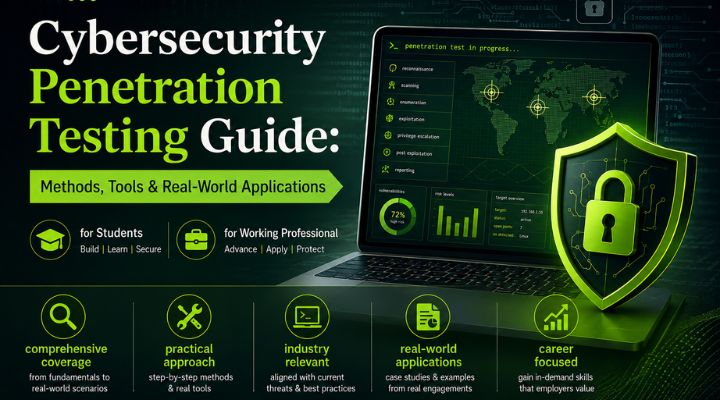
Most professional engagements follow a structured methodology. Whether you call them stages or phases, the logic is the same: understand the target, find a way in, prove the impact, and report it responsibly.
Here’s the penetration testing step-by-step guide in seven practical phases.
Step 1: Planning and Scoping
Everything starts with rules of engagement. The client and tester agree on what’s in scope, what’s off-limits, testing windows, and legal authorization. Skipping this step isn’t just unprofessional, it’s potentially illegal.
Step 2: Reconnaissance (Information Gathering)
The tester collects intelligence about the target, from public records and DNS data to employee details and exposed assets. Good recon often decides the whole engagement, since you can’t attack what you haven’t mapped.
Step 3: Scanning and Enumeration
Next, the tester probes live systems to identify open ports, running services, and software versions. Tools like Nmap and Nessus reveal the attack surface and surface likely weak points.
Step 4: Exploitation (Gaining Access)
This is the phase most people picture. The tester attempts to exploit the weaknesses found, perhaps via a vulnerable web form, weak credentials, or an unpatched service, to gain a real foothold inside the environment.
Step 5: Post-Exploitation and Privilege Escalation
Getting in is rarely the end goal. Here the tester explores how far an attacker could go: escalating from a basic user to administrator, moving laterally to other machines, and identifying the sensitive data truly at risk.
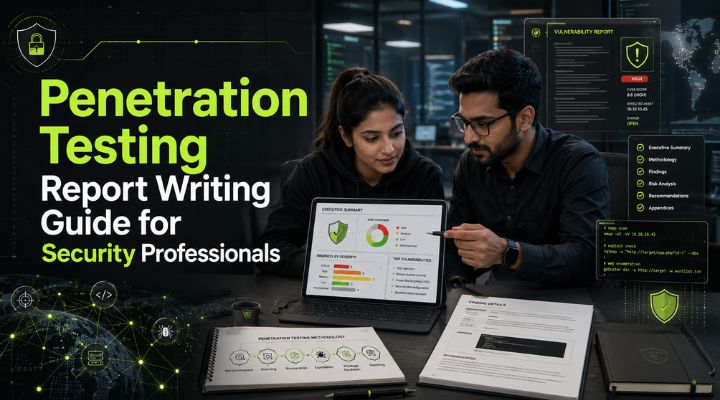
Step 6: Analysis and Reporting
Arguably the most valuable phase. The tester documents what was found, how it was exploited, the business impact, and clear, prioritized remediation steps. A great report turns technical findings into decisions a board can act on.
Step 7: Remediation and Retesting
Finally, the organization fixes the issues, and the tester verifies the fixes actually hold. Security is a loop, not a one-time event, so the strongest teams retest after every major change.
Essential Penetration Testing Tools to Know
You don’t need to memorize every tool, but recognizing the core kit helps you learn faster. Most testers build their workflow around a small, powerful set.
- Kali Linux: The go-to operating system that bundles hundreds of pre-installed security tools.
- Nmap: The industry-standard scanner for network and port discovery.
- Metasploit: A powerful framework for developing and launching exploits.
- Burp Suite: The leading toolkit for web application testing and request manipulation.
- Wireshark: A network protocol analyzer for inspecting traffic packet by packet.
- Nessus / OpenVAS: Vulnerability scanners used to map weaknesses before exploitation.
- John the Ripper & Hashcat: Password-cracking tools used to test credential strength.
In 2026, AI is increasingly woven into these workflows too, helping automate reconnaissance, prioritize findings, and even draft portions of reports, which is exactly why modern certifications now teach AI-assisted testing rather than ignoring it.
How to Learn Penetration Testing for Beginners (2026 Roadmap)
If you’re searching for the best penetration testing path for beginners in 2026, the good news is that the route is clearer than it used to be. You don’t need a computer science degree, but you do need to build skills in the right order.
Here’s a practical, step-by-step roadmap.
- Master the fundamentals first. Learn networking (TCP/IP, DNS, HTTP), how operating systems work (especially Linux), and basic scripting in Python or Bash. This foundation is non-negotiable.
- Understand security concepts. Get comfortable with the CIA triad, common vulnerabilities (the OWASP Top 10 is a great start), and how attacks actually unfold.
- Set up a home lab. Practice legally in isolated environments using deliberately vulnerable machines. Hands-on repetition is where real skill is built.
- Earn a recognized certification. A structured, industry-recognized credential gives you both the skills and the proof employers look for. This is where most beginners accelerate fastest.
- Build a portfolio. Document your labs, write-ups, and capture-the-flag challenges. A visible track record often matters as much as the certificate itself.
This is exactly the journey the CEH v13 (Certified Ethical Hacker) program is built around. As the world’s most recognized ethical hacking certification, CEH v13 spans 20 modules and 220+ hands-on labs covering over 550 attack techniques, the five phases of ethical hacking, and modern surfaces like cloud, IoT, and AI systems.
Crucially, v13 is the first version to weave AI into every phase of testing, which mirrors how attacks and defenses actually work today.
Is Penetration Testing Worth It as a Career?
Short answer: yes, and the numbers back it up. As breaches grow more expensive and regulations tighten, organizations are competing for people who can think like attackers and report like consultants.
A few reasons penetration testing remains one of the most rewarding paths in tech:
- Strong, durable demand: The market is growing at double-digit rates, and skilled testers are consistently in short supply.
- Attractive compensation: Offensive security roles typically command premium salaries because the skill set is specialized and hard to fake.
- Clear progression: You can grow from junior pentester to senior consultant, red team lead, or security architect.
- Genuinely engaging work: Every engagement is a fresh puzzle, which keeps the job from feeling repetitive.
That said, it’s worth being honest. The role rewards continuous learning, comfort with failure, and strong communication. If you enjoy solving problems and explaining them clearly, the career fit is excellent.
Common Challenges and Best Practices
Penetration testing is powerful, but it isn’t magic. Knowing the limits makes you a better professional.
- It’s a snapshot, not a guarantee. A test reflects security at a moment in time, so retest after major changes.
- Scope defines value. Too narrow and you miss real risks; clarify scope early and revisit it.
- Reporting is the product. Findings nobody can act on are wasted effort. Prioritize clarity and remediation guidance.
- Stay ethical and legal. Always work within written authorization. The line between ethical hacking and a crime is permission.
Start Your Penetration Testing Journey with 3.0 University
Reading about penetration testing is a great first step, but real expertise is built through guided, hands-on practice. That’s where 3.0 University comes in.
Our online Cybersecurity and Ethical Hacking programs, including the industry-recognized CEH v13 certification track, are designed to take you from curious beginner to job-ready professional.
With 3.0 University you get:
- Expert-led instruction from practitioners who actually run real engagements.
- Hands-on labs that mirror real attack scenarios, not just theory.
- Industry-recognized credentials that employers trust worldwide.
- Flexible online learning built for both students and busy working professionals.
Whether you want to break into cybersecurity, level up your IT career, or simply learn penetration testing the right way, the best time to start was yesterday. The second-best time is now.
Explore the Cybersecurity online course and CEH v13 program in Mumbai at 3.0 University and turn your curiosity into a career.
Frequently Asked Questions (FAQs)
What is penetration testing in simple words?
Penetration testing is a simulated cyberattack performed by ethical hackers to identify and exploit vulnerabilities before malicious attackers can use them.
What skills are required for penetration testing?
Key skills include networking, Linux, web security, scripting, vulnerability assessment, exploitation techniques, and cybersecurity fundamentals.
Can beginners learn penetration testing?
Yes. Beginners can start with networking, Linux, cybersecurity basics, and ethical hacking fundamentals before progressing to advanced penetration testing techniques.
How long does it take to learn penetration testing?
Most learners can understand penetration testing basics within a few months. Becoming job-ready typically requires consistent practice, hands-on labs, and certification training.
Is CEH v13 good for learning penetration testing?
Yes. CEH v13 is one of the most recognized ethical hacking certifications and provides foundational knowledge of penetration testing methodologies, tools, and attack techniques.
What is the difference between ethical hacking and penetration testing?
Ethical hacking is a broader cybersecurity discipline that includes multiple security assessment activities. Penetration testing is a specific, structured process used to evaluate security by simulating real-world attacks.
What is the best penetration testing course for beginners in 2026?
A beginner-friendly cybersecurity program that combines networking, ethical hacking, practical labs, and certification preparation such as the CEH v13 training offered by 3.0 University can provide a strong foundation.
Final Thoughts
Penetration testing is no longer a luxury reserved for big enterprises. As attacks accelerate and regulations tighten, proactively finding your own weaknesses, before someone else does, has become one of the smartest moves any organization can make. And for individuals, few cybersecurity skills are as in-demand, future-proof, or genuinely fascinating.
Ready to go from reading about it to doing it?
Start learning penetration testing with 3.0 University expert-led Cybersecurity and CEH v13 programs, and build the skills that keep the digital world safe.

You may also like

Cyber Security Course Eligibility