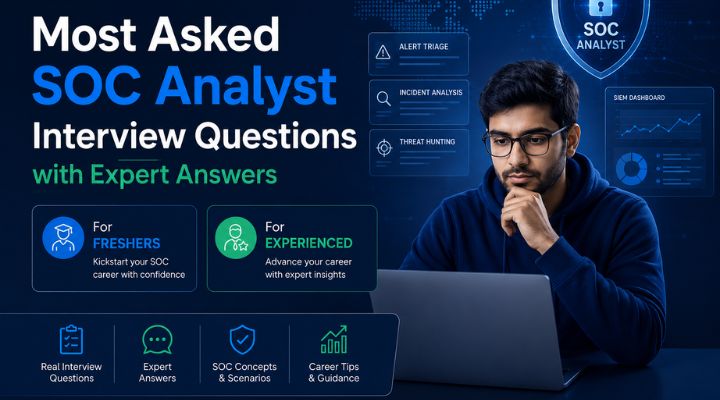
SOC Analyst Interview Questions & Answers
- Posted by 3.0 University
- Categories SOC Analyst
- Date May 23, 2026
- Comments 0 comment
You’ve studied the frameworks. You’ve set up your home lab. You’ve earned your CompTIA Security+ or maybe even your CEH. Now comes the part that trips up most aspiring SOC analysts the actual interview.
Here’s something most cybersecurity career guides won’t tell you: SOC analyst interviews aren’t just about knowing what a SIEM tool does. Hiring managers are stress-testing your instincts.
They want to know how you think when an alert fires at 2 AM, when your queue has 80 unreviewed tickets, and when you can’t tell if that PowerShell command is a legitimate IT script or the beginning of a ransomware attack.
This guide covers every type of SOC analyst interview question you’ll face in 2026 from Tier 1 entry-level screening questions to deep technical scenarios that senior analysts get grilled on.
We’ve structured this the way real interviews unfold, with model answers you can learn from (not just memorize).
Whether you’re a fresher stepping into your first SOC role or a mid-level analyst gunning for a Tier 2 or Tier 3 position, this is the most practical prep resource you’ll find.
Why SOC Analyst Interviews Are Different?
Unlike traditional IT interviews, SOC analyst interviews are designed to evaluate how you respond to real-world security events.
Interviewers typically assess:
- Security fundamentals
- Network knowledge
- Threat detection skills
- SIEM experience
- Incident response understanding
- Log analysis capabilities
- Communication and documentation skills
- Problem-solving approach
According to the ISC2 Cybersecurity Workforce Study, organizations worldwide continue to face a significant cybersecurity talent shortage, making skilled SOC professionals highly valuable.
However, competition for entry-level positions remains strong, making preparation essential.
Entry-Level SOC Analyst Interview Questions For Freshers
If you’re applying for your first SOC role, you’ll likely face a mix of foundational technical questions and behavioral questions designed to assess learning potential.
Hiring managers at this level know you don’t have years of experience they’re evaluating whether you can think critically and learn fast.
Que 1: What is a Security Operations Center (SOC)?
Answer:
A Security Operations Center (SOC) is a centralized team responsible for monitoring, detecting, analyzing, investigating, and responding to cybersecurity threats within an organization.
The SOC operates 24/7 using various security tools such as:
- SIEM solutions
- EDR platforms
- Threat intelligence feeds
- IDS/IPS systems
- Vulnerability management tools
Example:
If an employee receives a phishing email and clicks a malicious link, the SOC team investigates the activity, determines whether compromise occurred, and initiates remediation actions.
Que 2: What does a SOC Analyst do?
Answer:
A SOC Analyst monitors security alerts, investigates suspicious activities, escalates incidents, and helps protect organizational systems from cyber threats.
Common responsibilities include:
- Monitoring SIEM alerts
- Investigating suspicious events
- Conducting log analysis
- Responding to incidents
- Documenting findings
- Escalating serious threats
Que 3: What is the CIA Triad?
Answer:
The CIA Triad is a foundational cybersecurity model consisting of:
Confidentiality
- Protecting information from unauthorized access
Integrity
- Ensuring data remains accurate and unaltered
Availability
- Making systems and data accessible when needed
Practical Example:
Online banking systems must protect customer data (Confidentiality), prevent transaction manipulation (Integrity), and remain operational for users (Availability).
Que 4: What is the difference between IDS and IPS?
Answer:
IDS | IPS |
Detects threats | Detects and blocks threats |
Passive monitoring | Active prevention |
Generates alerts | Takes automated actions |
Example:
An IDS may alert analysts about malicious traffic, while an IPS can automatically block the attack.
Que 5: What is SIEM?
Answer:
SIEM (Security Information and Event Management) collects, correlates, and analyzes logs from multiple systems to identify security incidents.
Popular SIEM tools include:
- Splunk
- IBM QRadar
- Microsoft Sentinel
- ArcSight
- LogRhythm
SIEM platforms help analysts identify suspicious behavior that might otherwise go unnoticed.
Tier 1 SOC Analyst Interview Questions
Tier 1 analysts are typically the first responders within a SOC.
Que 6: What would you do when you receive a high-severity alert?
Answer:
A structured approach includes:
- Validate the alert
- Determine whether it is a true positive
- Gather supporting evidence
- Analyze affected assets
- Assess business impact
- Escalate if necessary
- Document findings
Expert Insight:
Many new analysts make the mistake of escalating immediately without investigation. Interviewers prefer candidates who demonstrate analytical thinking before escalation.
Que 7: What is a False Positive?
Answer:
A false positive occurs when a security tool incorrectly identifies legitimate activity as malicious.
Example:
A security scanner might flag a legitimate administrative script as malware due to its behavior.
Reducing false positives is critical because excessive alerts can lead to analyst fatigue.
Que 8: What is a True Positive?
Answer:
A true positive is a legitimate security event that requires investigation and response.
Example:
An attacker successfully attempts multiple failed logins followed by a successful login from an unusual geographic location.
Que 9: What logs would you investigate during a security incident?
Answer:
Common log sources include:
- Windows Event Logs
- Linux Syslogs
- Firewall Logs
- Proxy Logs
- DNS Logs
- VPN Logs
- Active Directory Logs
- EDR Telemetry
Experienced analysts correlate multiple log sources rather than relying on a single data point.
Technical SOC Analyst Interview Questions
Que 10: What is the difference between TCP and UDP?
Answer:
TCP
- Connection-oriented
- Reliable delivery
- Error checking
UDP
- Connectionless
- Faster communication
- No delivery guarantees
Examples:
TCP:
- HTTP
- HTTPS
- SSH
UDP:
- DNS
- VoIP
- Video streaming
Que 11: What is DNS and why is it important in cybersecurity?
Answer:
DNS translates domain names into IP addresses.
Cybercriminals often abuse DNS for:
- Command-and-control communication
- Malware delivery
- Data exfiltration
SOC analysts frequently review DNS logs during investigations.
Que 12: What is the difference between hashing and encryption?
Answer:
Hashing
- One-way process
- Cannot be reversed
- Used for integrity verification
Encryption
- Reversible process
- Protects confidentiality
- Requires a key
Example:
Passwords should be hashed, while sensitive files are typically encrypted.
Que 13: What is Endpoint Detection and Response (EDR)?
Answer:
EDR solutions continuously monitor endpoints to detect and respond to threats.
Popular EDR platforms include:
- CrowdStrike Falcon
- Microsoft Defender for Endpoint
- SentinelOne
- VMware Carbon Black
EDR tools provide analysts with process activity, file modifications, and attack timelines.
Que 14: What is MITRE ATT&CK?
Answer:
MITRE ATT&CK is a globally recognized framework that documents real-world attacker tactics, techniques, and procedures (TTPs).
SOC teams use ATT&CK to:
- Detect adversary behavior
- Improve threat hunting
- Enhance incident investigations
- Build detection rules
Scenario Based SOC Analyst Interview Questions
Que 15. What would you check first when investigating a potential phishing email?
Model Answer:
Phishing is the entry point for over 90% of cyberattacks, so this is bread-and-butter Tier 1 work.
My investigation checklist:
- Sender analysis: Does the display name match the actual email domain? Is the domain a lookalike (e.g., micros0ft.com instead of microsoft.com)? Check DMARC, DKIM, and SPF records.
- Header analysis: Where did the email actually originate from? Mail headers reveal the true sending server, which often differs from the display address.
- URL analysis: Hover (don’t click) over links. Do they match the displayed text? Run suspicious URLs through URLScan.io or VirusTotal. Look for URL shorteners masking the true destination.
- Attachment analysis: If there’s an attachment, check the file type. .exe or .vbs files are obviously suspicious, but so are macro-enabled Office documents (.docm, .xlsm). Run attachments in a sandbox like Any.run or Cuckoo Sandbox.
- Payload delivery check: Has anyone in the organization clicked the link or opened the attachment? Check endpoint telemetry and proxy logs.
- Scope assessment: Was this email sent to one person or to hundreds? A targeted spear-phishing email to the CFO is a very different scenario from a mass phishing campaign.
Que 16: Multiple failed login attempts are detected on a critical server. How would you respond?
Answer:
I would:
- Identify source IP addresses
- Check login timestamps
- Review account activity
- Determine if brute force activity exists
- Verify whether logins eventually succeeded
- Recommend account lockout or blocking measures
This investigation helps determine whether an attacker is attempting credential compromise.
Que 17: A workstation suddenly starts communicating with a known malicious IP. What would you do?
Answer:
Immediate actions include:
- Verify the threat intelligence source
- Investigate endpoint activity
- Review processes and network connections
- Isolate the system if necessary
- Collect forensic evidence
- Escalate to Incident Response
Expert Observation:
Interviewers often look for containment actions. Mentioning endpoint isolation demonstrates practical incident response knowledge.
Que 18: An employee downloads an unknown executable file. What would you investigate?
Answer:
I would examine:
- File hash
- File reputation
- Parent process
- User activity
- Network connections
- Endpoint alerts
- Sandbox results
The goal is determining whether the file is legitimate software or malware.
SOC Analyst Behavioral Interview Questions
Que 19: Why do you want to become a SOC Analyst?
Answer:
A strong response should combine curiosity, problem-solving ability, and passion for cybersecurity.
Sample Answer:
“I enjoy investigating technical problems and understanding how attackers operate. The SOC environment provides continuous learning opportunities while allowing me to contribute directly to protecting organizations from cyber threats.“
Que 20: How do you handle working under pressure?
Answer:
SOC environments can be fast-paced.
Sample Answer:
I prioritize incidents based on severity and business impact. I follow documented procedures, communicate clearly with stakeholders, and remain focused on facts rather than assumptions.
Que 21. Tell us about a time you solved a difficult technical problem.
Answer:
Use the STAR framework:
- Situation
- Task
- Action
- Result
Employers value structured problem-solving more than perfect outcomes.
Que 22. How do you stay updated on cybersecurity threats?
Answer:
A strong candidate may mention:
- Threat intelligence reports
- Security blogs
- Industry webinars
- Cybersecurity labs
- CTF competitions
- MITRE ATT&CK updates
- Security conferences
Continuous learning is essential because attack techniques evolve rapidly.
Top SOC Analyst Interview Questions 2026
Que 23. What is Threat Hunting?
Threat hunting is the proactive search for hidden threats that have bypassed traditional security controls.
Unlike alert-driven investigations, threat hunting begins with a hypothesis and seeks evidence across systems.
Que 24. What is XDR?
Extended Detection and Response (XDR) combines telemetry from multiple security layers, including:
- Endpoints
- Identity
- Cloud
- Network
XDR provides broader visibility than traditional security tools.
Que 25. How is AI changing SOC operations?
AI is helping SOC teams:
- Reduce alert fatigue
- Prioritize incidents
- Automate repetitive investigations
- Improve threat detection
However, analysts remain critical because AI cannot fully replace human judgment during complex investigations.
Que 26. How has AI changed the threat landscape, and what should SOC analysts do differently?
Model Answer:
AI has fundamentally changed the economics and sophistication of attacks. Three specific changes I’d highlight:
AI-generated phishing: LLMs have eliminated the “typo-riddled email” tell that trained user to spot phishing. Modern AI-crafted phishing emails are grammatically perfect, contextually relevant, and personalized at scale.
Detection can no longer rely on language quality alone behavioral indicators, sender analysis, and link/attachment analysis are more important than ever.
AI-assisted malware: WormGPT and similar jailbroken models have lowered the barrier for creating functional malware. Script kiddies now have access to capabilities previously requiring serious development skill.
AI-enhanced defense: On the blue team side, UEBA (User and Entity Behavior Analytics) powered by ML is getting significantly better at detecting anomalies that rule-based SIEM detection misses. Copilots for security tools (Microsoft Copilot for Security, for example) are beginning to assist analysts in triaging alerts faster.
For SOC analysts: lean into understanding how AI detection tools work (not just how to use them), and develop strong skills in behavioral analysis because that’s where detection is moving.
Que 27. What is cloud security, and what are the key differences in SOC monitoring for cloud vs. on-premises environments?
Model Answer:
Cloud security involves protecting data, applications, and infrastructure hosted on cloud platforms AWS, Azure, GCP, etc.
Key differences for SOC monitoring:
Shared responsibility model: In the cloud, the provider secures the infrastructure. You’re responsible for securing what you put on it. SOC teams need to understand exactly where the boundary lies for each cloud service they use.
Log sources are different: Instead of network flow data and Windows Event Logs, you’re working with CloudTrail (AWS), Azure Activity Logs, GCP Audit Logs, and service-specific logs. The telemetry is different, and detection rules need to be rewritten for this context.
IAM is everything: In the cloud, identity is the new perimeter. Misconfigured IAM roles, over permissioned service accounts, and stolen API keys are the most common attack vectors. SOC monitoring must include IAM activity especially privilege escalations and cross-account role assumptions.
Ephemeral resources: Cloud instances spin up and down constantly. A traditional “known good baseline” approach to anomaly detection breaks down when your environment is constantly changing.
CSPM tools: Cloud Security Posture Management tools (Wiz, Orca Security, Prisma Cloud) have become essential for continuously identifying misconfigurations. SOC analysts should be comfortable interpreting their findings.
Quick-Fire Technical Questions (And Concise Answers)
These often come up in rapid-fire segments of technical interviews.
Q: What is the difference between a vulnerability, a threat, and a risk?
A vulnerability is a weakness in a system. A threat is a potential actor or event that could exploit that weakness. Risk is the probability that a threat exploits a vulnerability, combined with the impact if it does.
Q: What port does HTTPS run on?
- (HTTP is 80.)
Q: What is OSINT?
Open-Source Intelligence gathering information from publicly available sources. SOC analysts use it for threat research, attacker infrastructure mapping, and investigating suspicious entities.
Q: What is a hash, and how would you use one in an investigation?
A hash is a fixed-length output produced by running data through a cryptographic hash function (MD5, SHA-1, SHA-256). In an investigation, file hashes are used to identify known malware. If a suspicious file’s SHA-256 hash appears in VirusTotal with 40/70 antivirus detections, that’s a confident malware identification.
Q: What is lateral movement?
The technique attackers use to progressively move through a network after initial access, gaining access to additional systems and escalating privileges. Classic examples: pass-the-hash, Kerberoasting, using RDP or SMB to reach additional hosts.
Q: What is the difference between authentication and authorization?
Authentication verifies who you are (username + password + MFA). Authorization determines what you’re allowed to do once authenticated (permissions, role assignments).
Q: What is a VPN and why can’t we always trust VPN traffic?
A VPN (Virtual Private Network) encrypts traffic and routes it through a server, masking the user’s true IP. In a SOC context, VPNs can be used by both legitimate remote workers and threat actors to mask their location or bypass geo-restrictions.
FAQ: SOC Analyst Interview Questions
1. What are the most common SOC analyst interview questions?
Common SOC analyst interview questions focus on SIEM tools, incident response, networking fundamentals, log analysis, phishing investigations, threat detection, and security monitoring processes.
2. How do I prepare for a Tier 1 SOC analyst interview?
Focus on networking concepts, security fundamentals, SIEM workflows, alert triage, log analysis, MITRE ATT&CK, and common incident response procedures. Hands-on practice with tools like Splunk and Wazuh can provide a significant advantage.
3. Are scenario-based SOC analyst interview questions difficult?
Scenario-based questions can be challenging because interviewers evaluate your thought process rather than memorized definitions. Employers want to understand how you investigate alerts, prioritize incidents, and respond to security events.
4. Can freshers crack SOC analyst interviews?
Yes. Many organizations hire entry-level candidates who demonstrate strong cybersecurity fundamentals, lab experience, analytical thinking, and willingness to learn.
5. Which technical skills are most important for SOC Analysts?
Key skills include SIEM monitoring, networking, Windows and Linux log analysis, threat detection, incident response, EDR tools, threat intelligence, and basic scripting knowledge.
6. Is certification required for SOC Analyst jobs?
Certification is not always mandatory, but certifications such as EC-Council Certified SOC Analyst (CSA), CompTIA Security+, and other recognized cybersecurity credentials can improve credibility and employability.
7. What is the average salary of a SOC Analyst in India?
SOC Analyst salaries vary based on experience, location, certifications, and technical skills. Candidates with hands-on SOC experience, SIEM expertise, and industry certifications typically receive better opportunities and compensation packages.
Cybersecurity Industry Statistics Every SOC Analyst Should Know
The demand for SOC Analysts continues to grow as organizations face increasingly sophisticated cyber threats.
According to the 2024 ISC2 Cybersecurity Workforce Study, the global cybersecurity workforce gap stands at approximately 4.8 million professionals, highlighting the urgent need for skilled cybersecurity talent worldwide.
This shortage has created strong career opportunities for aspiring SOC Analysts and security professionals.
The financial impact of cyberattacks is also increasing. IBM’s Cost of a Data Breach Report 2024 revealed that the average global cost of a data breach reached USD 4.88 million, representing a 10% increase compared to the previous year.
Organizations are investing heavily in Security Operations Centers (SOCs), threat detection technologies, and incident response teams to reduce these risks.
Verizon’s 2025 Data Breach Investigations Report (DBIR) found that credential abuse accounted for 22% of breaches, while phishing remained one of the most common attack methods used by threat actors.
These findings reinforce why SOC Analysts must develop strong skills in threat detection, log analysis, phishing investigation, and incident response.
These industry reports highlight a simple reality: organizations need trained SOC Analysts more than ever, and professionals with practical cybersecurity skills are increasingly valuable in today’s job market.
SOC Analyst Interview Questions for Freshers
Freshers should focus heavily on:
- Networking fundamentals
- Operating systems
- Cybersecurity concepts
- SIEM basics
- Incident response lifecycle
- MITRE ATT&CK framework
- Log analysis fundamentals
Common Fresher Mistake
Many candidates memorize definitions without understanding practical application.
For example, knowing what phishing is isn’t enough. You should also be able to explain:
- How phishing is detected
- What logs to investigate
- How to contain the threat
- How to prevent recurrence
Interviewers increasingly evaluate practical thinking over theoretical knowledge.
Tips to Crack a SOC Analyst Interview
Build a Home Lab
Hands-on practice significantly improves interview performance.
Practice with:
- Splunk
- Wazuh
- Security Onion
- Wireshark
- Microsoft Sentinel
Learn Log Analysis
Most SOC work revolves around analyzing logs and identifying suspicious activity.
Focus on:
- Windows Event IDs
- Authentication logs
- DNS queries
- Network traffic
Practice Incident Response Scenarios
Many interviews now include scenario-based questions.
Develop a repeatable process:
- Identify
- Analyze
- Contain
- Eradicate
- Recover
- Document
Understand MITRE ATT&CK
The ATT&CK framework frequently appears in modern SOC interviews.
Being able to map attacker behavior to ATT&CK techniques can differentiate you from other candidates.
Start Your SOC Analyst Career with 3.0 University
Preparing for SOC analyst interview questions becomes much easier when you gain hands-on experience with real-world cybersecurity tools and SOC workflows.
3.0 University offers an online SOC Analyst Course designed to help learners build practical skills in:
- SIEM Monitoring
- Threat Detection
- Incident Response
- Log Analysis
- Security Operations Center Processes
- Cybersecurity Investigation Techniques
The program is aligned with industry requirements and helps learners develop job-ready skills through practical training, expert guidance, and career-focused learning.
EC-Council Certified SOC Analyst (CSA) Course Online
Join the EC-Council Certified SOC Analyst Course Online in India at 3.0 University. Learn SIEM, threat detection, incident response, security monitoring, and SOC operations from experienced trainers while building practical cybersecurity skills for real-world security environments.
Whether you are a fresher, IT support professional, network engineer, system administrator, or cybersecurity enthusiast, structured SOC training can significantly improve your interview performance and job readiness.