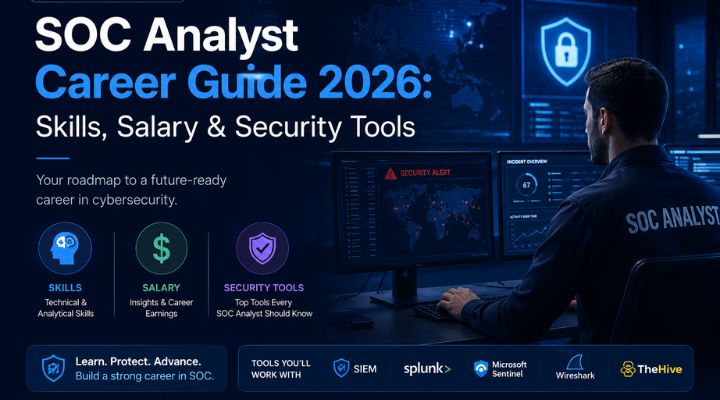
SOC Analyst Career Guide: Skills, Salary & Security Tools
- Posted by 3.0 University
- Categories Cyber Security
- Date May 15, 2026
- Comments 0 comment
If you’ve ever wondered who actually stops cyberattacks the moment they happen before they wreck a bank, a hospital, or a Fortune 500 firm you’re thinking about a cybersecurity SOC analyst.
Cyber threats are no longer limited to large enterprises or government agencies. Every business today from startups to global enterprises needs professionals who can monitor, detect, and respond to cyberattacks in real time. That is exactly where a cybersecurity SOC analyst becomes critical.
If you are planning a career in cybersecurity in 2026, becoming a SOC analyst is one of the smartest entry points into the industry. Companies are aggressively hiring skilled professionals who understand SIEM tools, threat detection, incident response, and security monitoring.
This complete guide explains everything you need to know about becoming a SOC analyst, including skills, salary, tools, certifications, career roadmap, and job opportunities in India.
Let’s get into it.
What is a SOC Analyst?
A cybersecurity SOC analyst is a security professional responsible for monitoring, detecting, investigating, and responding to cyber threats within an organization’s infrastructure.
SOC stands for Security Operations Center a centralized team that continuously monitors networks, endpoints, servers, applications, and security events to identify malicious activities before they cause damage.
In simple terms, a security operations center analyst acts as the first line of defense against cyberattacks.
What Is a Cybersecurity SOC Analyst, Really?
In practice, a cybersecurity SOC analyst spends their shift doing things like:
- Tuning SIEM rules so the team doesn’t drown in false-positive alerts
- Investigating a flagged PowerShell command running on a finance manager’s laptop
- Correlating logs across 12 systems to trace how an attacker got in
- Writing an incident report that the CISO will read on Monday morning
- Hunting for threats that didn’t trigger an alert — yet
It’s part detective work, part engineering, part communication. And it’s the entry point most people use to break into the broader cybersecurity industry.
Why SOC Analysts Are in Massive Demand in 2026
A few numbers worth sitting with:
- (ISC)²’s 2025 Cybersecurity Workforce Study estimated the global cybersecurity talent gap at over 4 million professionals.
- India’s cybersecurity market is projected to cross $13 billion by 2030, with NASSCOM forecasting demand for over 1 million skilled professionals by 2027.
- The average enterprise SOC now handles 10,000+ alerts per day, according to IBM’s Cost of a Data Breach Report.
Translation: organizations cannot hire SOC analysts fast enough. Banks, fintechs, healthcare networks, SaaS companies, GCCs in Bengaluru and Hyderabad, MSSPs (managed security service providers) all of them are scaling 24/7 security operations. They need people who can sit at a console and make smart decisions under pressure.
That demand is exactly why 3.0 University built its SOC Analyst Course Online in India to close that talent gap with industry-aligned, hands-on training.
SOC Analyst Job Description and Salary
Let’s get specific about what the role pays and what you’ll actually be expected to do.
SOC Analyst Job Description (Typical Posting)
A standard SOC analyst job description includes:
- Monitor security tools (SIEM, EDR, IDS/IPS, firewalls) around the clock
- Triage and validate alerts within defined SLAs (often 5–15 minutes)
- Perform initial incident response and containment
- Conduct log analysis and forensic investigation
- Document incidents and contribute to threat intelligence
- Collaborate with IT, network, and DevOps teams during active incidents
- Continuously tune detection rules to reduce noise
SOC Analyst Salary in India (2026)
Salaries vary by tier, location, and certifications, but here’s a realistic snapshot:
Experience Level | Role | Salary Range (INR/year) |
0–1 years | SOC Analyst L1 (Tier 1) | ₹4 – ₹7 LPA |
2–4 years | SOC Analyst L2 (Tier 2) | ₹8 – ₹14 LPA |
4–7 years | SOC Analyst L3 / Incident Responder | ₹15 – ₹25 LPA |
7+ years | SOC Lead / Threat Hunter / Manager | ₹25 – ₹45+ LPA |
Globally particularly in the US, UAE, Singapore, and parts of Europe — these figures roughly 2x to 4x once you add certifications like CSA, CEH, or GCIH and a couple of years of hands-on SOC experience.
The SOC Analyst Career Roadmap
A clean SOC analyst career roadmap generally looks like this:
Stage 1 — SOC Analyst Tier 1 (L1)
You’re the first set of eyes. You triage alerts, follow runbooks, escalate genuine incidents. Most people spend 12–24 months here.
Stage 2 — SOC Analyst Tier 2 (L2)
You dig deeper. You own investigations end-to-end, do real incident response, and start writing detection logic. This is where the role gets seriously interesting.
Stage 3 — SOC Analyst Tier 3 (L3) / Threat Hunter / Incident Responder
You hunt for threats that haven’t triggered alerts. You lead major incidents. You shape detection engineering.
Stage 4 — Specialization
From L3, careers fork into rewarding paths:
- Threat Intelligence Analyst
- Digital Forensics & Incident Response (DFIR)
- Detection Engineer
- Red Teamer / Penetration Tester
- SOC Manager → CISO track
The beauty of starting as a cybersecurity SOC analyst is that almost every other high-paying role in security branches off from it.
What Is the Role of a SOC Analyst in Cybersecurity?
If you’ve ever wondered exactly where SOC analysts sit in the bigger picture, here’s the cleanest way to think about it:
- Identify: They identify what’s running on the network and what’s normal.
- Detect : They build and tune detection logic to spot the abnormal.
- Respond: They contain and remediate threats when something fires.
- Report: They communicate findings to leadership, legal, and sometimes regulators.
In short, the role of a SOC analyst in cybersecurity is to be the operational layer that turns expensive security tools into actual protection. Without skilled analysts, a SIEM is just a very expensive log viewer.
Essential Skills Every SOC Analyst Needs
Technical skills matter, but the ones that separate average analysts from great ones are surprisingly often the soft ones.
Technical Skills
- Networking fundamentals: TCP/IP, DNS, HTTP, common ports, packet analysis
- Operating systems: Windows event logs, Linux logs, basic command line
- SIEM operation: Writing queries, building correlation rules, tuning alerts
- Endpoint detection: Understanding EDR telemetry and process trees
- Cloud security basics: AWS CloudTrail, Azure logs, GCP audit logs
- Threat intelligence: Understanding MITRE ATT&CK, IoCs, TTPs
- Scripting: Python or PowerShell for automation and log parsing
Soft Skills (Underrated, but Career-Defining)
- Calm under pressure: Hiring managers test for this in interviews
- Clear written communication: Your incident reports become legal artifacts
- Curiosity: The analysts who advance ask “why” three more times than peers
- Time management: You’ll juggle alerts, investigations, and documentation simultaneously
Top Tools Used by SOC Analysts
You’ll see the same handful of tools across most SOC environments. Mastering a few of these dramatically improves your employability.
SIEM Platforms
- Splunk
- IBM QRadar
- Microsoft Sentinel
- Elastic SIEM
- ArcSight
EDR / XDR Platforms
- CrowdStrike Falcon
- SentinelOne
- Microsoft Defender for Endpoint
- Carbon Black
Threat Intelligence
- MISP
- Recorded Future
- VirusTotal
- AlienVault OTX
SOAR (Security Orchestration)
- Splunk SOAR
- Palo Alto Cortex XSOAR
- Tines
Frameworks Every Analyst Should Know
- MITRE ATT&CK
- Cyber Kill Chain
- NIST Incident Response Lifecycle
The SOC Analyst Course Online in India at 3.0 University trains learners on real SIEM environments including Splunk and Microsoft Sentinel through live labs, so you graduate with hands-on experience and not just theory.
How to Become a Cybersecurity SOC Analyst in 2026?
This is the part most career switchers and freshers actually need: the practical, step-by-step plan.
Step 1: Learn Networking & Security Basics
Start with:
- Networking
- Operating systems
- Cybersecurity fundamentals
- Security concepts
Without fundamentals, advanced SOC training becomes ineffective.
Step 2: Gain Hands-On Practice
You need practical exposure to:
- SIEM tools
- Threat detection labs
- Log analysis
- Incident simulations
This is where structured training becomes important.
Step 3: Earn Industry Certifications
Relevant certifications include:
- EC-Council CSA
- CompTIA Security+
- Google Cybersecurity Certificate
- Splunk Certifications
Step 4: Build a Cybersecurity Portfolio
Most freshers ignore this. That is a mistake.
Create:
- Threat investigation reports
- Home labs
- SIEM projects
- Detection rule examples
A portfolio often matters more than generic resumes.
Step 5: Apply for Entry-Level SOC Roles
Target roles such as:
- SOC Analyst L1
- Security Monitoring Analyst
- Cybersecurity Analyst
- Threat Monitoring Analyst
Complete Guide to Becoming a SOC Analyst: Common Mistakes to Avoid
-
Chasing Too Many Certifications
Certifications without hands-on skills do not make you employable.
-
Ignoring Networking Fundamentals
Weak networking knowledge destroys your investigation abilities.
-
Learning Only Theory
SOC roles are practical. Employers test real-world troubleshooting skills.
-
Avoiding Labs & Simulations
Hands-on experience is what separates job-ready candidates from beginners.
What Qualifications Are Needed for a SOC Analyst?
Most employers look for a combination of:
- A bachelor’s degree in Computer Science, IT, or a related field (not always mandatory — skills increasingly outweigh degrees)
- At least one industry certification (CSA, Security+, CEH, or CySA+)
- Hands-on familiarity with at least one SIEM
- Understanding of MITRE ATT&CK and incident response lifecycle
- Demonstrable home lab or CTF experience for freshers
Career switchers from IT support, networking, or system administration have a noticeable advantage that operational foundation translates directly into SOC work.
Is SOC Analyst a Good Career in 2026?
Straight answer: yes, and probably for the next decade.
Three reasons:
- The problem keeps getting worse, not better. AI-driven phishing, deepfake social engineering, and ransomware-as-a-service have all expanded the attack surface dramatically in 2025–2026.
- The role is recession resistant. Even during tech hiring slowdowns, security headcount has continued to grow according to multiple industry reports.
- It opens every other door in cybersecurity. Threat hunting, red teaming, DFIR, security engineering, CISO track all of them sit downstream of SOC experience.
The flip side worth being honest about: shift work is real (many SOCs run 24/7), alert fatigue is a known issue, and the first 12 months can be intense.
But the people who push through almost universally describe it as the best career decision they made.
Challenges You Should Expect (and How to Handle Them)
No career guide is complete without the honest bits:
- Alert fatigue: Solved through better tuning and SOAR automation
- Shift rotations: Most SOCs use 8–12-hour shifts; some offer compressed weeks
- Imposter syndrome: Universal in the first year, fades with reps
- Rapidly evolving threats: You’ll need to learn continuously (this is actually a feature, not a bug, if you love the field)
Why Train at 3.0 University
For learners in India looking for a structured, employer-aligned path, the SOC Analyst Course Online in India at 3.0 University offers:
- EC-Council Certified SOC Analyst (CSA) curriculum alignment
- Hands-on labs on real SIEM platforms (Splunk, Microsoft Sentinel)
- Live training with industry practitioners (not just instructors)
- Threat detection, log analysis, and incident response modules
- Placement assistance and interview preparation
- Flexible online format suited to working professionals
You can explore the full program here: 3.0 University SOC Analyst Certification Course
Cybersecurity SOC Analyst Career Roadmap
Here is a realistic long-term growth path.
|
Experience |
Role |
|
0–2 Years |
SOC Analyst L1 |
|
2–4 Years |
SOC Analyst L2 |
|
4–6 Years |
Incident Responder |
|
5–8 Years |
Threat Hunter |
|
8+ Years |
SOC Manager / Security Architect |
Frequently Asked Questions
-
What is a cybersecurity SOC analyst?
A cybersecurity SOC analyst is a professional responsible for monitoring, detecting, analyzing, and responding to cyber threats inside a Security Operations Center (SOC).
-
How do you become a SOC analyst?
You become a SOC analyst by learning networking, cybersecurity fundamentals, SIEM tools, incident response, and gaining hands-on practical experience through labs and training programs.
-
Is SOC analyst a good career in 2026?
Yes. SOC analyst is one of the fastest-growing cybersecurity careers due to increasing cyber threats, regulatory pressure, and enterprise demand for security monitoring professionals.
-
What qualifications are needed for a SOC analyst?
Basic IT knowledge, networking fundamentals, cybersecurity training, SIEM understanding, and relevant certifications such as EC-Council CSA or Security+ are highly valuable.
-
What is the role of a SOC analyst in cybersecurity?
A SOC analyst monitors systems, investigates security alerts, detects cyber threats, and supports incident response activities to protect organizational infrastructure.
Final Thoughts
The cybersecurity SOC analyst role is one of the rare careers in 2026 where demand, salary, learning curve, and long-term optionality all line up in your favor. You don’t need to be a prodigy. You need curiosity, persistence, the right tools, and a structured path.
If you’re ready to make the move whether you’re a fresher, a working IT professional, or switching careers entirely the SOC Analyst Course Online in India at 3.0 University is built precisely for this transition.
EC-Council aligned, taught by working practitioners, packed with SIEM and incident response labs, and backed by placement support.
Your future in cybersecurity starts with one well-aimed alert. Make sure you’re the analyst trained to handle it.

You may also like

Cyber Security Course Eligibility