Top SOC Analyst Tools Explained: SIEM, EDR & SOAR Platforms
- Posted by 3.0 University
- Categories SOC Analyst
- Date May 20, 2026
- Comments 0 comment
Every 39 seconds, a cyberattack hits a system somewhere in the world. Modern Security Operations Centers process millions of events every single day and a single missed alert can cost a company millions of dollars and irreparable brand damage.
Here’s the harsh reality: no human analyst can sift through 10,000+ daily logs without serious help. Yet many aspiring cybersecurity professionals walk into SOC interviews unable to name the tools that actually power a real Security Operations Center. Hiring managers spot this gap within minutes.
The fix?
Master the right SOC analyst tools specifically SIEM, EDR, and SOAR platforms. This guide breaks down the must-know SOC analyst tools 2026 employers expect on your resume, with real-world examples and a clear learning path.
What Are SOC Analyst Tools?
SOC analyst tools are the software platforms a security team relies on to detect, investigate, and respond to cyber threats. Think of them as the eyes, hands, and reflexes of a Security Operations Center.
A typical SOC analyst tool stack overview includes:
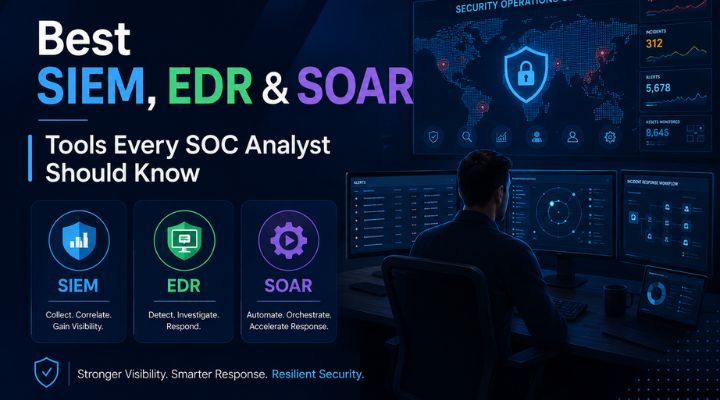
- Detection tools (SIEM): Collect, parse, and correlate logs from across the network
- Endpoint tools (EDR): Monitor laptops, servers, and individual devices in real time
- Response tools (SOAR): Automate repetitive actions and orchestrate workflows
- Threat intelligence platforms: Add context to alerts using global threat data
- Ticketing and case management: Track every investigation from start to closure
Without these tools, analysts would drown in noise. With them, they can spot a ransomware beacon hidden inside seemingly legitimate traffic.
SIEM Tools for SOC Analyst: The Brain of the SOC
SIEM, short for Security Information and Event Management, is the first tool every SOC analyst should master.
It aggregates logs from firewalls, servers, endpoints, identity providers, and cloud services then correlates them to spot suspicious patterns no single source could reveal alone.
Why SIEM Matters More Than Ever in 2026
According to Gartner, more than 80% of mid-to-large enterprises now run a SIEM platform. Knowing how to navigate one is no longer optional it’s the baseline expectation for entry-level SOC roles.
Best SIEM Platform for SOC Analyst (Top 5 in 2026)
- Splunk Enterprise Security — The industry leader, deployed in most Fortune 500 SOCs
- IBM QRadar — Strong correlation engine, especially popular in banking and finance
- Microsoft Sentinel — Cloud-native, growing fast alongside Azure adoption
- Elastic Security (ELK Stack) — Open-source favorite, budget-friendly and flexible
- LogRhythm — Reliable mid-market choice with solid UEBA capabilities
Splunk for SOC Analyst: Still the King?
Yes, and it isn’t even close. Despite the rise of cloud-native competitors, Splunk remains the most asked-about SIEM in SOC interviews worldwide.
Learning SPL (Search Processing Language) gives candidates a measurable hiring advantage. Even job postings at companies using Sentinel or QRadar often list “Splunk experience” as a strong plus.
EDR Tools: Your Eyes on Every Endpoint
While SIEM watches the network, EDR tools (Endpoint Detection and Response) watch individual devices every laptop, every server, every privileged login attempt.
Modern EDR solutions go far beyond traditional antivirus. They record process behavior, track parent-child relationships, and let analysts run live forensics on a compromised host without ever touching the keyboard physically.
Leading EDR Tools in 2026
- CrowdStrike Falcon — Cloud-delivered, lightweight agent, the current gold standard
- SentinelOne Singularity — Strong autonomous response, AI-driven detections
- Microsoft Defender for Endpoint — Tight Windows integration, included in M365 E5
- VMware Carbon Black — Popular in regulated industries with strict compliance needs
- Cybereason — Excellent threat-hunting interface and attack-story visualization
Real-world example: During the 2023 MOVEit breach, organizations with mature EDR deployments contained the intrusion within hours.
Those without it averaged 21 days of attacker dwell time and significantly higher recovery costs.
SOAR Platforms: Automating the Repetitive Work
SOAR (Security Orchestration, Automation, and Response) platforms tie the entire SOC together. They take the routine alerts analysts handle a hundred times a day and automate them through pre-built playbooks.
Top SOAR Platforms Worth Knowing
- Palo Alto Cortex XSOAR — Market leader with the largest integration library
- Splunk SOAR (formerly Phantom) — Tight, native integration with Splunk SIEM
- IBM Resilient — Powerful incident response workflows and reporting
- Tines — No-code SOAR, rising fast among modern, lean SOCs
A practical use case: instead of manually checking every phishing email reported by employees, a SOAR playbook can extract the URL, detonate it inside a sandbox, query multiple threat intel feeds, update the SIEM, and auto-reply to the user all in under 90 seconds. That’s hours saved every single day.
SIEM vs EDR vs SOAR: Quick Comparison
|
Category |
Primary Job |
What It Watches |
Example Tool |
|
SIEM |
Log correlation & alerting |
Network-wide events |
Splunk, Sentinel |
|
EDR |
Endpoint behavior monitoring |
Individual devices |
CrowdStrike, SentinelOne |
|
SOAR |
Automating response |
The full SOC workflow |
Cortex XSOAR, Tines |
Think of it this way: SIEM tells you something is wrong. EDR shows you exactly where it’s happening. SOAR helps you fix it faster than any human could alone.
Top Tools Used by SOC Analysts (Beyond the Big Three)
Beyond SIEM, EDR, and SOAR, modern analysts work daily with a wider toolkit:
- Wireshark: Packet-level network analysis, always relevant
- VirusTotal: Quick file, URL, and IP reputation checks
- MITRE ATT&CK Navigator: Mapping adversary tactics and techniques
- TheHive: Open-source incident response and case management
- MISP: Collaborative threat intelligence sharing
- Sysmon: Deep Windows endpoint logging for forensic visibility
- OSQuery: SQL-style real-time queries across endpoints
How Beginners Should Learn SOC Analyst Tools?
Many aspiring analysts waste time trying to master every tool at once.
Instead, focus on learning the fundamentals behind each category first.
Recommended Learning Path
Step 1: Learn SIEM Basics
Start with:
- Log analysis
- Event correlation
- Alert investigation
- Splunk SPL queries
Step 2: Understand Endpoint Security
Learn:
- Process monitoring
- Malware behavior
- Endpoint telemetry
- Threat investigation workflows
Step 3: Practice Incident Response
Understand:
- Alert triage
- IOC analysis
- Threat containment
- Root cause analysis
Step 4: Learn Automation Concepts
Study:
- SOAR workflows
- Playbooks
- API integrations
- Security orchestration
Reading about SIEM is one thing. Writing a correlation rule that catches lateral movement inside an Active Directory environment is another entirely.
This is exactly why hands-on training matters far more than certifications alone. Employers want analysts who can investigate, not just recite.
The online SOC analyst course in Pune at 3.0 University is built around real SOC scenarios. Students work inside live SIEM consoles, hunt threats across EDR dashboards, and build SOAR playbooks from scratch the same workflows used in Tier-1 enterprise SOCs.
If you’re looking for a SOC Analyst course online in Mumbai, India that mirrors what real SOCs actually run, this is one of the most practical and career-focused options available today. Graduates leave with a SOC analyst course online with certificate, plus a portfolio of real investigations recruiters can verify.
Frequently Asked Questions (FAQs)
1. What tools do SOC analysts use?
SOC analysts use SIEM platforms (Splunk, Microsoft Sentinel, IBM QRadar), EDR tools (CrowdStrike, SentinelOne, Defender for Endpoint), SOAR platforms (Cortex XSOAR, Splunk SOAR), threat intelligence feeds, packet analyzers like Wireshark, and ticketing systems such as Jira or ServiceNow.
2. What is SIEM in a SOC?
SIEM stands for Security Information and Event Management. It’s the central nervous system of a SOC collecting logs from every part of the organization, correlating them in real time, and alerting analysts when something looks suspicious. Every modern SOC runs on a SIEM.
3. Which SIEM is best for SOC analysts?
Splunk remains the most widely adopted SIEM and the most frequently requested skill in SOC job postings worldwide. Microsoft Sentinel is the fastest-growing alternative, especially in cloud-first organizations. For learning, both make excellent starting points.
4. What is the difference between SIEM and SOAR?
SIEM detects threats by analyzing logs and generating alerts. SOAR responds to those threats by automating investigation and response workflows. Put simply: SIEM tells you what happened, SOAR helps you fix it without manual effort. Together, they cut response times from hours to minutes.
5. Is Splunk used by SOC analysts?
Yes, extensively. Splunk is the de facto SIEM in many enterprise SOCs and a frequent interview topic. Knowing SPL (Search Processing Language) gives candidates a measurable, real-world advantage during technical screenings.
Final Thoughts: Build the Stack, Build the Career
The SOC of 2026 isn’t built on a single tool it’s built on a stack. SIEM gives you visibility. EDR gives you depth. SOAR gives you speed.
Master the trio, and you transform from someone who “knows about cybersecurity” into someone organizations actively want to hire.
Ready to build hands-on SOC skills?
Explore 3.0 University online SOC analyst course a job-focused, certificate program designed for both beginners and working professionals. Learn the exact tools real SOCs use, work through real investigations, and step into the cybersecurity industry with genuine confidence.

You may also like
How to Build a SOC Analyst Resume & Job Application?