SOC Analyst Tier Levels Explained: Tier 1, Tier 2 & Tier 3
- Posted by 3.0 University
- Categories SOC Analyst
- Date May 21, 2026
- Comments 0 comment
If you have ever wondered how Security Operations Centers (SOCs) actually detect, contain, and shut down cyberattacks the answer lies in a layered defense model built around SOC analyst tiers.
Every alert that pings inside a modern SOC moves through a clearly defined chain of analysts: Tier 1, Tier 2, and Tier 3.
This tiered structure is what allows a SOC team to handle thousands of daily alerts without missing the one signal that matters. For anyone planning a cybersecurity career in India, understanding the SOC analyst levels is the first real step toward landing a high-paying role in this field.
In this guide, we break down what each tier does, the skills you need, salary expectations, and the SOC analyst level progression path that can take you from entry-level monitoring to senior threat-hunting roles.
What Is a SOC Analyst?
A SOC (Security Operations Center) Analyst is a cybersecurity professional responsible for monitoring, detecting, investigating, and responding to security threats targeting an organization’s digital infrastructure. They work inside a centralized command room physical or virtual that watches network traffic, endpoints, cloud workloads, and user activity around the clock.
Think of a SOC as the “air traffic control” of cybersecurity. Just like air traffic controllers cannot all do the same job at the same skill level, SOC analysts are organized into tiers. Each tier has a specific scope, a specific level of authority, and a specific set of tools.
This is exactly why understanding SOC analyst tiers matters both for hiring managers building a SOC team and for professionals planning their growth roadmap.
Why Are SOC Analyst Tiers Structured This Way?
Cyberattacks today are not isolated events. A single ransomware incident can begin with a phishing email, escalate through credential theft, move laterally across cloud systems, and end with data exfiltration all within hours.
No single analyst can handle every step of that chain. So SOC operations are split into tiers based on three key factors:
- Alert volume vs. complexity – Tier 1 absorbs the high-volume, lower-complexity work. Tier 3 handles the rare, high-impact incidents.
- Time-to-respond – Each tier has a different response speed, from real-time triage to deep-dive forensic analysis that can take days.
- Skill depth – The deeper the threat, the more specialized the analyst. Tier 3 analysts often bring reverse-engineering and threat-intelligence skills.
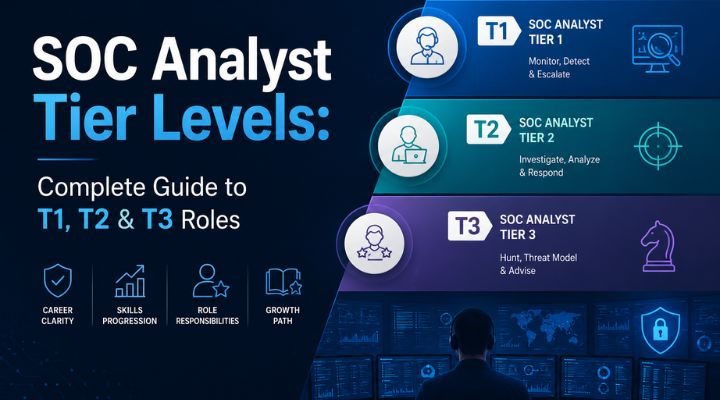
The result is a pyramid: many Tier 1 analysts at the base, fewer Tier 2 analysts in the middle, and a small number of highly specialized Tier 3 experts at the top.
This is the core structure that every modern SOC including those hiring graduates from the SOC Analyst Course Online in India offered by 3.0 University is built around.
Tier 1 SOC Analyst: The First Line of Defense
A Tier 1 SOC analyst is the entry point of the SOC. They are the first humans to look at almost every alert generated by SIEM tools, firewalls, EDR platforms, and intrusion detection systems. Their job is fast, repetitive, and absolutely critical because if a real attack is missed at Tier 1, it may never be caught downstream.
SOC Analyst Tier 1 Responsibilities
The day-to-day responsibilities of a Tier 1 SOC analyst typically include:
- Continuously monitor SIEM dashboards (Splunk, IBM QRadar, Microsoft Sentinel, ArcSight) for suspicious activity.
- Perform initial triage of security alerts determining whether each one is a true positive, false positive, or benign.
- Document, log, and create tickets for each verified incident using ITSM tools like ServiceNow or Jira.
- Run basic investigations using playbooks and standard operating procedures (SOPs).
- Escalate confirmed incidents to Tier 2 with proper context, indicators of compromise (IOCs), and event timelines.
- Maintain shift logs, handover notes, and contribute to alert-tuning recommendations.
Skills and Tools Required
To land a Tier 1 SOC analyst role, you typically need:
- A working knowledge of TCP/IP, DNS, HTTP, and common network protocols.
- Familiarity with at least one SIEM platform Splunk is the most widely used in Indian SOCs.
- Understanding of the MITRE ATT&CK framework, the cyber kill chain, and common attack patterns.
- Basic scripting awareness (PowerShell, Python, or Bash is a plus).
- Soft skills: calm under pressure, sharp attention to detail, and clear written communication.
Is a Tier 1 SOC Analyst an Entry-Level Role?
Yes, Tier 1 is universally treated as an entry-level role. Most professionals enter the cybersecurity industry through Tier 1 after completing a recognized program like the EC-Council Certified SOC Analyst (CSA) certification. It is the most common stepping stone, and it’s the role employers expect freshers and career switchers to take on first.
Tier 2 SOC Analyst: The Incident Responder
Once Tier 1 escalates a confirmed incident, the Tier 2 SOC analyst takes over. This is where the work shifts from monitoring to active investigation.
Tier 2 analysts dig into the “what, how, and how bad” of an incident and they have the authority to contain it.
Tier 2 SOC Analyst Responsibilities
- Conduct deep-dive investigations into incidents escalated from Tier 1.
- Correlate logs across multiple data sources endpoints, network, cloud, identity systems to reconstruct attacker activity.
- Use EDR/XDR platforms (CrowdStrike, SentinelOne, Microsoft Defender) to scope the blast radius of an attack.
- Lead incident response activities: containment, eradication, and recovery, often in coordination with IT and DevOps teams.
- Tune SIEM detection rules and write new correlation rules based on observed attack patterns.
- Apply threat intelligence to enrich incidents checking IOCs against threat feeds and TTPs against MITRE ATT&CK.
- Mentor Tier 1 analysts and refine playbooks to reduce future escalations.
What Skills Are Needed for a Tier 2 SOC Analyst?
Tier 2 is where technical breadth turns into technical depth. Hiring managers typically look for:
- 2–5 years of hands-on SOC experience, usually starting as a Tier 1 analyst.
- Strong command of incident response frameworks- NIST 800-61, SANS PICERL, and ISO 27035.
- Practical malware analysis fundamentals- static analysis, sandboxing, and IOC extraction.
- Experience with SOAR platforms to automate repetitive parts of incident response.
- Solid scripting ability Python or PowerShell to parse logs and accelerate investigations.
- Certifications that signal capability: EC-Council CSA, CompTIA CySA+, Blue Team Level 1 (BTL1), or GIAC GCIH.
Difference Between Tier 1 and Tier 2 SOC Analyst
This is one of the most common questions from learners exploring a SOC career and the cleanest way to understand the difference between Tier 1 and Tier 2 SOC analyst is by mapping their role on the alert lifecycle.
Tier 1 = Detection + Triage. They answer the question: “Is this alert real?” Their job ends when they confirm an incident and escalate it with context.
Tier 2 = Investigation + Response. They answer the question: “How did this happen, how bad is it, and how do we stop it now?” Their job continues through containment, remediation, and lessons learned.
In plain terms, Tier 1 prevents alerts from being ignored Tier 2 prevents incidents from becoming breaches. Both are essential, but the scope, authority, and depth of investigation are very different.
Tier 3 SOC Analyst: The Threat Hunter and Expert
Tier 3 is the apex of the SOC. While Tier 1 and Tier 2 are reactive responding to alerts and incidents Tier 3 SOC analysts are proactive. They go looking for threats that have not yet generated alerts.
Tier 3 SOC Analyst Job Role and Responsibilities
The Tier 3 SOC analyst job role typically covers:
- Threat hunting across the environment using hypothesis-driven analysis (e.g., “If an attacker used X technique, what would it look like in our logs?”).
- Conducting advanced digital forensics on compromised endpoints, servers, and cloud workloads.
- Performing malware reverse engineering to understand previously unseen samples.
- Developing custom detection logic, YARA rules, Sigma rules, and SOAR playbooks.
- Researching adversary tradecraft, APT groups, and emerging vulnerabilities relevant to the organization.
- Leading incident response during major breaches and acting as the technical authority for the CISO.
- Continuously improving the SOC’s overall detection and response maturity.
Tier 3 Skill Profile
Tier 3 analysts blend the mindset of an attacker with the discipline of a defender. Typical skills include:
- Deep expertise in OS internals (Windows, Linux), memory forensics, and disk forensics.
- Strong programming and scripting Python, PowerShell, Go, or Rust.
- Reverse engineering tools like IDA Pro, Ghidra, and x64dbg.
- Advanced certifications: GIAC GCFA, GCIH, GREM, OSCP, or CISSP for strategic leadership.
- Business acumen communicating risk to executives without burying them in jargon.
SOC Analyst Tiers at a Glance: Tier 1 vs Tier 2 vs Tier 3
Here is a side-by-side comparison of the three SOC analyst levels to help you map where you currently stand and where you want to go:
Parameter | Tier 1 SOC Analyst | Tier 2 SOC Analyst | Tier 3 SOC Analyst |
Role Title | Triage / Alert Analyst | Incident Responder | Threat Hunter / Expert Analyst |
Experience | 0–2 years (Entry-level) | 2–5 years (Mid-level) | 5+ years (Senior-level) |
Core Function | Monitor SIEM, triage alerts, escalate | Investigate incidents, contain threats | Hunt advanced threats, forensics, reverse engineering |
Tools Used | SIEM (Splunk, QRadar), ticketing tools | EDR, SOAR, threat intel platforms | Malware sandboxes, custom scripts, MITRE ATT&CK |
Decision Authority | Limited – escalates most cases | Owns containment & remediation | Strategic defines defense posture |
Avg. Salary (India) | ₹4–6 LPA | ₹8–14 LPA | ₹18–30+ LPA |
Reports To | Tier 2 / SOC Lead | SOC Manager | CISO / Head of Security |
Note: Salary ranges are typical Indian market estimates for 2025–2026 and vary by location (Mumbai, Bengaluru, Hyderabad pay higher), industry (BFSI and consulting pay premium), and certifications.
SOC Analyst Level Progression Path: How to Move Up
The SOC analyst level progression path is one of the most well-defined career ladders in cybersecurity. Unlike many tech roles where promotions feel fuzzy, SOC progression is built around clear, measurable competencies.
Step 1: Build Your Foundation (Months 0–6)
Start with the fundamentals networking, operating systems, and basic security concepts. Pick up a recognized certification like EC-Council CSA or CompTIA Security+ to validate your skills. This is the phase where structured training matters most, and where a focused SOC Analyst Course Online in India from 3.0 University can compress months of self-study into a structured, mentor-led journey.
Step 2: Land Your First Tier 1 Role (Months 6–18)
Apply for SOC Analyst Tier 1 or Junior SOC Analyst openings. Most large IT services firms, banks, and MSSPs in India hire freshers at this level. Expect a starting salary of ₹4–6 LPA. Use this time to master your SIEM, learn shift discipline, and build a documented track record of escalations.
Step 3: How Long Does It Take to Go from Tier 1 to Tier 2 SOC Analyst?
On average, it takes 2 to 3 years to move from Tier 1 to Tier 2 SOC analyst. The transition usually happens when you’ve consistently demonstrated:
- The ability to investigate incidents end-to-end without senior help.
- Strong familiarity with EDR tools and at least one scripting language.
- Authoring or improving at least a few detection rules and playbooks.
- A relevant certification like CSA, CySA+, BTL1, or GCIH.
Some high-performers move up in as little as 12–18 months, especially in fast-scaling MSSPs. Others may take longer if their current SOC has limited incident exposure.
Step 4: From Tier 2 to Tier 3 (Years 4–7+)
Moving from Tier 2 to Tier 3 is less about time and more about specialization. You typically need to develop expertise in one of: threat hunting, digital forensics, malware analysis, or detection engineering. Senior certifications like GCFA, GCIH, GREM, or OSCP combined with a portfolio of complex incident leadership open the door to Tier 3 roles.
Tools and Technologies Used Across SOC Tiers
Regardless of which tier your target, fluency with the right tools is non-negotiable. The toolkit grows in complexity as you move up the tiers:
SIEM Platforms (All Tiers)
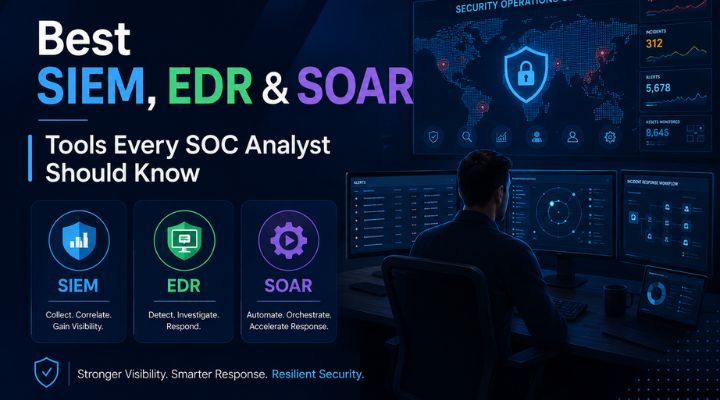
Splunk, IBM QRadar, Microsoft Sentinel, ArcSight, and LogRhythm. SIEM is the heart of any SOC Tier 1 lives in it, Tier 2 builds detections inside it, Tier 3 designs the overall architecture around it.
EDR / XDR (Tier 2 and Tier 3)
CrowdStrike Falcon, SentinelOne, Microsoft Defender for Endpoint, and Palo Alto Cortex XDR. These tools provide endpoint-level visibility that pure SIEMs cannot match.
SOAR (Tier 2 and Tier 3)
Cortex XSOAR, Splunk SOAR, and Tines. SOAR automates repetitive response actions and ties SIEM, EDR, and threat intel together.
Threat Intelligence (Tier 2 and Tier 3)
MISP, Recorded Future, Mandiant Advantage, and AlienVault OTX. Threat intel enriches incidents and helps Tier 3 analysts anticipate adversary moves.
Forensics and Reverse Engineering (Tier 3)
Volatility, Autopsy, FTK, IDA Pro, Ghidra, and Wireshark. These are the deep-dive tools that separate Tier 3 analysts from the rest of the SOC.
How to Become a SOC Analyst in India (2026)
If you are starting from scratch, here is a realistic 6–9-month roadmap to break into a Tier 1 SOC role:
- Master networking and operating system fundamentals TCP/IP, DNS, Active Directory, Linux command line.
- Learn one SIEM tool deeply Splunk Fundamentals is a great place to start.
- Study the MITRE ATT&CK framework and practice mapping real-world attacks to it.
- Earn a recognized certification the EC-Council Certified SOC Analyst (CSA) is the most relevant credential for Indian employers.
- Build hands-on labs TryHackMe’s SOC Level 1 path, LetsDefend, and Blue Team Labs Online are excellent for portfolio building.
- Apply to MSSPs, IT services giants, BFSI SOCs, and product-based companies hiring Tier 1 analysts.
If you want a structured, mentor-led path instead of figuring it out alone, consider enrolling in the EC-Council Certified SOC Analyst Course Online in Mumbai at 3.0 University.
The program covers SIEM (Splunk), threat detection, incident response, MITRE ATT&CK, and includes placement support designed specifically to take learners from zero to Tier 1 ready and beyond.
Frequently Asked Questions (FAQs)
1. What is the difference between a Tier 1 and Tier 2 SOC analyst?
A Tier 1 SOC analyst focuses on monitoring SIEM dashboards, performing initial alert triage, and escalating confirmed incidents. A Tier 2 SOC analyst takes the escalated incident and performs deep investigation, containment, and remediation.
In short: Tier 1 detects, Tier 2 responds.
2. What does a Tier 3 SOC analyst do?
A Tier 3 SOC analyst proactively hunts for advanced threats, conducts digital forensics, performs malware reverse engineering, and builds custom detections. They lead the response during major breaches and act as the SOC’s technical authority typically reporting to the CISO or Head of Security.
3. How long does it take to go from Tier 1 to Tier 2 SOC analyst?
Most analysts move from Tier 1 to Tier 2 in 2–3 years, although high performers in fast-scaling SOCs can transition in as little as 12–18 months. The key requirements are demonstrated investigation skills, at least one EDR tool mastery, basic scripting ability, and a Tier 2-relevant certification.
4. Is a Tier 1 SOC analyst an entry-level role?
Yes. Tier 1 SOC analyst is widely recognized as an entry-level cybersecurity role and is the most common starting point for freshers, career switchers, and recent graduates entering the security industry. Typical starting salaries in India range from ₹4 to ₹6 LPA.
5. What skills are needed for a Tier 2 SOC analyst?
A Tier 2 SOC analyst needs strong incident response fundamentals (NIST 800-61, SANS PICERL), hands-on experience with SIEM and EDR platforms, basic malware analysis, scripting in Python or PowerShell, and familiarity with SOAR tools. Certifications like EC-Council CSA, CompTIA CySA+, BTL1, or GIAC GCIH are highly valued.
Final Thoughts: Choose a Tier, Then Build the Roadmap
The SOC analyst tiers are not just job titles they are a complete career roadmap inside cybersecurity. Tier 1 gets you in the door. Tier 2 turns you into a real defender. Tier 3 makes you an expert that organizations fight to retain.
Wherever you are on this journey, the most important step is the first one: getting structured, industry-aligned training that lines up with what SOCs in India actually hire for.
The Certified SOC Analyst Course Online in India at 3.0 University is built around exactly this blueprint EC-Council certification, live SIEM labs, real incident response scenarios, expert trainers, and placement support to help you launch your SOC career with confidence.
Ready to start your SOC analyst career?
Join the EC-Council Certified SOC Analyst Course Online in Mumbai at 3.0 University and take the first step from learner to Tier 1 SOC analyst and beyond.

You may also like
How to Build a SOC Analyst Resume & Job Application?