
Why are Developers Switching to Blockchain Technology in 2026?
- Posted by 3.0 University
- Categories Blockchain, Web3
- Date February 26, 2026
- Comments 0 comment
The Developer’s Guide to Web3 vs Web2: Key Differences and Benefit
In 2026 the big shift is seen in the tech field. The transition of the internet from the single page till the digital tokens built on Blockchain is huge if you observe.
The evolution of the internet took its time but the pace increased when it came to Web3.
Talking about what is better between Web3 vs Web2?
What is preferred by the tech world and if at all why are developers switching to Blockchain? One needs some deeper understanding.
The answer to why move from Web2 to Web3 now depends more on data management.
Web2 is more on the central authority based whereas the core of Web3 is decentralisation, giving power to each individual user.
And as far as developers are considered, building on Blockchain gives the freedom of building on your own land whereas Web2 is more of a rented property. And who doesn’t like freedom.
Going ahead in this article we will look at the differences, the technical side of this and also the reason behind developers switching to Web3 and Blockchain.
What is the main difference between Web2 and Web3 for developers?
The most important difference in both is the architecture of the database and who has the control over the data.
Since we all know Web2 is more centralized, building apps is also done on centralised servers like Amazon/ AWS or Google Cloud.
With respect to Web3, each individual user has certain ownership. Smart contracts are written by developers on blockchain networks and deployed. The blockchain is selected as per the use cases, some use Ethereum while others prefer Solana.
The core thought and logic behind that is taking away the authority from a single entity, keeping data transparent and distributing ownership among different nodes.
Why are Developers Switching to Blockchain Technology?
The answer to the most persistent question- why developers are switching to blockchain technology cannot be given that easily.
But one of the most important reasons is Web2 platform’s limitations.
It is the case even for seasoned developers, not just those who have exposure to the Web3 world.
It’s of concern when an engineer/ developer wishes to build an equitable and transparent application.
Solving the Platform Risk Problem
With regards to the development aspect, in Web2, the developers are more dependent on the owners of central platforms. Twitter (now X), Reddit, or Facebook can change their APIs, shut down access, or change algorithms overnight, and businesses built on top of them can be ruined.
Web3 provides “permissionless innovation.” A smart contract that gets created once and is deployed on blockchain is then available for everyone to use or build on their own on top of it.
This doesn’t need taking any permission. The rules are encoded in the code, not up to corporate discretion.
Composability: The “Money Legos” Effect
Web3 brings a level of composability that has never been seen before.
With Web3, because smart contracts on the same blockchain are open-source and interoperable, developers can stack existing protocols into their own applications like Legos.
A developer does not have to create a new lending system because they can use Aave or Compound.
They do not have to create a new exchange because they can use Uniswap’s liquidity. This is much faster than the API integrations of Web2.
What are the key technical benefits of Web3 for developers?
In addition to the ideology, there are important, hard-nosed technical advantages of Web3 for developers that make the transition appealing.
The technology addresses problems that have been frustrating distributed systems engineers for decades. Built-in Identity and Authentication.
The authentication process on Web2 is messy due to usernames and passwords, and high dependency on third party authentication providers such as Google.
This authentication is replaced with digital wallets based on blockchain and smart contracts in Web3. The user’s public address is their identity. Users are verified based on their private key sign-in.
From the developer perspective this means that there’s no requirement of storing password hashes which are sensitive information. That also reduces security overheads substantially.
Payments and Monetization
Payment systems in Web2 involve working with gateways such as Stripe or PayPal, banking laws, and geographical restrictions.
In Web3, value transfer is a native feature of the network. The benefits of decentralized apps include the capacity of executing extremely small payments, rapid transfers globally, or carrying out complicated revenue sharing schemes via the smart contracts removing any other intermediating factors.
Smooth Functioning
Since it is built on the central server, Web2 apps go down when the central server is down.
Web3’s distributed ownership tackles this problem in an unique way. Until all the nodes spread across the world are running on the blockchain network, the applications never go down.
What are current blockchain developer trends and career opportunities?
The talent pool for crypto engineers remains in high demand and is still outstripped by supply.
As the web3 space evolves from speculative trading, infrastructure and utility are becoming ever more important.
New Trends for Blockchain Developers
- Layer 2 Scaling: Developers are shifting away from building on Ethereum Mainnet because of the expense and are instead opting for Layer 2 scaling solutions such as Optimism, Arbitrum, and Base, or side-chains such as Polygon.
- Zero-Knowledge (ZK) Technology: There is huge demand for developers who have a grasp of ZK proofs for privacy preservation and scaling solutions (ZK-Rollups).
- Account Abstraction (ERC-4337): This trend is all about enhancing the user experience by enabling crypto wallets to behave like Web2 accounts, thereby eliminating the scary seed phrase experience.
Demand for Specialised Education
However the transition from Web2 to Web3 developer needs specific knowledge and skills. One can’t just replicate the same practices.
To bridge this gap, structured education is becoming essential. Institutions like 3.0 University are stepping in to provide targeted training.
For developers looking to make the jump, exploring resources like their Blockchain Development Program or even their AI Program can provide the foundational knowledge necessary for this new era.
You can check out their offerings at: View Courses
Clearing Out Some Key Factors
Differentiating Factors | Web2 | Web3 |
Data Privacy | Stored on a central private server. Each user gets subscription with authentication of username and passwords | Data is stored on public Blockchain. It is accessible to any and everyone but user identity is linked to a wallet (pseudonymous) |
Development | Uses a central private server, a traditional coding system that is in practice. | Works on blockchain technology, uses smart contracts. |
Acceptance & Chances of Replacement | Widely accepted as the primary technology. It is very difficult to replace it. | The acceptance is slowly increasing in multiple sectors from finance to healthcare. It can coexist in a hybrid kind of with Web2 |
Shortcomings |
|
|
Summing It Up
The transition from Web2 to Web3 is not just a technology upgrade. In true sense it’s a major shift in the way we look at digital ownership and rights of each of the individual members of the entire ecosystem.
In the current scenario, Web2 is providing a better user experience, quick processing but at the cost of giving major power to a few large tech companies.
Web3 is trying to break that system and distribute the ownership to each and every user. But that again is a difficult thing to penetrate till the last level of operation, existing systems and mode of operations.
Reaching to a mid-way where best of both the modules is accepted is going to be the future. For the engineers/developers who want to remain a part of this system, they need to buckle up and learn the skills.
The preference switch is going to be gradual but it’s unavailable. Something like Web2.5 might exist and we need to be prepared for that.

You may also like
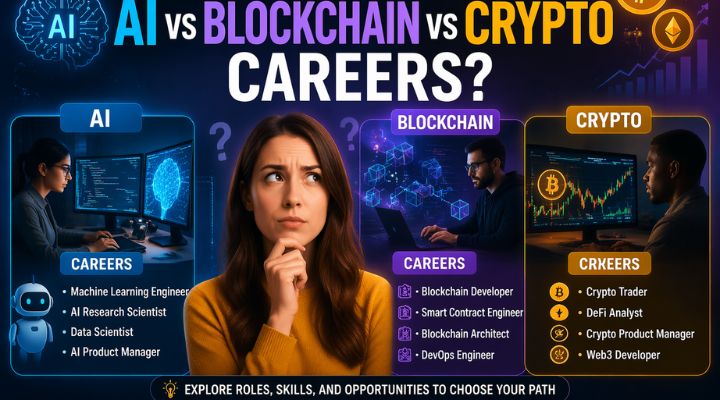
AI vs Blockchain vs Crypto Careers: What to Choose in 2026?