
How to Start a Career in AI: A Practical, Step-by-Step Roadmap
To start a career in AI, learn Python and core mathematics first, then study machine learning, build real projects, and earn a recognised certification. Most people reach an entry-level standard in 12 to 18 months with consistent daily effort. A computer science degree is not required.
Key Takeaways
- Python is your starting point. Every serious AI role expects Python fluency. Learn it before anything else on your AI career path.
- Math matters, but not at PhD level. Linear algebra, calculus, and probability are enough to understand how models learn and fail.
- Projects beat certificates alone. A GitHub repo with three real ML projects carries more weight in Indian tech hiring than most online badges by themselves.
- The market is genuinely large. India’s AI market is projected to reach $7.8 billion by 2025 (NASSCOM, 2024), and AI job postings grew 74% in 2024 (LinkedIn Workforce Report, 2024).
- Specialise early. Generative AI, computer vision, and NLP are the three hottest tracks right now. Pick one after your foundations are solid.
- Certifications from credible providers accelerate hiring. Google AI, IBM AI Engineering, and AWS Machine Learning Specialty are the three most recognised names in Indian job descriptions.
Why an AI Career in India Is Worth Pursuing Right Now
India ranks third globally in AI talent pool size, behind only the United States and China, according to the Stanford AI Index 2024. That’s a strong position, but it also means competition is real. The engineers who get hired are not necessarily the smartest; they are the ones who can demonstrate applied skills on actual problems.
Average salaries tell part of the story. An AI intern in India earns roughly 3 to 6 LPA. A mid-level AI engineer earns 10 to 25 LPA. Senior ML engineers and AI architects can command 25 to 80 LPA depending on the company and specialisation (AmbitionBox / Glassdoor India, 2024). These are not outlier figures; they reflect consistent patterns across Bangalore, Hyderabad, and Pune hiring data.
The roles are diversifying too. Beyond traditional ML engineering, Indian companies are now hiring AI product managers, AI ethics consultants, and prompt engineers. If you are a working professional from a non-technical background, this broadening is genuinely useful. You can explore what a career in AI looks like across different specialisations before committing to a specific track.
Who Can Start a Career in AI
Students after 12th, graduates from any stream, and working professionals from IT, finance, healthcare, and manufacturing are all entering AI roles. The prerequisites differ slightly by track. An ML engineering role needs stronger coding skills. An AI product or data analysis role needs domain knowledge plus analytical thinking. Neither requires a postgraduate degree as a hard requirement.
IITs and IIMs are producing AI talent, but so are self-taught engineers from tier-2 cities who built credible portfolios through NPTEL courses and Kaggle competitions. The hiring signal has shifted from pedigree to proof of work.
How to Start a Career in AI Without a Degree
No formal degree is required at most Indian tech companies. What matters is a demonstrable skill set, a portfolio of real projects, and relevant certifications. A degree in computer science, mathematics, or statistics does accelerate progression into senior and research-oriented roles, but it is not a gating requirement for entry-level positions.
How to Start a Career in AI: The Step-by-Step Roadmap
Here is how to structure your first 12 to 18 months so that you are not just learning, you are building something hireable.
- Build your mathematical and programming foundation (Months 1 to 3)
- Learn machine learning concepts and tools (Months 3 to 7)
- Build a portfolio with real projects (Months 6 to 10)
- Get certified and start applying (Months 9 to 18)
Step 1: Build Your Mathematical and Programming Foundation (Months 1 to 3)
Start with Python. Not just syntax, but NumPy, Pandas, and Matplotlib. These three libraries appear in virtually every ML project you will ever work on. Spend six to eight weeks here before touching any ML framework.
Alongside Python, work through linear algebra (vectors, matrices, eigenvalues), calculus (partial derivatives, chain rule), and probability (Bayes’ theorem, distributions). You do not need a university course. Mathematics for Machine Learning by Deisenroth, Faisal, and Ong is freely available online and covers exactly what you need, nothing more.
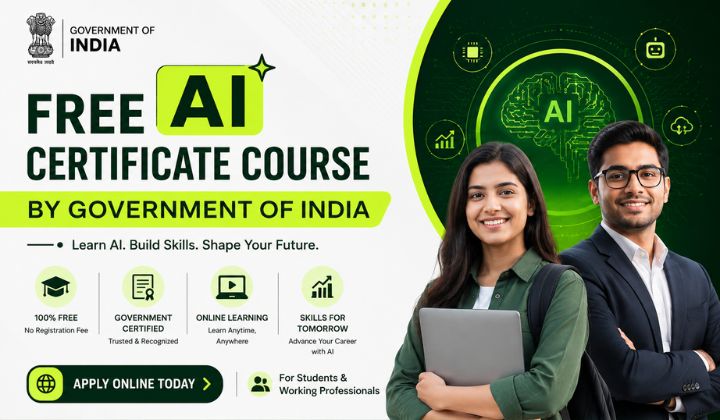
The Government of India’s free AI programmes through NPTEL and AICTE are a practical starting point for Indian learners. You can also check out this free AI course with certificate launched by the Government of India, which covers foundational concepts at no cost.
Step 2: Learn Machine Learning Concepts and Tools (Months 3 to 7)
Once Python and math feel comfortable, move into machine learning proper. Andrew Ng’s Machine Learning Specialisation on Coursera (Stanford) is still the best structured introduction available. It is practical, the assignments are real, and the certificate is recognised by Indian employers.
Learn scikit-learn for classical ML. Then move to TensorFlow or PyTorch for deep learning. Most industry teams in India use PyTorch for research and TensorFlow for production deployment, but knowing both at a basic level is better than mastering only one. Pick PyTorch first if you are unsure.
Cover these core topics in this order: supervised learning, unsupervised learning, model evaluation, overfitting and regularisation, neural networks, convolutional neural networks (computer vision), and recurrent networks or transformers (NLP). Do not rush this phase. Shallow understanding of all topics is far less useful than solid understanding of half of them.
Step 3: Build a Portfolio With Real Projects (Months 6 to 10)
This is where most beginners stall. They finish courses but never build anything independently. Employers hiring for AI roles in Bangalore and Hyderabad consistently say that three to five well-documented GitHub projects matter more than a list of certificates.
Good project ideas for Indian learners include: a crop disease detection model using computer vision (relevant to agri-tech, a growing sector), a sentiment analysis tool for Hindi-English mixed text (a real NLP challenge), or a fraud detection model using public financial datasets from data.gov.in.
Document everything. Write a clear README. Explain your dataset choices, your model architecture decisions, and your results. This documentation is often what interviewers read before they look at the code.
Step 4: Get Certified and Start Applying (Months 9 to 18)
Certifications validate what your portfolio demonstrates. The three most cited in Indian AI job descriptions are Google’s Professional Machine Learning Engineer certification, IBM AI Engineering Professional Certificate (Coursera), and AWS Machine Learning Specialty. Each requires real preparation, not just watching videos.
3.0 University’s AI programmes are worth considering here, particularly if you want structured mentorship alongside self-paced content. Their curriculum is designed specifically for the Indian job market and includes project reviews and career support that purely self-directed learning does not provide.
Start applying before you feel ready. Most people wait too long. An AI internship at 3 to 6 LPA gives you production experience that accelerates everything that follows. If you want a deeper breakdown of the technical requirements for engineering roles, read this guide on how to become an AI engineer.
Skills Comparison: What Different AI Roles Actually Require
Not every AI role requires the same skill set. This is one of the most misunderstood parts of planning how to start a career in AI. Here is a direct comparison of five common entry-to-mid-level AI roles in the Indian market.
| Role | Core Skills Required | Key Tools | Avg. Salary (India, 2024) | Coding Required? |
|---|---|---|---|---|
| ML Engineer | Python, model training, deployment, MLOps | PyTorch, TensorFlow, Docker, AWS SageMaker | 12 to 25 LPA | Yes, extensively |
| Data Scientist | Statistics, Python/R, EDA, ML modelling | Pandas, scikit-learn, Jupyter, SQL | 10 to 22 LPA | Yes, moderately |
| AI Product Manager | Product thinking, AI literacy, stakeholder management | JIRA, Figma, basic Python understanding | 15 to 30 LPA | No, but helpful |
| NLP Engineer | Transformers, text processing, fine-tuning LLMs | Hugging Face, spaCy, PyTorch, BERT/GPT variants | 14 to 28 LPA | Yes, extensively |
| Computer Vision Engineer | CNNs, image processing, object detection | OpenCV, YOLO, TensorFlow, PyTorch | 12 to 26 LPA | Yes, extensively |
| Source: AmbitionBox, Glassdoor India, LinkedIn Salary Insights (2024). Figures represent median ranges across Bangalore, Hyderabad, and Pune markets. | ||||
The AI PM role is worth flagging for professionals from business, consulting, or product backgrounds. It is one of the fastest-growing AI roles in Indian startups right now, and the coding bar is lower than most people assume.
Common Mistakes People Make When Starting an AI Career
Tutorial hell is real. A lot of beginners spend six months completing courses without ever running code on a dataset they chose themselves. Courses teach you concepts. Projects teach you how to think. You need both, but you need to move to independent projects faster than feels comfortable.
Skipping the math is the other common trap. You can get a model running without understanding backpropagation, but you will not be able to debug it when it fails, and it will fail. Interviewers at companies like Flipkart, Infosys BPM, and Ola AI routinely ask conceptual questions about gradient descent, loss functions, and bias-variance tradeoff. Surface-level knowledge breaks down fast in those conversations.
Do not ignore deployment. A model that lives only in a Jupyter notebook is not production-ready. Learn Flask or FastAPI to serve your models. Learn basic Docker. Even a simple deployed demo on Hugging Face Spaces shows employers that you understand the full pipeline, not just the training phase.
If you are coming from a cybersecurity or IT background, AI skills are increasingly relevant to security roles. AI-powered threat detection and automated vulnerability scanning are reshaping the field. Read about how to become a penetration tester to understand how AI tools are changing that career path and where the two disciplines intersect.
Actionable Next Steps to Start Your AI Journey
If you are reading this and have not started yet, here is what to do this week. Install Python and Jupyter. Complete one section of a beginner Python course. Then open a public dataset from Kaggle or data.gov.in and just explore it. No model, no algorithm. Just look at the data. That single habit, being curious about data, is what separates people who progress from people who do not.
Set a 90-day goal: finish your Python and math foundations, complete one structured ML course, and publish one project to GitHub. That is it. Do not plan 18 months ahead before you have spent 90 days actually doing the work.
When you are ready to go deeper, 3.0 University’s AI certification programmes offer structured curriculum, mentor feedback, and career placement support designed for the Indian market. Whether you are a fresher or a professional pivoting into AI, having a structured programme alongside self-study significantly reduces the time it takes to become job-ready. Explore their AI career programmes to find the track that fits your background and goals.
Knowing how to start a career in AI is only the beginning. The real work is showing up consistently for the next 12 months. The market is large, the salaries are real, and the demand is not slowing down. Start this week, not next month.
Frequently Asked Questions
How to start a career in AI?
Start with Python programming and foundational math (linear algebra, probability). Then study machine learning using Coursera’s Stanford ML course or NPTEL resources. Build three to five real projects and publish them on GitHub. Earn one recognised certification (Google, IBM, or AWS). Apply for AI internships within 12 months. Consistency and portfolio quality matter most.
Do you need coding for AI?
Yes, for most AI roles. Python is the primary language across ML engineering, data science, NLP, and computer vision. That said, roles like AI product management require AI literacy rather than deep coding ability. If you are entering a technical AI role, expect to write and debug Python code daily. There is no way around it for engineering tracks.
What is the best AI career path for freshers in India?
For freshers, the most accessible entry points are ML engineer intern, junior data scientist, or AI research assistant roles. Start with a structured course, build a portfolio on Kaggle, and target companies in Bangalore, Hyderabad, or Pune. Indian startups in fintech, healthtech, and agritech are actively hiring junior AI talent with demonstrable project experience.
How long does it take to become an AI engineer?
With consistent daily study of two to three hours, most people can reach an entry-level AI engineer standard in 12 to 18 months. A computer science background can shorten this to 6 to 9 months. Non-technical professionals typically need 18 to 24 months to build the required depth. Structured programmes with mentorship reduce this timeline meaningfully.
Which AI specialisation has the highest salary in India?
Generative AI and large language model (LLM) engineering currently command the highest salaries in the Indian market, with senior roles reaching 40 to 80 LPA at product companies. AI architects and ML platform engineers also fall in this range. Specialisations in NLP and computer vision for applied domains like healthcare and autonomous systems follow closely behind.
Is a degree required to start a career in AI in India?
No, a formal degree is not a hard requirement at most Indian tech companies. Many successful AI engineers are self-taught or hold non-CS degrees. What matters is a demonstrable skill set, a portfolio of projects, and relevant certifications. However, a degree in computer science, mathematics, or statistics does accelerate progression into senior and research-oriented roles.
Last updated: June 2025. Reviewed by the 3University editorial team.

You may also like

Highest Paid Profession in India