Key Differences Between Ethical Hacking and Penetration Testing
- Posted by 3.0 University
- Categories Emerging Technology
- Date January 24, 2025
- Comments 0 comment
In the digital realm that dwell in today, where cyber threats keep changing, realizing different cybersecurity practices is very important. A key difference in this area is between ethical hacking and penetration testing.
These two methods often seem similar but have different features and goals. In this piece, besides ethical hacking, penetration testing explained to a great extent remains as one of the key manifestations.
Ethical hacking covers many activities that look at and improve an organization’s security, going beyond just finding system weaknesses to include things like training employees and preparing for incidents.
On the other hand, penetration testing is more specific, usually defined by a clear goal that focuses on mimicking attacks to find weaknesses in certain systems.
Although, the difference between ethical hacking and pen testing, as a whole, may, be an intriguing as well as enlightening topic to learn, knowing the intricacies of those becomes as much imperative.
This important difference is vital for professionals and organizations that want to apply effective cybersecurity actions.
To help clarify these differences, the visual comparison shown in [citeX] helps explain how ethical hacking and penetration testing have different but supporting roles in cybersecurity.
Overview of cybersecurity and the roles of ethical hacking and penetration testing
In a time with more digital interactions, the need for strong cybersecurity rules is very clear. Organizations deal with many threats that find and exploit weaknesses in their systems, making it essential to have strong defense plans.
In such a scenario, for the most part, ethical hacking and penetration testing tend to be extremely important parts of a complete cybersecurity plan.
Interestingly, while the often-used term “ethical hacking” is, obviously, referred to the legal process of checking systems for security issues using a variety of tools and methods.
Penetration testing is a part of ethical hacking that specifically simulates attacks to check how well security measures work.
Both practices aim to improve an organization’s security but are different in focus and method.
Penetration tests are typically limited in time and specific, while ethical hacking may cover wider evaluations. Therefore, knowing the differences between these roles is crucial for organizations aiming to strengthen their defenses against changing threats. [Image Reference]
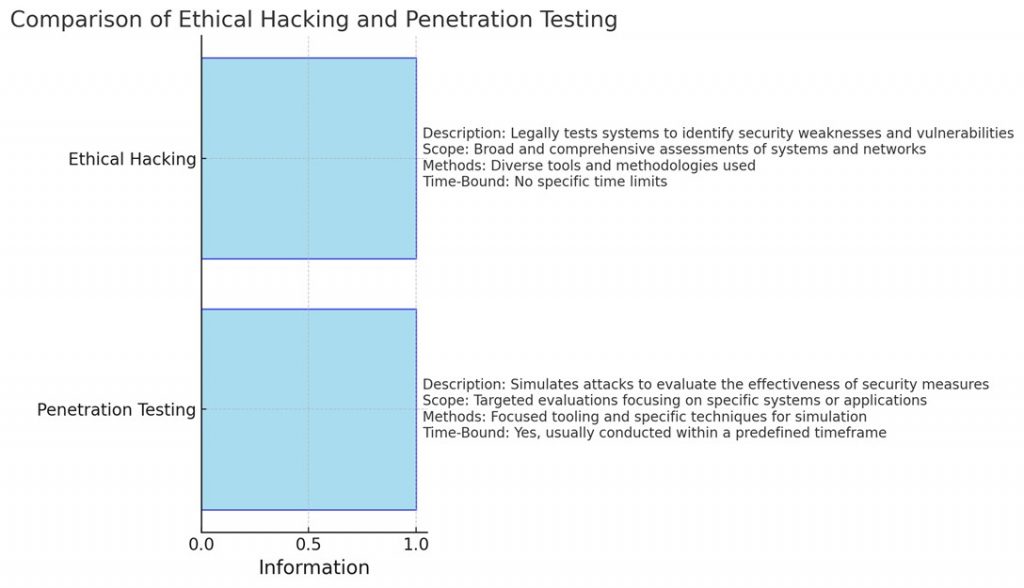
This chart provides a comparison between Ethical Hacking and Penetration Testing. It outlines the key aspects of each role, including their descriptions, scopes of work, methods used, and whether they are time-bound.
Ethical Hacking involves broad assessments of systems and networks without specific time limits, while Penetration Testing focuses on targeted tests within a predetermined timeframe.
Ethical Hacking
In an instantly varying digital sphere, having a good cybersecurity plan is very foremost. Ethical hacking is a key part of this plan and means taking steps to find and reduce possible security risks before bad actors can use them.
Unlike penetration testing, which usually looks at specific weaknesses within a set limit, ethical hacking takes a wider approach by looking at the organization’s entire security situation.
It demands a strong understanding of different ways attackers operate and requires regular interaction with the IT systems of the organization.
This complete approach can be illustrated through comparing the wide-ranging methods of ethical hacking to the more focused methods of penetration testing, which shows their different functions.
In the end, ethical hacking is crucial to creating a culture of security awareness and strength in organizations, which shows how necessary it is in current discussions about cybersecurity.
Definition and objectives of ethical hacking in the cybersecurity landscape
Undoubtedly, it’s exceptionally a predominant factor, in the realm of cybersecurity, to identify the variation between ethical hacking and penetration testing.
Ethical hacking encompasses an extensive scope of activities devised to improve an organization’s security through proactive steps.
In contrast, penetration testing usually focuses on attempts to exploit specific weaknesses. Ethical hackers evaluate the entire security system, looking for weaknesses in all areas.
Their main goal is not just to find vulnerabilities but to provide useful information that can lead to better security practices and policies.
This overall approach helps create a culture of ongoing improvement and defense against cyber threats.
The visual comparison between ethical hacking and penetration testing clearly shows these differences, illustrating how ethical hacking is essential for maintaining and boosting organizational security, which is crucial for the wider area of cybersecurity.
Penetration Testing
In a time when cyber threats change constantly, it is very important for organizations to understand what penetration testing does to improve cybersecurity.
Penetration testing identifies weaknesses by simulating attacks in a structured way, making it essential for checking how strong an organization’s systems are.
Unlike wider ethical hacking methods that use many techniques, penetration testing usually focuses on specific areas and assessments. This targeted approach lets security experts mimic real-life attack situations, giving organizations useful insights and strategies for fixing issues.
The visual aid in [citeX] shows the differences between ethical hacking and penetration testing, making their separate goals clearer.
By understanding these roles, organizations can better distribute resources and apply strong security measures that match their specific weaknesses.
In conclusion, penetration testing is key in the larger field of ethical hacking and cybersecurity.
Description of penetration testing methodologies and their significance in identifying vulnerabilities
Recognizing the factors and ingrained specifics of penetration testing methods is amply crucial for organizations that intend to improve their cybersecurity. These procedures usually include several types of testing, such as black-box, white-box, and gray-box testing.
The testing group receives varying amounts of information at the start, which determines the type. This variety helps in customized checks for system weaknesses, showing possible ways that bad actors could use to get in.
Also, penetration testing is important not just for finding weaknesses; it also helps create strong security plans by pretending to have real attacks in a safe setting.
These careful practices allow organizations to use their resources wisely, as they learn about their security status and possible risks.
The image clearly shows how penetration testing is different from ethical hacking, improving our understanding of how they work together within cybersecurity.
Conclusion
In a nutshell, the line between ethical hacking and penetration testing is vital for grasping the broader picture of cybersecurity.
Differences include how they work, what they aim to achieve, how long they last, and the skills needed.
Ethical hacking covers a wider range of tasks that aim to protect systems, while penetration testing is more focused on finding specific weaknesses within set limits. This understanding is key for organizations wanting to strengthen their cybersecurity.
Additionally, [citeX] clearly illustrates these differences, elucidating the roles and duties of each practice.
Visual aids, like those included, help cybersecurity experts and stakeholders understand these ideas better, leading to better choices about security measures.
Ultimately, understanding the conspicuous roles of ethical hacking and penetration testing is critical for effectively protecting sensitive data in a digital world full of threats.
Summary
Knowing the different roles between ethical hacking and penetration testing is important for managing cybersecurity well. Ethical hacking includes various activities aimed at finding and reducing possible security risks in an organization’s entire system.
This ongoing process not only checks for system weaknesses but also helps with incident response and developing security plans.
On the other hand, penetration testing is a focused evaluation that imitates specific attack situations within a set limit, emphasizing the discovery of weaknesses in certain systems or applications.
This difference in focus and duration means there are major operational and strategic factors for cybersecurity actions.
Organizations have to choose whether to set up extensive ethical hacking programs or to perform occasional penetration tests based on their particular security requirements and available resources.
Visual aids like [citeX] can help summarize these differences, making it clearer how they affect the improvement of cybersecurity strength in complicated and changing digital environments.
Characteristic | Ethical Hacking | Penetration Testing |
Definition | Broad practice of probing systems for vulnerabilities | Specific type of ethical hacking that simulates real-world attacks |
Scope | Wide-ranging; includes all aspects of security assessment | Narrower focus; typically targets specific systems or applications |
Objectives | Enhance overall security posture, identify all vulnerabilities | Test specific defenses and report on exploits |
Methodology | Involves various techniques and tools; often continuous assessment | Typically follows a defined methodology (e.g., OWASP, NIST) |
Compliance | May not always comply with external regulations | Often required for compliance with standards (e.g., PCI-DSS, HIPAA) |
Reporting | Focuses on comprehensive security assessments | Provides specific reports on vulnerabilities identified and exploited |
Key Differences Between Ethical Hacking and Penetration Testing

You may also like

What is more Important Degree or skill in 2026?

Highest Paying Jobs in India 2026