Cybersecurity in the Digital Era
- Posted by 3.0 University
- Categories Cyber Security
- Date March 4, 2024
- Comments 0 comment
Cybersecurity: Attain Tools & Power of Digital Era and Security
In this piece, learn the fundamentals of launching a career in cybersecurity, such as choosing between cyber and traditional education, creating a portfolio, and knowing about career perspectives and lifelong learning.
In the cybersecurity world, which is so dynamic and recursively the same, one has to employ a prudent approach to education and develop relevant skills. Either studying via online portals or in a traditional classroom setting, people have the freedom to enroll in a platform that meets their lifestyle and needs.
Shaping a solid portfolio featuring one’s abilities and work emerges as a vital phase for standing out in the very dynamic cybersecurity job market. In addition, internships and real-life experiences prepare future engineers for different fields, with valuable skills and relationships earned.
With the ever-increasing demand for qualified cybersecurity professionals for their future career prospects, the mastery of new tools and techniques, as well as the commitment to lifelong learning, are a necessity for any person who wishes to stand out in securing the future online infrastructure.
Online vs. Offline Learning
Whether one should learn online or offline depends on a learner’s individual learning preferences, schedule flexibility, and access to resources.
In a way, both options are valid and can result in high-quality cybersecurity education.
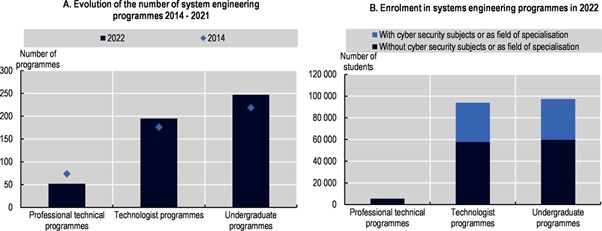
Employment Prospects in Cyber Security Education: Employment Rate
Graduates in cyber security fields are in dire need of professionals.
The majority of employed graduates in information technology and services in Colombia are cybersecurity experts, constituting exactly 96%.
Besides the other ICT professionals (75%), the country has a well-structured information and technological services sector.
Surprisingly, a growing number of cyber incidents have demonstrated the importance of cyber security over the past ten years.
The substantial employability rate highlights the severe shortage in the cyber security workforce.
To practice cybersecurity in Latin America, 500 thousand people are required.
Companies and governments employ around 79% of information technology workers, according to the Bureau of Labor Statistics.
In this occupation, 12% are self-employed, compared with 42% who have other educational backgrounds.
(Image courtesy: OECD Library)
Building a Portfolio
Utilize your portfolio in the cybersecurity area to showcase your skills, projects, and experience.
You can include individual projects, such as contributions to open-source projects or work during internships.
GitHub is a great hub for cybersecurity professionals to host and share their projects to impress potential employers. It fosters coding, web development, and content updating teamwork. You may create, store, change, merge, and collaborate on files and code them.
GitHub is readily accessible to team members and displays the newest version in real-time. All collaborators may then make and observe changes.
Internships and Real-world Experience
Internships provide a learning environment where students can practice their skills and meet professionals.
It also increases students’ employability.
Leaders in the tech sphere, such as Google and Microsoft, provide cybersecurity internships for students to show the industry’s challenges and needs.
Career Prospects in Cybersecurity
Cybersecurity specialists are highly sought-after, with placements not just in government but also in finance, health care, and technology. The field gives the candidates competitive salaries, job security, and the potential for positional advancement.
From September 2022 to August 2023, to everyone’s surprise, there was a deficit of 28 cybersecurity professionals for every 100 cybersecurity positions sought by employers.
Moreover, this year, there were over half a million job openings that needed cybersecurity skills; as a result, companies are struggling to find qualified candidates.
Cybersecurity positions usually take 21% longer to fill than other IT roles.
Continuing Education and Certifications
Cybersecurity is a very dynamic field that demands professionals to always learn and upgrade their skills and knowledge.
Achieving higher qualifications and regular learning opportunities are the keys to career advancement.
1.Assess the current status and goals.
Evaluate your knowledge, experience, and education.
Besides, you can set short- and long-term goals, which is critical for advancing in the cybersecurity job market. As a cybersecurity professional, what are your strengths and weaknesses?
Which skills or knowledge gaps need filling?
What degrees, certificates, and qualifications are required for your job?
What jobs, responsibilities, or projects do you want?
Answering these questions can help you create a feasible career strategy.
2.Always improve your skills.
Cybersecurity must stay updated due to changing threats, technology, and trends.
Enhancing your job requires being current on cybersecurity developments, best practices, and industry standards.
There are myriad methods one can choose from! You may learn by taking online classes; besides, you may gain knowledge by reading books and blogs, listening to podcasts, watching webinars, visiting conferences, or joining communities of practice.
Consider becoming certified or obtaining a degree to demonstrate your talents and dependability to prospective employers and customers.
Cybersecurity professionals must keep their technological skills up to date.
Free internet tools help me keep up with emerging cybersecurity advances, which is a priority.
Newcomers should start by understanding the technology, protocol, and standards, learning application development, and scripting languages, and beginning immediately.
Understanding a structure helps you overcome it.
Second, analyzing public security bug reports is a fantastic learning tool.
It will provide you with real-world experience conducting an assault.
Scripting, H1 hacktivity, and stack overflow helped me with almost everything.
There are several medium articles, PortSwigger labs, and blogs and forums nowadays.
Use “Google”—it has everything.
Executive candidates must improve their presentation and communication skills.
Convince a few non-technical people of the necessity of a security budget.
3.Build a network and reputation.
Cybersecurity job advancement requires a solid industry network and reputation.
You should network with other cybersecurity experts for advice, assistance, and support.
Join online forums, social media groups, or events to ask questions, share thoughts, or help.
Create a portfolio, blog, or speak at events to showcase your work.
This method builds field authority, credibility, and visibility.
Networking and reputation-building are key in cybersecurity and AI.
With enhanced persuasion and targeted synthetic content, AI-enabled bots are increasing their Return On Networking Investment (RONI).
Security demands more than a procedure—it requires a mindset.
Thus, younger cyber and information security experts should use every opportunity to create strong personal and professional ties with other security professionals.
Your career progression and possibilities will improve.
The beginning of a cybersecurity profession may be uncertain.
It is a broad industry with several specializations.
Contact everyone in security (and ask for references). Understanding how different areas fit your goals is helpful.
While extending your network, consider hiring security consultants with consulting experience in private enterprise, government, and non-profits.
4.Always seek feedback and improvement
To succeed in cybersecurity, actively seek feedback and development from coworkers, supervisors, clients, and mentors.
Accepting constructive criticism may improve your performance, abilities, and knowledge.
Begin soliciting input and be receptive to using it.
Set realistic goals and track your progress.
This technique shows your competence, forward-thinking attitude, and openness to new information.
Professional growth requires self-improvement, especially in a fast-changing area like cybersecurity.
Feedback helps identify strengths and weaknesses.
Seeking and accepting constructive feedback demonstrates merit.
Having clear, quantifiable goals ensures that efforts achieve the desired consequences.
Being self-aware, adaptable, and focused on improvement defines a growth mindset.
Cybersecurity professionals must embrace criticism, learning, and growth.
Ask for feedback and accept criticism.
Ask for genuine people who care about you, not dishonest rivals who want to keep you down.
Listen and improve as much as possible.
5.Take on new tasks
To advance in cybersecurity, you must seek out new challenges that test your limits, extend your viewpoint, and elevate your position.
This career requires flexibility and adaptation to changing needs, expectations, and situations.
Discovering cybersecurity ideas, innovations, and improvements requires curiosity and creativity.
To pursue hobbies, passions, or objectives in the field, one must be confident and bold.
This technique may reveal new cybersecurity employment options, potentials, or paths.
Cybersecurity Tools and Technologies
It is vital to keep abreast of the most recent cybersecurity defenses/shields and methodologies.
Familiarity with security software, encryption tools, and intrusion detection systems is a prerequisite to gaining an appreciation of the field.
Ethical Considerations in Cybersecurity
The ethics of cybersecurity are of great importance.
The professionals should be cautious while ensuring security and privacy by asking some hard ethical questions.
Summing it up…
As we may conclude it by saying that Cybersecurity as a profession offers an exciting prospect for those who possess the relevant skills and knowledge.
Students can access cybersecurity courses from various degree programs, certifications, and diplomas to kickstart their cybersecurity careers.
Picking the right course and getting hands-on experience is the foundation for the future of cybersecurity professionals, thus creating a path for a prosperous and fulfilling career in this ever-changing and important field.
Equipped with work experience and constant learning, it can be easier to swim through cyber security career lanes and protect critical digital infrastructures all over the world.

You may also like

Cyber Security Course Eligibility