Artificial Intelligence vs Human Intelligence
- Posted by 3.0 University
- Categories Artificial Intelligence
- Date April 20, 2026
- Comments 0 comment
AI just crossed a threshold most people missed. On SWE-bench Verified the gold-standard coding benchmark top models jumped from 60% to nearly 100% of the human expert baseline in a single year.
Stanford’s 2026 AI Index now reports that 88% of surveyed companies use AI in some form, and Anthropic, Google, OpenAI, and DeepSeek are separated by razor-thin margins at the frontier.
And yet, the same generation of models still fails at 88% of household robot tasks and can’t always read an analog clock.
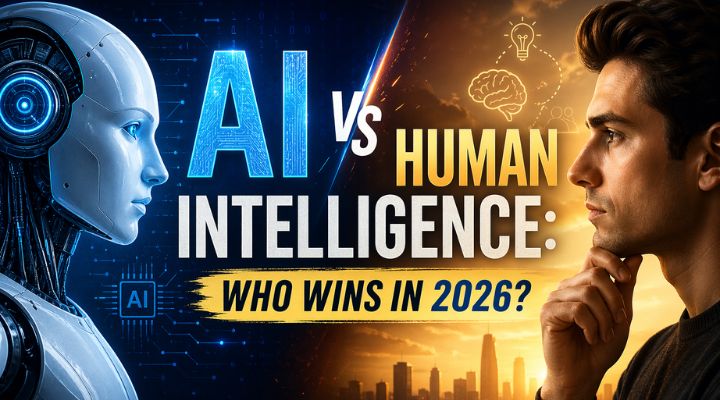
That contradiction is the real story of artificial intelligence vs human intelligence in 2026 not a winner, not a loser, but a “jagged frontier” where machines superhumanly outperform us in narrow slices while stumbling on things a five-year-old handles easily.
This guide breaks down the difference between AI and human intelligence, what it means for your career, which jobs AI can’t replace, and how to position yourself for the augmented-intelligence economy now emerging across India and the world.
Quick Answer: What Is the Difference Between AI and Human Intelligence?
Artificial Intelligence (AI) learns from massive datasets and runs on algorithms, excelling at speed, scale, and pattern recognition. Human Intelligence (HI) learns from lived experience and excels at emotion, moral reasoning, creativity, and context. AI handles the “what” and “how fast.” Humans handle the “why” and “what matters.”
In short: AI is narrow and scalable, humans are general and wise.
What Is Artificial Intelligence?
Artificial Intelligence is a field of computer science that builds systems capable of performing tasks that traditionally required human thinking recognising speech, translating language, generating images, writing code, or making predictions.
Modern AI runs on three core ingredients:
- Data — billions of text, image, audio, or sensor inputs used for training.
- Algorithms — mathematical models, especially deep neural networks and transformers.
- Compute — GPUs and specialised chips that process data at scale.
Today’s frontier AI systems include large language models (LLMs) like Claude, GPT-4/5, Gemini, and DeepSeek-R1, along with image models, voice agents, and autonomous coding agents.
These systems now meet or exceed human experts on PhD-level science questions, competition mathematics, and multimodal reasoning according to Stanford’s 2026 AI Index.
But AI remains “narrow intelligence.” It is extraordinary at the task it was trained for and often helpless outside that box.
What Is Human Intelligence?
Human intelligence is the full spectrum of cognitive, emotional, social, and physical capacities that let a person understand the world, learn from very few examples, and make value-based decisions in ambiguous situations.
Its core components include:
- Reasoning — logic, abstraction, cause-and-effect thinking.
- Emotional intelligence — recognising and managing emotions in ourselves and others.
- Creativity — original thought, imagination, artistic and scientific invention.
- Intuition — pattern recognition shaped by embodied experience.
- Moral and ethical judgement — deciding what should be done, not just what can be done.
- Adaptability — transferring knowledge across completely unrelated domains.
A child can watch an unfamiliar animal once and recognise it for life. A human can walk into a tense meeting, read the room in three seconds, and adjust their tone. No AI system does either reliably.
Artificial Intelligence vs Human Intelligence: 10 Key Differences
Here’s how the two forms of intelligence compare across the dimensions that matter most in 2026.
# | Dimension | Artificial Intelligence | Human Intelligence |
1 | Origin | Engineered by humans using code, data, and compute | Biological, shaped by evolution, experience, and culture |
2 | Learning | Needs millions of labelled examples | Learns from one or a few examples |
3 | Speed | Processes terabytes of data in seconds | Slower, but deeper contextual processing |
4 | Scale | Serves thousands of users simultaneously | One conversation, one task at a time |
5 | Emotion | Simulates emotion; does not feel it | Genuinely experiences empathy, love, fear, motivation |
6 | Creativity | Remixes patterns from training data | Generates truly novel ideas rooted in meaning |
7 | Decision-making | Optimises for a defined objective | Weighs ethics, intent, long-term consequence |
8 | Adaptability | Breaks outside its training distribution | Transfers skills across wildly different domains |
9 | Common sense | Often fails on basic physical-world reasoning | Embodied, intuitive, usually reliable |
10 | Energy use | A single training run can consume megawatt-hours | The human brain runs on ~20 watts |
This is why the smartest organisations in 2026 don’t ask “AI or humans?” they ask “AI and humans, doing what each does best.”
Cognitive Abilities Compared: Problem-Solving, Creativity, Emotional Intelligence
Problem-Solving
AI excels at convergent problem-solving narrowing many options to the single best answer within a defined space. Think: fraud detection, drug-molecule screening, chess, or debugging code.
Humans dominate divergent problem-solving opening up a vague, messy situation, reframing the question itself, and imagining solutions no dataset contains. A founder deciding whether to pivot a startup is doing something no model has been trained on.
Creativity
Generative AI can now produce striking images, music, and prose. But it is fundamentally a statistical echo of what humans have already made. True creativity writing a novel that captures a generation, composing a song that makes strangers cry, proposing general relativity requires lived experience, emotional resonance, and cultural context.
Interestingly, Pew Research’s 2026 survey found that about half of Americans believe AI will worsen human creativity over time, making creative work an increasingly valuable and scarce human skill.
Emotional Intelligence
This is where the gap is widest. AI can recognise a sad face or a frustrated tone, but it doesn’t feel anything. It can’t sit with a grieving family, mentor a struggling employee, or read the silence in a negotiation.
LinkedIn’s 2026 “Jobs on the Rise” data shows that behavioural therapists, strategic HR leaders, and senior managers are among the fastest-growing roles precisely because authentic human connection has become a premium commodity.
Where AI Outperforms Humans in 2026
Let’s be honest: in several domains, AI has already won decisively.
- Data analysis at scale — AI scans millions of records in seconds to surface patterns no human team could find.
- Speed and consistency — AI doesn’t tire, get bored, or suffer decision drift. Studies show humans make different decisions late in the day than they do in the morning; AI doesn’t.
- Repetitive cognitive work — document review, invoice processing, log triage, basic customer support.
- Pattern recognition in medical imaging — AI matches or beats specialists in detecting certain cancers and retinal diseases.
- Code generation and software engineering — SWE-bench Verified scores jumped from 60% to ~100% of the human baseline between 2024 and 2025.
- Forecasting — weather, logistics, demand planning; AI now produces standalone weather forecasts.
- 24/7 scale — a customer service AI can handle thousands of tickets at once; a human agent handles one.
In data-heavy environments, AI is no longer optional. It is infrastructure.
What Humans Still Do Better Than AI
Despite the hype, there is a large and growing list of capabilities AI can’t credibly replicate.
- Moral and ethical judgement — AI optimises; it does not value. Humans are required when decisions involve fairness, dignity, cultural nuance, or consequence.
- Genuine creativity with intent — not pattern remixing, but meaning-making.
- Complex negotiation and persuasion — reading silence, status, and hidden motives.
- Leading through uncertainty — setting vision when data is absent or misleading.
- Empathy and care work — therapy, nursing, coaching, teaching young children.
- Physical dexterity in unstructured environments — robotics still succeeds in only ~12% of household tasks.
- Cross-domain transfer — applying lessons from biology to business, from music to mathematics.
- Knowing when to stop trusting the AI — AI doesn’t know when it is wrong; humans must.
This is the human moat. And it’s widening.
Will AI Replace Human Jobs? The Real 2026 Numbers
The single most asked question in this debate: Will AI take my job?
Here’s what the most credible 2025–2026 data actually says:
- World Economic Forum (Future of Jobs, through 2030): AI will disrupt 22% of jobs with 170 million new roles created and 92 million displaced, a net gain of 78 million positions.
- PwC 2025 Global AI Jobs Barometer: Job numbers are rising even in highly automatable roles, and workers with AI skills command wage premiums of up to 56% over peers.
- IMF (2026): Around 40% of global jobs are exposed to AI-driven change, with developed economies seeing higher exposure.
- Stanford AI Index 2026: 88% of surveyed companies now use AI; corporate AI investment hit $581.69 billion in 2025 — up 129.9% year-on-year.
- PwC 2026 AI Performance Study: Just 20% of organisations are capturing 74% of AI’s economic value the gap between AI leaders and laggards is widening fast.
The pattern is clear: AI is reshaping work far more than it is eliminating it. The losers are workers (and companies) who refuse to adapt. The winners are those who treat AI as a force multiplier.
What About India?
For India, the picture is especially dynamic. The country’s IT services, BPM, and customer experience sectors sit at the epicentre of both risk and opportunity.
Key shifts:
- From “Degree-First” to “Skills-First” hiring — employers want demonstrable AI fluency, not just certificates.
- Entry-level IT roles (QA, L1 support, basic developers) are being rapidly automated.
- AI-native roles (prompt engineers, AI product managers, MLOps engineers, AI governance specialists, applied AI researchers) are exploding.
- NITI Aayog’s 2025 roadmap projects that routine, scalable tech work will be disrupted first but new use cases, budget pools, and convergent technologies will create millions of “AI-first” jobs if India invests in reskilling.
The defining 2026 skill in India is not “can you code” it’s “can you direct, audit, and combine AI systems to deliver outcomes a pre-AI team of five used to deliver.”
Jobs AI Can’t Replace (Yet and Maybe Ever)
Some roles are structurally resistant to automation because they depend on the capabilities AI fundamentally lacks.
- Mental health therapists and counsellors — trust, empathy, and human presence are the product.
- Senior leaders and strategists — judgement under uncertainty, stakeholder management, vision.
- Teachers of young children — mentorship, emotional modelling, social development.
- Surgeons and critical-care physicians — dexterity plus split-second ethical calls.
- Creative directors and showrunners — coherent vision across hundreds of contributors.
- Investigative journalists — source trust, ethical judgement, narrative craft.
- Skilled trades in unstructured environments — plumbers, electricians, emergency responders.
- Diplomats and negotiators — reading people, culture, and power.
- Clergy, social workers, care workers — deep human connection work.
- Human-AI orchestrators — the brand-new class of roles defining how AI is deployed, audited, and trusted.
If your work primarily involves empathy, ethics, original vision, physical judgement, or accountability — your moat is strong.
High-Growth AI Careers for 2026 and Beyond
For students and mid-career professionals in India, these are the roles with the strongest demand-to-supply ratios:
- AI/ML Engineer — building, fine-tuning, and deploying models.
- Prompt Engineer & AI Workflow Designer — engineering reliable outputs from LLMs.
- MLOps / LLMOps Engineer — productionising AI systems at scale.
- AI Product Manager — bridging business goals and model capabilities.
- AI Ethics & Governance Specialist — a booming field as regulation arrives globally.
- AI Cybersecurity Analyst — defending against AI-augmented attacks.
- Data Scientist / AI Research Analyst — extracting insight from enterprise data.
- Applied AI Consultant — helping traditional businesses adopt AI.
- AI-Augmented Creator — marketers, designers, and writers who use AI to 10x output.
- Robotics & Automation Engineer — embodied AI is the next frontier.
Want to see which of these fits you best?
Explore our guide to the Top 10 AI Careers for Non-Techies and the full AI Education and Job Market in 2026 outlook.
Challenges & Risks of the AI Revolution
This is not a purely rosy picture. Serious challenges come with rapid AI adoption.
- Hallucination and confident wrongness — AI speaks fluently even when the facts are thin. Human verification is non-negotiable.
- Bias and fairness — models inherit biases from training data, which can entrench discrimination in hiring, lending, and policing.
- Job churn and reskilling pressure — WEF projects 59% of the global workforce will need training by 2030; ~120 million workers are at medium-term risk if that training doesn’t arrive.
- Privacy and data security — more data flowing through more models means more attack surface. (Generative-AI-assisted attacks are now a top concern — see our guide on Ethical Hacking with Generative AI.)
- Over-reliance and skill atrophy — Gartner predicts 50% of organisations will require “AI-free” skills assessments by 2026 to protect critical thinking.
- Concentration of power — 74% of AI’s economic value is being captured by just 20% of companies, risking winner-take-all dynamics.
- Environmental cost — frontier model training consumes enormous energy and water.
- Trust and misinformation — deepfakes and synthetic media are eroding epistemic trust.
These aren’t reasons to reject AI. They’re reasons to build it and use it responsibly.
The Future of AI and Human Intelligence: Augmented, Not Replaced
The most important shift of 2026 is conceptual: the winning model is no longer “AI vs humans” but augmented intelligence humans and AI working together, each amplifying the other.
What augmentation looks like in practice:
- A customer service agent using an AI co-pilot handles up to 35% more tickets per hour and the quality of the hard cases goes up because the agent has bandwidth.
- A doctor uses AI to pre-read imaging scans, then applies clinical judgement on the edge cases.
- A marketer uses AI to generate 20 campaign variations, then picks and refines the two that have real emotional truth.
- A software engineer directs an AI coding agent and focuses on architecture, security, and trade-offs.
- A teacher uses AI to personalise exercises for 40 students at once, while spending the classroom hour on mentorship.
PwC’s 2026 study shows AI leaders are making 2.8x more decisions without human intervention than peers but they are doing so precisely because they have invested in Responsible AI frameworks and cross-functional governance boards. Trust, not autonomy, is the real moat.
The future belongs to humans who can direct AI, not compete with it.
How to Stay Relevant in the Age of AI: 7 Skills to Build Now
If you take one action after reading this, make it this: pick two skills below and start this month.
- AI fluency — learn to prompt, evaluate, and orchestrate LLMs and AI agents. This is the new literacy.
- Critical thinking and verification — the more AI writes, the more valuable humans who can audit become.
- Emotional intelligence and communication — the single most AI-resistant skill set.
- Creative problem framing — defining the right question matters more than computing the answer.
- Domain depth — AI rewards specialists who know their field better than the model does.
- Ethics, governance, and compliance — regulation is arriving; early movers win.
- Continuous learning habit — the ability to learn a new tool every six months now beats ten years in an old one.
A 2025 PwC Global AI Jobs Barometer finding worth remembering: workers who combine AI skills with their existing expertise can earn up to 56% more than peers who don’t.
Conclusion: Intelligence Is No Longer a Solo Sport
Artificial intelligence and human intelligence are not opposites locked in a zero-sum race. They are complementary systems with complementary strengths and the 2026 economy increasingly rewards the people and organisations who understand that.
AI brings speed, scale, pattern recognition, and tireless consistency. Humans bring meaning, ethics, creativity, emotional truth, and the ability to decide what’s actually worth doing.
The question is no longer “Will AI replace me?” It’s “Am I the kind of human an AI-native company can’t operate without?”
Answer that well through deliberate skilling, AI fluency, and cultivation of your uniquely human strengths and the next decade is the most opportunity-rich period of your career.
Frequently Asked Questions (FAQs)
- What is the main difference between artificial intelligence and human intelligence?
AI learns from large datasets using algorithms and excels at speed, scale, and narrow pattern recognition. Human intelligence learns from lived experience and excels at emotion, ethics, creativity, and context. AI handles execution; humans handle meaning and judgement.
Can artificial intelligence replace human intelligence completely?
No. AI is narrow it performs specific tasks well but lacks genuine emotion, moral reasoning, embodied common sense, and true creativity. Even the best 2026 frontier models exhibit “jagged intelligence,” solving PhD-level problems while failing at tasks a child handles. Full replacement of human general intelligence is not on the horizon.
Will AI replace human jobs by 2030?
AI will reshape more jobs than it eliminates. The World Economic Forum projects 92 million jobs displaced and 170 million new roles created by 2030 a net gain of 78 million positions. Routine cognitive work is most at risk; creative, ethical, interpersonal, and strategic work is least at risk.
Which jobs can AI not replace?
Roles requiring empathy, moral judgement, original creativity, complex negotiation, physical dexterity in unstructured environments, or accountability for outcomes. Examples include therapists, senior leaders, surgeons, teachers of young children, skilled trades, creative directors, and AI governance specialists.
What skills should I learn to stay relevant in the AI era?
Prioritise AI fluency (prompting, evaluation, orchestration), critical thinking, emotional intelligence, creative problem framing, deep domain expertise, AI ethics and governance, and a continuous learning habit. Workers combining AI skills with domain expertise earn up to 56% more than peers, per PwC’s 2025 AI Jobs Barometer.
How is AI affecting jobs in India specifically?
India’s IT, BPM, and CX sectors are seeing rapid automation of routine roles (basic QA, L1 support, simple development) alongside explosive growth in AI-native roles. Hiring is shifting from “Degree-First” to “Skills-First,” and AI fluency is becoming the baseline expectation for tech and knowledge workers.
What is augmented intelligence?
Augmented intelligence is the model of humans and AI working together, with each doing what it does best AI for speed, scale, and pattern recognition; humans for judgement, ethics, creativity, and accountability. Organisations using this model consistently outperform those chasing full automation.
Ready to Build an AI-Proof Career?
The gap between AI leaders and laggards is widening every month. The professionals who thrive in 2026 and beyond won’t be those who resist AI they’ll be the ones who learn to direct it.
At 3.0 University’s School of Intelligent Systems, we offer industry-aligned programs designed to turn you into exactly that kind of professional whether you come from a tech, business, design, or non-technical background.
👉 Explore AI courses at 3.0 University → 👉 Browse all courses → 👉 Talk to our admissions team →
Don’t just watch the AI revolution happen. Build the skills that make you indispensable inside it.

You may also like