
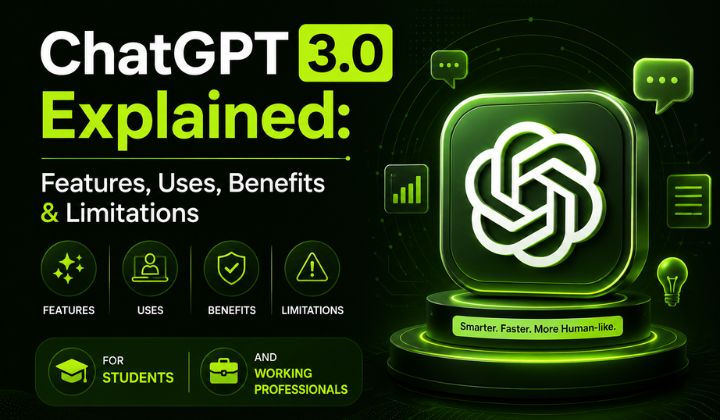
ChatGPT 3.0 Guide (2026): How It Works, Features & Use Cases
- Posted by 3.0 University
- Categories Artificial Intelligence
- Date May 10, 2026
- Comments 0 comment
ChatGPT 3.0 is an AI-powered conversational language model based on GPT-3 (Generative Pre-trained Transformer 3), developed by OpenAI. It uses deep learning and natural language processing (NLP) to understand prompts, generate human-like responses, answer questions, write content, assist with coding, and perform various language-based tasks.
Key Takeaways
- ChatGPT 3.0 is not an official product name. It usually refers to ChatGPT built on the GPT-3.5 model that first made the chatbot famous in late 2022.
- It runs on next-word prediction. A transformer model plus reinforcement learning from human feedback (RLHF) is what made it feel conversational.
- It was free and useful, but limited. Great for everyday writing and basic coding, weaker at deep reasoning, long context, and factual accuracy than later models.
- ChatGPT 3 vs ChatGPT 4: GPT-4 added image input, a much larger context window, and far fewer errors.
- It is largely retired. GPT-3.5 left the ChatGPT app in 2024, and by 2026 ChatGPT runs on the GPT-5 family.
- AI literacy is now a core security skill. The 2025 ISC2 Workforce Study ranks AI as the single most in-demand cybersecurity capability.
What is ChatGPT 3.0?
ChatGPT 3.0 refers to conversational AI applications powered by GPT-3, one of the most influential large language models (LLMs) introduced by OpenAI.
So there are three related-but-different things worth separating:
- GPT-3 — a raw language model OpenAI released in 2020 (not a chatbot you could talk to easily).
- GPT-3.5 — an improved model, tuned for conversation, that powered the original free ChatGPT.
- ChatGPT — the chat product (the app/website) that put the model in a simple, friendly interface.
In short: GPT-3.5 was the engine, and ChatGPT was the car. ChatGPT 3.0 is just how the public remembers that first viral version.
How Does ChatGPT 3.0 Work?
ChatGPT 3.0 operates using a transformer-based neural network architecture.
Step 1: Pre-Training
The model is trained on vast amounts of publicly available text from books, websites, articles, and other sources.
During training, it learns:
- Grammar and sentence structure
- Context and relationships between words
- Common facts and concepts
- Patterns of human communication
Step 2: Prompt Processing
When a user enters a question, the model analyzes the prompt and predicts the most likely next words based on learned patterns.
For example:
Prompt: Explain cloud computing.
Response: The model generates a structured explanation by predicting each subsequent word in sequence.
Step 3: Response Generation
The AI produces human-like text by calculating probabilities for possible responses and selecting the most relevant output.
This process occurs within seconds, creating a conversational experience.
Key Features of ChatGPT 3.0 (GPT-3.5)
For a free tool in 2022–23, the GPT-3.5 version of ChatGPT was remarkably capable. Its main features and capabilities included:
- Natural conversation: answers follow-up questions and remembers context within a chat.
- Writing and editing: emails, summaries, blog drafts, resumes, and rewrites in different tones.
- Explaining concepts: breaking down complex topics into beginner-friendly language.
- Basic to intermediate coding: generating snippets, explaining errors, and writing simple scripts.
- Translation and language help: rough translation and grammar correction across many languages.
- Brainstorming: ideas, outlines, names, and structured lists on demand.
ChatGPT 3 vs ChatGPT 4: What’s the Difference?
This is one of the most common questions, so here’s a side-by-side look. GPT-4 (launched March 2023) was a major leap over GPT-3.5 in almost every area.
Feature | ChatGPT 3 (GPT-3.5) | ChatGPT 4 (GPT-4) |
Released | November 2022 | March 2023 |
Input types | Text only | Text + images (multimodal) |
Context window | ~4K–16K tokens | Up to ~128K tokens |
Reasoning | Good for simple tasks | Stronger logic and complex problem-solving |
Accuracy | More frequent mistakes | Noticeably fewer errors and hallucinations |
Coding | Basic to intermediate | More reliable, handles larger code |
Cost | Free | Paid (ChatGPT Plus at launch) |
Best for | Drafting, summaries, learning | Professional, technical, analytical work |
Bottom line: GPT-3.5 made AI chat mainstream; GPT-4 made it dependable enough for serious professional use. Each later generation right up to today’s GPT-5 family has continued that trend toward accuracy and reasoning.
Is ChatGPT 3.0 Free, and Is It Still Available in 2026?
Yes, it was free. The original ChatGPT (GPT-3.5) launched as a free tool, which is a big reason it reached 100 million users faster than almost any app in history.
But no, it’s not really available anymore. GPT-3.5 was replaced inside the ChatGPT app by newer models back in 2024, and the older GPT-3 model was retired from OpenAI’s developer API in January 2024.
By June 2026, ChatGPT runs entirely on the GPT-5 family, with GPT-5 Instant models serving even the free tier.
So if you open ChatGPT today, you’re no longer using ChatGPT 3.0 – you’re using something several generations more capable, usually at no cost for everyday tasks.
Accuracy, Coding, and Limitations
How accurate is ChatGPT 3.0 for professional use?
GPT-3.5 was reliable for low-risk tasks like drafting and summarizing, but it could confidently state wrong information a problem known as hallucination.
For anything high-stakes (legal, medical, financial, or security advice), its output always needed expert review. Newer models reduced this significantly, but human verification still matters.
Can ChatGPT 3.0 write code and solve programming problems?
Yes, within limits. It could write functions, explain code, fix simple bugs, and help beginners learn.
For large codebases, niche frameworks, or complex logic, it often produced code that looked right but didn’t fully work. It was best treated as a fast junior assistant, not a replacement for a developer.
What are the limitations of ChatGPT 3.0?
- Knowledge cutoff — it didn’t know about events after its training date.
- No live internet or images — text-only, with no browsing in the base version.
- Hallucinations — plausible-sounding but incorrect answers.
- Shorter memory — it lost track of very long conversations.
- Bias — it can reflect biases present in its training data.
Why This Matters for Your Cybersecurity Career
Understanding how tools like ChatGPT work is no longer optional for tech and security professionals it’s becoming a core skill. The data backs this up clearly.
According to the 2025 ISC2 Cybersecurity Workforce Study (based on responses from over 16,000 professionals), AI is now the most in-demand skill in cybersecurity, with roughly 70% of professionals pursuing AI-related qualifications.
The same study found that 95% of teams report at least one skills gap, and skills gaps not raw headcount are now the top workforce concern.
The threat side adds urgency: industry research in 2025 found that around 76% of organizations say they cannot match the speed of AI-powered attacks. Defenders who understand how AI models generate text, where they fail, and how attackers misuse them are in a strong position.
Here’s how practical AI knowledge connects to common security roles:
Security role | How AI / LLM skills apply | Relevant certification |
SOC Analyst | Summarize logs, triage alerts, draft incident reports faster | CompTIA Security+, ISC2 CC |
Penetration Tester | Research vulnerabilities and draft test scripts quickly | CEH (EC-Council) |
GRC / Compliance | Draft policies and map controls to frameworks | ISC2 CISSP, CISA |
AI Security Engineer | Secure LLM apps, defend against prompt injection | Applied AI security training |
The takeaway: you don’t need to build AI models. You need to use them wisely, recognize their risks, and secure the systems that rely on them.
Frequently Asked Questions (FAQs)
1. What is ChatGPT 3.0 and how does it work?
ChatGPT 3.0 is an AI language model based on GPT-3 that generates human-like responses using deep learning and natural language processing.
2. What are the features of ChatGPT 3.0?
Key features include content generation, coding assistance, summarization, translation, and conversational AI capabilities.
3. Is ChatGPT 3.0 free to use?
Availability depends on the platform offering GPT-3-powered services. Some applications provide free access, while others require subscriptions.
4. What is the difference between ChatGPT 3 and ChatGPT 4?
GPT-4 offers better reasoning, higher accuracy, stronger coding performance, and multimodal capabilities.
5. How accurate is ChatGPT 3.0 for professional use?
It is useful for productivity but should not replace human verification, especially in critical domains.
6. Can ChatGPT 3.0 write code?
Yes. It can generate, explain, and debug code across multiple programming languages.
7. What are the limitations of ChatGPT 3.0?
Limitations include hallucinations, limited reasoning, lack of real-time information, and occasional inaccuracies.
8. Is ChatGPT 3.0 still available in 2026?
While newer AI models are more common, GPT-3 remains historically important and is still referenced in educational and research contexts.
9. Can ChatGPT 3.0 help students learn?
Yes. It can assist with explanations, research, study materials, and academic writing support.
10. Why is learning AI important today?
AI skills are increasingly valuable across industries and can improve productivity, automation, and career growth.

You may also like


Artificial Intelligence vs Human Intelligence