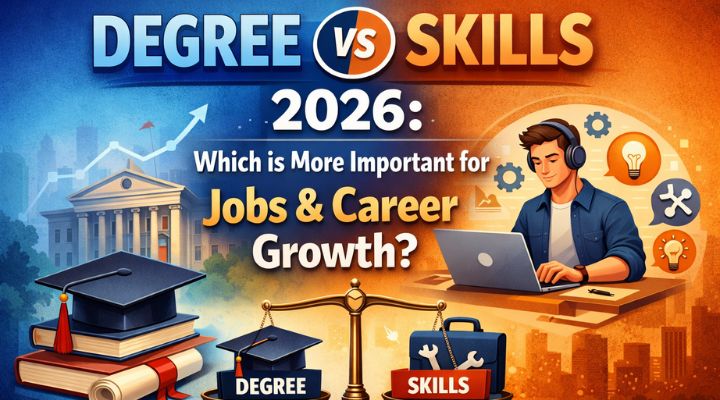
What is more Important Degree or skill in 2026?
- Posted by 3.0 University
- Categories Emerging Technology
- Date April 15, 2026
- Comments 0 comment
In 2026, skills carry more weight than degrees for most tech, creative, and business roles — but a degree still matters for regulated professions (medicine, law, engineering licensure, research) and for getting past the first-round filter at legacy Indian IT firms.
The winning formula is a degree + demonstrable skills + a portfolio, not one or the other.
The 2026 Hiring Landscape: What Changed
The debate of degree vs skills isn’t theoretical anymore the data has decisively shifted.
- 76% of employers globally now use some form of skills-based hiring, up from 73% in 2023 (TestGorilla, 2024).
- 65% of organisations evaluate candidates on specific competencies rather than traditional credentials like degrees or job titles.
- LinkedIn’s workforce data shows skills-based hiring expands the available talent pool by 6.1x — and by 8.2x for AI roles.
- Between 2017 and 2023, degree requirements were dropped from roughly 20% of job postings that previously listed them, according to research from the Burning Glass Institute (now Lightcast).
- 39% of existing skill sets are expected to transform by 2030, according to the World Economic Forum’s Future of Jobs Report.
Companies like Google, Apple, IBM, Accenture, Tesla, Dell, and Bank of America have publicly dropped four-year degree requirements for many roles. In India, the story is more nuanced — which we’ll unpack below.
Degree vs Skills: At-a-Glance Comparison
| Factor | Degree | Skills |
|---|---|---|
| Proves | Theoretical knowledge, discipline, commitment | Practical ability to do the job |
| Time to acquire | 3–5 years | 3–12 months (for most digital skills) |
| Average cost (India) | ₹4–25 lakh | ₹0–50,000 (online courses, bootcamps) |
| Used for filtering at | MNCs, PSUs, campus placements, government jobs | Startups, tech roles, freelance, remote jobs |
| Validates via | University certificate, marksheet | Portfolio, GitHub, certifications, live projects |
| Stays relevant | Slowly outdated; concepts last decades | Must be continuously updated |
| Best for | Regulated fields, research, higher studies | Tech, design, marketing, sales, content, SaaS |
| Earning ceiling | High with brand-name institutions | Very high for top performers; no ceiling in product/tech |
Why Skills Are Winning the 2026 Hiring Race
1. Employers now care about output, not pedigree
A LinkedIn analysis of 11 million UK job listings between 2018 and 2024 found that mentions of degree requirements for AI roles dropped by 15%, even as demand for these roles grew by 21%.
Recruiters are screening for what you can build, not where you studied.
2. Skills-based hiring is 5x more predictive of job performance than degree-based screening
McKinsey research repeatedly surfaces this multiple hires made through skills assessments stay longer, ramp up faster, and perform better on the job than hires screened primarily on credentials.
3. AI changed the game
84% of talent leaders now use AI in recruitment (Scale.jobs, 2026). AI resume scanners rank candidates by skill-keyword match, portfolio links, and verifiable project work not by the tier of the college printed on the degree.
4. Soft skills are the new moat
When AI can write code, draft copy, and crunch data, what humans bring is judgement.
71% of hiring managers now rank Emotional Intelligence (EQ) higher than IQ, and employees with strong EQ earn roughly $29,000 more per year on average.
5. The top in-demand skills aren’t taught in most degree courses
Across global surveys for 2026, the skills employers most want are:
- Analytical thinking (69% of employers rank it #1)
- AI literacy and prompt engineering
- Data analysis and interpretation
- Cloud computing (AWS, Azure, GCP)
- Cybersecurity fundamentals
- Digital marketing and SEO
- UX/UI design
- Creative problem-solving
- Communication and collaboration
- Adaptability and learning agility
Most Indian universities are still catching up on these which is exactly why skills-first candidates are leapfrogging degree-first ones.
But Degrees Still Matter — Here’s Where
Let’s not swing to the other extreme. A degree is far from dead. It continues to pull weight in several scenarios:
- Regulated professions: Medicine, law, chartered accountancy, civil engineering, architecture, teaching, and civil services all require a specific degree by law.
- Campus placements: In India, the first filter for TCS, Infosys, Wipro, HCL, Capgemini, and most MNC campus drives is still a minimum of 60% across 10th, 12th, and graduation, with a full-time degree from an AICTE/UGC-recognised institution.
- Overseas education and work visas: H-1B, UK Skilled Worker, and Canadian PNP applications all rely heavily on formal degrees.
- Research, academia, and deep-tech R&D: A master’s or PhD is often non-negotiable.
- Senior leadership in traditional industries: Banking, pharma, and manufacturing still weight academic credentials in leadership tracks.
The takeaway: a degree opens a specific set of doors. Skills determine how far you walk through them.
The India Context: What’s Actually Happening in 2026
India’s hiring picture is in the middle of a transition and it matters for how you plan your career.
The numbers tell the story
- India’s tech workforce is projected to reach 9.5 million professionals by FY 2026 and the industry value is set to cross $300 billion (Taggd India Decoding Jobs 2026).
- India’s AI economy alone is forecast to hit $17 billion by 2027.
- TCS, Infosys, HCLTech, and Wipro collectively plan to onboard ~82,000 freshers in FY 2026.
- NASSCOM projects that cloud technologies could account for 8% of India’s GDP by 2026, generating up to 1.4 crore new jobs.
- India’s semiconductor mission alone is projected to create 10 lakh jobs by 2026.
- The Union Budget 2025–26 allocated ₹2,000 crore specifically for AI infrastructure and research.
The dual reality Indian graduates face
Legacy MNC IT (TCS, Infosys, Wipro): Still degree-first. You need the minimum 60% cut-offs, a full-time engineering/MCA/MSc degree, and zero active backlogs. The degree is the filter.
New-age companies (Zomato, Razorpay, PhonePe, Swiggy, Cred, Indian startups, GCCs, SaaS companies): Increasingly skills-first. A strong GitHub, a live project, a Kaggle rank, or a freelance portfolio weighs more than your college name.
NEP 2020 is quietly rewriting the rulebook. The National Education Policy 2020 explicitly pushes for skill-integrated degrees, multiple entry–exit points, and credit for vocational training. Combined with initiatives like NSDC, PMKVY, and Skill India, India is institutionally moving toward a “degree + skill” model rather than a pure degree model.
The Tier-2/Tier-3 opportunity: As hiring decentralises to Coimbatore, Indore, Mangalore, and Mohali, students outside metros have more access than ever — if they can demonstrate skills. Pin code matters less. Portfolio matters more.
Industry-by-Industry: What Weighs More
| Industry | Degree Weight | Skills Weight | Reality Check |
|---|---|---|---|
| Medicine, Law, CA, Civil Services | 🔴 Critical | 🟡 Secondary | Degree is mandatory by law |
| Legacy IT Services (TCS, Infy, Wipro) | 🟠 High | 🟡 Medium | Degree gets you in; skills decide role + salary |
| Product Tech (FAANG, startups, SaaS) | 🟡 Low–Medium | 🔴 Critical | Portfolio > college name |
| Data Science & AI | 🟡 Medium | 🔴 Critical | Kaggle, papers, projects rule |
| Design & UX | 🟢 Minimal | 🔴 Critical | Portfolio is everything |
| Digital Marketing, SEO, Content | 🟢 Minimal | 🔴 Critical | Results + case studies win |
| Sales & Business Development | 🟡 Medium | 🔴 Critical | Track record + soft skills dominate |
| Finance & Banking (front office) | 🟠 High | 🟠 High | Both needed |
| Manufacturing & Core Engineering | 🟠 High | 🟠 High | Degree certifies; skills differentiate |
| Government & PSU | 🔴 Critical | 🟡 Secondary | Degree + competitive exam route |
How AI Is Reshaping the Degree vs Skills Debate
AI has accelerated the skills-first shift in three specific ways:
- AI automates what degrees traditionally taught. Rote knowledge, basic coding, routine analysis — all increasingly handled by tools. What remains valuable is judgement, creativity, and the ability to direct AI.
- “AI-adjacent skills” are now the highest-paid skill category. Prompt engineering, AI product management, ML ops, and AI ethics roles pay 30–60% premiums globally.
- AI raises the floor on what “skilled” means. A fresher who can build with LLMs, automate workflows, and ship real products is functionally a mid-level hire in 2020 terms.
The blunt truth: a 2026 graduate who can’t use AI effectively is at a structural disadvantage against one who can regardless of which institution either attended.
How to Build Real Skills in 2026 (Without Abandoning Your Degree)
You don’t have to choose. Here’s a practical stack:
- Pick one high-demand vertical: AI/ML, cloud, cybersecurity, data analytics, product design, digital marketing, or full-stack development.
- Complete 2–3 structured courses: Platforms like Coursera, edX, Udemy, NPTEL, Great Learning, Scaler, and 3University offer industry-aligned curricula. Prioritise ones with projects and graded assessments.
- Build a visible portfolio: GitHub for coders, Behance/Dribbble for designers, a personal website or Notion page for everyone else. Showcase 3–5 real projects, not certificates.
- Earn recognised certifications: AWS, Google Cloud, Microsoft Azure, Meta, HubSpot, and Google Digital Garage credentials are globally respected.
- Get real-world exposure: Internships, freelance gigs on Upwork/Contra, open-source contributions, hackathons, or case-study competitions.
- Build proof of soft skills: Lead a college club, run a newsletter, teach on YouTube, contribute to communities on LinkedIn or X.
A candidate with a B.Tech, two certifications, a GitHub with three deployed projects, and one internship will out-compete a candidate with just a B.Tech every single time, in 2026.
FAQ: Degree vs Skills in 2026
Q1. Is a degree still necessary in 2026?
Necessary for regulated professions (medicine, law, engineering licensure, civil services), most Indian MNC campus placements, and overseas study/work. Not necessary for most tech, creative, digital marketing, and product roles — where skills, portfolio, and certifications carry more weight.
Q2. Can I get a job in India without a degree?
Yes — especially in tech, design, content, digital marketing, freelancing, and startups. Companies like Zomato, Razorpay, and several Indian startups hire based on skills. But lacking a degree will close doors at TCS, Infosys, Wipro, banks, government jobs, and most MNCs.
Q3. Do Google, IBM, and Accenture really hire without a degree?
Yes, for many roles globally. They’ve publicly removed degree requirements for roles where equivalent experience or certifications demonstrate capability. In India, however, their campus hiring still prefers degree-holders due to volume and process efficiency.
Q4. Which is better for a high-paying job: degree or skills?
Skills win for uncapped earning potential (product tech, AI, freelance, entrepreneurship). Degrees win for stable, predictable income ladders (banking, PSUs, consulting, regulated industries). The highest earners combine both.
Q5. How long does it take to become job-ready through skills alone?
For most digital skills: 6–12 months of structured learning plus 3–6 months of project work and internships. Total: roughly 9–18 months to reach entry-level job readiness.
Q6. Are online certifications respected by employers in India?
Certifications from Google, AWS, Microsoft, Meta, IBM, Coursera (from top universities), and recognised Indian institutes are respected. Generic “certificate of completion” documents carry little weight.
Q7. What skills will be most in demand in India in 2026?
AI and machine learning, cloud computing, data analysis, cybersecurity, full-stack development, UX/UI design, digital marketing, prompt engineering, product management, and strong communication.
Q8. Should I drop out of college to focus on skills?
No — except in rare, extreme cases. Finish your degree while parallelly building skills, a portfolio, and internship experience. You get both credibility and capability, which is the strongest combination in 2026.
The Verdict: Degree + Skills, Not Degree vs Skills
The old framing degree vs skills is a false binary. In 2026, the candidates winning offers, promotions, and high salaries are the ones who have stacked both:
- A recognised degree that clears institutional filters.
- A sharp, in-demand skill stack that makes them immediately useful on day one.
- A portfolio, certifications, or internship record that proves the skills.
- Soft skills — communication, adaptability, collaboration that AI can’t replace.
A degree tells employers who you were at 22. Skills tell them who you are today. The market rewards the second answer.
Ready to build a future-proof skill stack alongside your degree?
Explore 3.0 University industry-aligned programs in AI, data, cloud, and digital skills designed for Indian students who want both a degree and a clear career advantage in 2026 and beyond.

You may also like
Highest Paying Jobs in India 2026
Top Online Courses for High Salary Jobs in 2026