
What Are Smart Contracts?
- Posted by 3.0 University
- Categories Blockchain, Cryptocurrency, Ethereum
- Date March 13, 2023
- Comments 0 comment
The Technology That Removes Trust Issues
Imagine signing an agreement where no middleman is required, no delays happen, and everything executes automatically.
That’s exactly what smart contracts do.
They are transforming industries from finance and real estate to gaming and healthcare by replacing traditional agreements with code-based automation on blockchain.
If you’ve heard about crypto, blockchain, or Web3, understanding smart contracts is no longer optional it’s essential.
What Are Smart Contracts?
A smart contract is a digital contract that automatically executes actions when specific conditions written in code are fulfilled, without the need for intermediaries.
How Do Smart Contracts Work?
Smart contracts operate on blockchain networks like Ethereum.
Step-by-Step Process:
- Agreement Creation
- Terms are written in code (e.g., payment conditions)
- Deployment
- The contract is uploaded to the blockchain
- Trigger Event
- A condition is met (e.g., payment received)
- Automatic Execution
- Contract executes instantly (e.g., transfer ownership)
- Immutable Record
- Stored permanently on blockchain
Real-World Example of Smart Contracts
Example: Freelance Payment
- A client agrees to pay ₹50,000 after project completion
- Funds are locked in a smart contract
- Once work is approved → payment is automatically released
No delays. No disputes. No third party.
Why Smart Contracts Matter (Future Scope)
Smart contracts are a core part of the Web3 revolution.
Key Reasons They Matter:
- Eliminate intermediaries (banks, brokers)
- Reduce fraud and manipulation
- Enable trustless systems
- Power decentralized finance (DeFi)
Market Insight:
- The global smart contract market is expected to grow rapidly due to adoption in:
- Banking
- Supply chain
- NFTs
- Gaming
Latest Trends in Smart Contracts (2025–2026)
1. Rise of DeFi (Decentralized Finance)
Platforms use smart contracts for:
- Lending
- Borrowing
- Yield farming
2. Integration with AI
AI + smart contracts = automated decision-making systems
3. Enterprise Adoption
Big companies are using blockchain for:
- Supply chain tracking
- Legal automation
4. Cross-Chain Smart Contracts
Contracts that work across multiple blockchains
5. Regulation & Compliance
Governments are slowly introducing frameworks
Key Benefits of Smart Contracts
1. Automation
No manual intervention required
2. Transparency
All transactions are publicly verifiable
3. Security
Blockchain encryption reduces fraud
4. Cost Savings
Removes intermediaries
5. Speed
Instant execution of agreements
Smart Contract Use Cases
1. Finance (DeFi)
- Loans without banks
- Crypto trading platforms
2. Real Estate
- Automatic property transfers
- Reduced paperwork
3. Healthcare
- Secure patient data sharing
4. Supply Chain
- Track goods from origin to delivery
5. Gaming & NFTs
- Ownership of digital assets
Career Opportunities in Smart Contracts
The demand for blockchain professionals is growing rapidly.
Top Roles:
- Smart Contract Developer
- Blockchain Engineer
- Web3 Developer
- Solidity Developer
Skills Required:
- Programming (Solidity, JavaScript)
- Blockchain fundamentals
- Cryptography basics
Salary Insight:
- Entry-level: ₹6–12 LPA (India)
- Experienced: ₹20+ LPA
Challenges of Smart Contracts
1. Code Vulnerabilities
Bugs can lead to financial losses
2. Legal Uncertainty
Not fully recognized in all countries
3. Scalability Issues
Blockchain networks can be slow
4. Irreversibility
Once executed, cannot be changed
Smart Contracts vs Traditional Contracts
|
Feature |
Traditional Contracts |
Smart Contracts |
|
Execution |
Manual |
Automatic |
|
Intermediaries |
Required |
Not needed |
|
Speed |
Slow |
Instant |
|
Transparency |
Limited |
High |
FAQs
1. What is a smart contract in simple terms?
A smart contract is a self-executing digital agreement that runs automatically when conditions are met.
2. Which blockchain uses smart contracts?
The most popular is Ethereum, but others include Binance Smart Chain and Solana.
3. Are smart contracts legally valid?
It depends on the country. Some regions are starting to recognize them legally.
4. Can smart contracts be hacked?
Yes, if poorly coded. Security audits are essential.
5. What language is used for smart contracts?
Solidity is the most commonly used programming language.
6. Are smart contracts only used in crypto?
No, they are used in finance, healthcare, real estate, and more.
7. How can I learn smart contracts?
You can start with blockchain courses, coding basics, and hands-on projects.
Don’t wait—Web3 is the future, and it’s already here.
Want to build a career in Blockchain & Smart Contracts?
Start learning today and become a Web3-ready developer.
Enroll in a professional blockchain course and gain hands-on experience with:
- Smart contract development
- Real-world projects
- Industry tools

You may also like
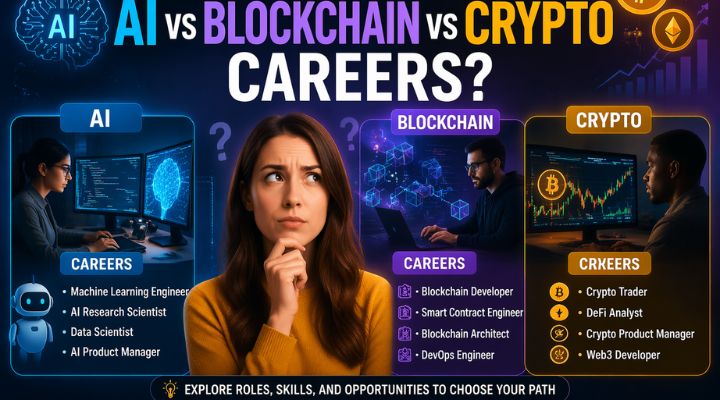
AI vs Blockchain vs Crypto Careers: What to Choose in 2026?