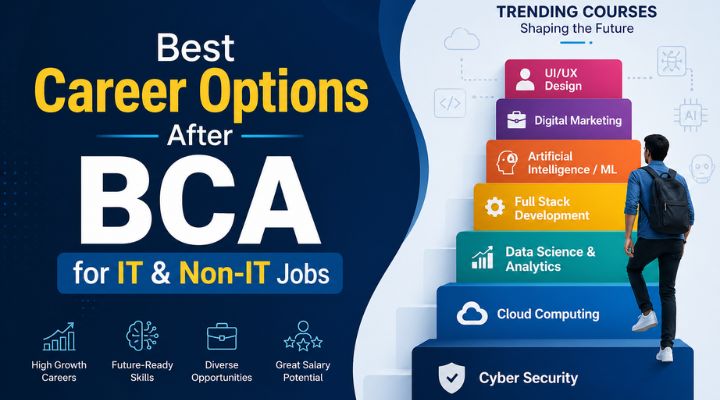
Best Career Options After BCA for IT & Non-IT
- Posted by 3.0 University
- Categories Career Advice
- Date January 2, 2026
- Comments 0 comment
What to Do After BCA in 2026? : Best High-Paying Jobs, Salary & Future Scope in India
You’ve finished BCA or you’re about to. And now you’re staring at the same question every Indian computer applications graduate ends up asking: what next?
Here’s the uncomfortable truth most colleges won’t tell you. India produces roughly 15 million graduates every year, but the gap between what classrooms teach and what employers in 2026 actually need is wider than ever.
The Naukri JobSpeak Index opened 2026 with a 12% year-on-year hiring jump, and AI/ML roles alone surged 34% in January 2026. The jobs are absolutely there. The question is whether your skill profile fits them.
The good news?
A BCA degree, when paired with the right specialization, is one of the most flexible launchpads into Indian tech right now. You don’t need a B.Tech from an IIT to land a ₹8 LPA fresher offer. You need to know which roles are hiring, what they actually pay, and which skills move the needle.
This guide walks you through the 10 best career options after BCA in 2026, the realistic salary you can expect as a fresher, government job paths, higher-studies routes, and the skills that decide whether you start at ₹3 LPA or ₹12 LPA.
Quick Answer: What Are the Best Career Options After BCA in 2026?
The top career options after BCA in 2026 are:
- Full Stack Developer (₹4–9 LPA fresher)
- Cybersecurity Analyst / Ethical Hacker (₹4–8 LPA fresher)
- Data Analyst / Data Scientist (₹4–10 LPA fresher)
- AI / Machine Learning Engineer (₹6–15 LPA fresher)
- Cloud Engineer (₹5–10 LPA fresher)
- Blockchain / Web3 Developer (₹6–14 LPA fresher)
- Software Developer (₹3.5–8 LPA fresher)
- DevOps Engineer (₹5–9 LPA fresher)
- UI/UX Designer (₹3.5–7 LPA fresher)
- Digital Marketing / SEO Specialist (₹3.5–6.5 LPA fresher)
Why Career Planning After BCA Matters More Than Ever in 2026
The Indian IT job market in 2026 looks very different from even three years ago.
AI has automated a large chunk of entry-level coding work the basic CRUD apps, the simple SQL queries, the manual QA scripts that used to be a fresher’s first three months on the job.
At the same time, AI has created entirely new roles that pay 2–3× more: prompt engineers, MLOps engineers, AI integration developers, agentic AI builders. The roles disappearing aren’t being replaced one-to-one. They’re being replaced by higher-skill, higher-paying roles.
The other big shift: skills now beat marks. A BCA graduate with a 65% aggregate, a strong GitHub portfolio, and one real internship will out-earn a 90% aggregate with no projects in most product company hiring loops. Companies like Razorpay, Zerodha, Postman, and CRED openly advertise that they don’t filter by college tier.
What this means for you: the BCA degree gets you an interview. Your portfolio, your specialization, and your domain pick decide your starting salary.

In lakhs INR, the chart shows the average yearly wages for different jobs that BCA graduates may get in 2025. Data Scientists make the most money, with a salary of 14.7 lakhs. Software Developers come in second with a salary of 8.4 lakhs.
Cybersecurity Analysts, Cloud Engineers, Full Stack Developers, and Blockchain Developers are some of the other jobs that pay less, between 5.8 and 6.9 lakhs. This shows that the demand and pay in various professions are not the same.
What is the Best Option After BCA?
For those holding a Bachelor of Computer Applications (BCA) degree, pursuing a Master’s in the same field (MCA) is often considered a very promising next step, an option that’s quite beneficial, generally speaking.
An MCA not only helps you learn more about technology and software development, but it also makes it simpler to acquire work in a variety of high-paying areas that are expected to grow a lot by 2026.
People who have an MCA learn the abilities they need to work as software engineers, data scientists, and system analysts, among other things.
These careers are quite popular in industries like IT and cloud computing. These kinds of professions pay well and provide you a lot of chances to go up and be flexible.
In a competitive work market, those with a strong academic background in computer applications may truly stand out as technology and software develop. So, if you’re thinking about your future in IT jobs that are often changing, it’s a good idea to go back to school.
BCA Job Opportunities for Freshers
Furthermore, when we incorporate images showing these changes, it makes the opportunities for BCA graduates much clearer, highlighting the importance of continued education, I would say.

Top 10 Career Options After BCA in 2026 (With Real Salary Data)
Below are the ten highest-paying, fastest-growing career paths a BCA graduate can realistically target in India in 2026 with the fresher salary ranges actually being offered, not the inflated averages most blogs quote.
1. Full Stack Developer
This is the single largest hiring category for BCA graduates in 2026. Naukri and LinkedIn India together had over 80,000 active full stack postings in early 2026.
- What you’ll do: Build both the front-end (what users see) and the back-end (servers, databases, APIs) of web and mobile apps.
- Fresher salary: ₹4–9 LPA. Top-tier candidates with strong DSA and a deployed portfolio crack ₹12–15 LPA at funded startups.
- Hot stacks in 2026: MERN (MongoDB, Express, React, Node.js) is dominant in startups; Java + Spring Boot + React rules at TCS, Infosys, Wipro, and Accenture.
- Best for: BCA graduates who like building things end-to-end and want the broadest job pool to choose from.
2. Cybersecurity Analyst & Ethical Hacker
India is projected to need over 1 million cybersecurity professionals by 2026, and the supply is nowhere close. The DPDP Act has made security teams mandatory across BFSI, healthcare, and SaaS. CERT-In tracked over 1.3 million cybersecurity incidents in a single recent year every one of those is a hiring trigger.
- What you’ll do: Monitor systems for threats, run penetration tests, respond to breaches, harden infrastructure.
- Fresher salary: ₹4–8 LPA with CEH or CompTIA Security+. ₹3–6 LPA without certifications.
- Mid-career trajectory: ₹10–25 LPA in 4–6 years; senior roles like Security Architect command ₹25–50 LPA.
- Best for: Curious, methodical thinkers. You don’t need to be a coding rockstar — networking fundamentals, Linux, and tool proficiency (Wireshark, Burp Suite, Metasploit) matter more.
3. Data Analyst / Data Scientist
Every Indian company that has gone digital — banks, hospitals, e-commerce, even kirana-tech startups is now hiring people who can turn raw data into decisions.
- What you’ll do (Analyst): Pull data with SQL, model in Excel/Power BI, build dashboards, surface trends.
- What you’ll do (Scientist): Build statistical and ML models that predict customer behavior, fraud, churn, demand.
- Fresher salary: Data Analyst — ₹4–7 LPA. Data Scientist — ₹6–12 LPA, with top-tier offers reaching ₹15+ LPA.
- Best for: BCA graduates comfortable with logic and statistics. A Google Data Analytics certificate alone has been shown to push fresher offers up by ₹1–2 LPA.
4. AI / Machine Learning Engineer
The single highest-paying entry point for technical freshers in India in 2026. AI has shifted from “nice to have” to “core to product roadmap” across every major Indian tech company.
- What you’ll do: Build, fine-tune, and deploy ML models. Increasingly, work with LLMs and agentic AI systems.
- Fresher salary: ₹6–15 LPA at mid-tier companies; ₹20–35 LPA+ at top product companies and AI labs.
- What you need: Python, PyTorch or TensorFlow, hands-on experience with LLM APIs, and at least one deployed project. The role is not accessible without demonstrated skill — but a structured 4–6 month program plus real projects is enough to break in.
- Best for: BCA graduates willing to invest in serious upskilling beyond their syllabus.
5. Cloud Engineer
India’s public cloud market is on track to hit $17.8 billion by 2027, growing at ~23% annually. Every company migrating from on-prem to AWS, Azure, or GCP needs cloud engineers.
- What you’ll do: Design cloud architecture, manage deployments, optimize cost, automate infrastructure.
- Fresher salary: ₹5–10 LPA with AWS Cloud Practitioner or Azure Fundamentals certified. ₹4–6 LPA without.
- Senior trajectory: Cloud Architects routinely earn ₹20–35 LPA in 5–7 years.
- Best for: BCA graduates who like systems thinking. Cloud + cybersecurity is one of the highest-paying combos in 2026.
6. Blockchain / Web3 Developer
Web3 has matured well past the 2021 hype cycle. In 2026, the real hiring is in enterprise blockchain (supply chain, banking, identity), DeFi protocol engineering, and stablecoin infrastructure.
- What you’ll do: Write smart contracts in Solidity or Rust, build dApps, integrate Web3 wallets and protocols.
- Fresher salary: ₹6–14 LPA — premium driven by talent scarcity. Senior roles cross ₹40 LPA.
- What you need: Solid JavaScript foundation, Solidity, understanding of EVM and consensus mechanisms.
- Best for: BCA graduates who want first-mover advantage in a field where the talent pool is still small enough that you can stand out.
7. Software Developer (Service-Side)
The traditional path. TCS, Infosys, Wipro, Cognizant, Accenture, HCL these companies still hire BCA freshers in volume every year. It’s not the highest-paying route, but it’s the most accessible.
- What you’ll do: Maintain client codebases, build features, work in large agile teams.
- Fresher salary: ₹3.5–5 LPA at service-based companies; ₹6–12 LPA at product-based companies.
- Reality check: Service-company freshers get the least learning per rupee — but the brand on your resume opens doors. Most people switch to better-paying product roles after 18–24 months.
8. DevOps Engineer
The bridge between development and operations. As Indian SaaS companies scale globally, DevOps has become one of the most stable high-pay roles.
- What you’ll do: Manage CI/CD pipelines, automate deployments, monitor production systems, handle Kubernetes and Docker.
- Fresher salary: ₹5–9 LPA. Tough to enter directly as a fresher — most start as Cloud or Backend engineers and transition in.
- Best for: BCA graduates with strong Linux command-line comfort and curiosity about how systems run at scale.
9. UI/UX Designer
Tech has become product-driven, and product is design-driven. Indian SaaS and consumer apps are paying premium for designers who understand user research and design systems not just Figma button-pushers.
- What you’ll do: Run user research, build wireframes and prototypes, design interaction flows, ship in design systems.
- Fresher salary: ₹3.5–7 LPA, with top design school grads going higher.
- Best for: BCA graduates with strong visual instincts who don’t want to code daily. Add a 6-month design certification to BCA and the path is real.
10. Digital Marketing / SEO Specialist
Underrated, but in 2026 it’s evolved into a tech-adjacent role. SEO now requires understanding AI search (ChatGPT, Perplexity, Google AI Overviews), schema markup, and analytics scripting. A BCA graduate has a structural advantage over a non-tech marketer.
- What you’ll do: Run paid ads, build SEO strategies, manage analytics, increasingly use AI tools to scale content and campaigns.
- Fresher salary: ₹3.5–6.5 LPA. Performance marketers at growth-stage startups can hit ₹8–10 LPA quickly.
- Best for: BCA graduates who lean creative and want a faster path to entrepreneurship.
Higher Studies After BCA: When It’s Worth It (and When It Isn’t)
Here’s where most BCA graduates get bad advice. Higher studies are not automatically the right move they’re the right move for specific outcomes.
Choose MCA if:
You want a deeper technical foundation, you’re targeting roles like Systems Architect or specialized R&D, or you want to teach in the future. Strong MCA programs add ₹1–2 LPA to your starting offer at MNCs. But understand: after 2–3 years of work experience, your skills decide your salary, not whether you have an MCA.
Choose MBA in IT or Systems if:
You want to move into product management, tech consulting, or business-side roles. An MBA from a Tier-1 college (IIM, ISB, FMS) opens doors a BCA + MCA never will. Don’t take an MBA from a low-tier college expecting a salary jump it usually doesn’t deliver.
Choose M.Tech (lateral entry) if:
You’re targeting deep technical or research roles in AI, robotics, or systems. Realistic but niche.
Choose specialized certifications if:
You want to maximize ROI on time. A 4–6 month structured program in cybersecurity, AI, Web3, or cloud will, in most cases, deliver a higher salary jump than a 2-year MCA at a fraction of the time and cost. This is especially true if you’re already employed and upskilling.
Most realistic combo for 2026:
BCA 1 year of work experience in a junior role specialized certification in your target domain switch to a higher-paying role at year 2.
Government Jobs After BCA in India
Government jobs after BCA still attract a huge chunk of graduates because of stability, pension, and predictable hours. Pay scales are lower than top private offers but include strong benefits.
- IBPS IT Officer (Scale I): ₹40,000–55,000/month base + allowances. Top entry point for BCA graduates into PSU banks.
- Technical Assistant — NIC, DRDO, ISRO, BEL: ₹35,000–60,000/month. Recruitment usually through SSC or organization-specific exams.
- Programmer / Data Analyst — Central Government: ₹40,000–70,000/month under various ministries.
- State Government IT Officer: ₹30,000–55,000/month. Recruited via state PSCs.
- Cybersecurity roles in CERT-In, NCIIPC, Defense: ₹50,000–90,000/month, with security clearances. Demand is rising fast given the DPDP Act enforcement.
If government is your target, start exam prep parallel to BCA’s final year IBPS, SSC CGL, and state PSC IT cadre exams need 6–12 months of dedicated preparation.
Skills That Will Define BCA Careers in 2026
Across every role above, the same handful of skills keep separating ₹3 LPA freshers from ₹10 LPA freshers.
Technical foundations:
Strong DSA in at least one language (Python, Java, or JavaScript), basic SQL, comfortable with Git/GitHub, one project deployed publicly.
Domain layer:
Pick one specialization and go deep: AI/ML, cybersecurity, cloud, full stack, or blockchain. Spreading thin across all five is the most common mistake BCA students make.
The “AI native” expectation (new in 2026):
Product companies now expect freshers to have integrated at least one AI feature into their projects. LLM API calls, AI-powered search, recommendation logic. Resumes without this signal are quietly filtered out at top companies.
Portfolio over CGPA:
Three deployed projects on GitHub with clean READMEs will out-rank a 9.0 CGPA in most interview loops. A 3-month internship even unpaid beats a year of theory.
Soft skills :
Written communication (especially in remote-first companies), the ability to break down ambiguous problems, and basic stakeholder management. These don’t show up in your degree but they decide promotions.
Certifications that move the needle (2026):
Google Data Analytics, AWS Cloud Practitioner, Microsoft Azure Fundamentals, CompTIA Security+, CEH, Meta Front-End Developer.
Common Challenges BCA Graduates Face and How to Overcome Them
“My college isn’t a top tier.” It matters less than ever. Tier-2 college graduates are breaking into Razorpay, CRED, Zerodha, and Postman regularly through open hiring platforms Unstop, HackerRank, Cutshort. Your portfolio is the equalizer.
“I’m not getting calls from companies.”
Stop relying only on campus placements. 60% of fresher hiring in 2026 happens off-campus through LinkedIn, GitHub-driven outreach, and Discord/Twitter tech communities. Cold-DM founders. Build in public. Comment thoughtfully on engineering posts.
“Service company offers feel low.”
They are. ₹3.5 LPA at TCS is a baseline, not a ceiling. Treat the first job as a 12–18 month skill-building phase, then switch to a product company at 80%+ salary jumps. Most BCA graduates cross ₹10 LPA by year 3 if they switch strategically.
“I don’t know which specialization to pick.”
Pick the one where you can stomach 4 hours of self-study a day for the next 6 months. Interest beats market hype every time. A motivated cybersecurity learner will out-earn a bored AI/ML pretender.
Where 3.0 University Fits Into Your Post-BCA Plan
If you’ve read this far, you’ve probably noticed a pattern: the highest-paying BCA career paths in 2026 aren’t the generic ones.
They’re the specialized emerging-tech tracks AI, cybersecurity, Web3, blockchain where talent scarcity is real and salary premiums are 30–80% above the BCA average.
That’s exactly the gap 3.0 University’s online programs are built to close.
If you want to break into ethical hacking and security, the Certified Ethical Hacker v13 Program gets you industry-standard certification plus hands-on labs.
If Web3 is your bet, the Full Stack Blockchain Developer Program takes you from JavaScript to deployed smart contracts. For AI-leaning learners, our School of Intelligent Systems builds the AI/ML skill stack employers actually screen for in 2026.
These aren’t generic certificates. They’re built around the exact roles paying ₹6–15 LPA to BCA freshers in India right now taught by industry experts, with globally recognized credentials.
Your BCA opens the door. The right specialization decides which room you walk into.
FAQs: Career Options After BCA in 2026
Q1: What is the highest-paying job after BCA in India in 2026?
AI / Machine Learning Engineer is currently the highest-paying entry-level role for BCA graduates in 2026, with fresher salaries ranging from ₹6 LPA to ₹15 LPA, and top product companies offering ₹20+ LPA for candidates with demonstrated portfolios. Cybersecurity, Web3 development, and cloud engineering follow closely.
Q2: Is MCA necessary after BCA to get a good job?
No. An MCA can add ₹1–2 LPA to your starting MNC offer, but after 2–3 years of work experience, skills decide your salary, not your degree. Many BCA graduates who skip MCA and instead invest in specialized certifications (AI, cybersecurity, cloud, Web3) end up earning more than peers who pursued an MCA.
Q3: What is the average salary of a BCA fresher in India in 2026?
A typical BCA fresher in India earns between ₹2.5–4.5 LPA at service-based companies and ₹6–12 LPA at product-based companies and funded startups. The variance is driven almost entirely by skills, projects, and certifications — not by college tier alone.
Q4: Can a BCA graduate get a government job?
Yes. BCA graduates are eligible for IBPS IT Officer (PSU banks), Technical Assistant roles at NIC, DRDO, ISRO, BEL, programmer and data analyst roles in central and state government departments, and cybersecurity roles at CERT-In and NCIIPC. Salaries range from ₹30,000 to ₹90,000 per month depending on the post and grade.
Q5: Can BCA graduates get into AI, cybersecurity, or Web3 roles?
Absolutely and these are among the fastest-growing career paths after BCA in 2026. Companies hiring for AI, cybersecurity, and Web3 roles look at skills and portfolios over degree type. A BCA graduate with a focused 4–6 month specialization, two deployed projects, and a relevant certification can compete directly with B.Tech graduates for the same roles.
Q6: Which is better BCA + MCA or BCA + industry certifications?
For most students aiming at the private tech sector, BCA + industry certifications delivers a higher ROI than BCA + MCA. Certifications cost less, take less time, are tightly aligned with what employers actually screen for, and let you start earning 2 years earlier. Choose MCA only if your goal is research, teaching, or government roles where the degree is mandatory.
Q7: What should a BCA student do in their final year to maximize career options?
Three things, in order of priority. First, build and deploy two portfolio projects on GitHub one full stack, one in your chosen specialization. Second, complete one internship, even unpaid. Third, earn one industry certification aligned with your target role (AWS, Google Data Analytics, CEH, or similar). Students who do all three typically receive offers ₹2–4 LPA above their classmates’ median.
Final Thoughts: Your BCA Is a Launchpad, Not a Verdict
The career options after BCA in 2026 are wider, better-paid, and more accessible than at any point in the last decade but only if you treat your degree as the starting line, not the finish.
The graduates earning ₹10–15 LPA right out of college aren’t the ones with the highest CGPA. They’re the ones who picked one specialization, built two real projects, earned one credible certification, and started networking before their final semester ended.
Pick your direction this month. Start building this week. Your first job offer is six to twelve months of focused work away and it sets the salary trajectory for the next decade of your career.
The Indian tech industry in 2026 has more open seats than qualified candidates. Make sure you’re in the second group.

You may also like

Highest Paid Profession in India

How To Build A Career Growth Plan In 90 Days?